

Don’t be fooled by spending spree
Advertisement
Read this article for free:
or
Already have an account? Log in here »
To continue reading, please subscribe:

Digital Subscription
One year of digital access for only $205*
- Enjoy unlimited reading on winnipegfreepress.com
- Read the E-Edition, our digital replica newspaper
- Access News Break, our award-winning app
- Play interactive puzzles
*First annual payment billed as $205.00 + GST for one year. This annual subscription will automatically renew at $233.00 + GST every 52 weeks (10% off the regular annual price of $259.35). Offer available to new and qualified returning subscribers only. Cancel any time.
To continue reading, please subscribe:
Add Free Press access to your Brandon Sun subscription for only an additional
$1 for the first 4 weeks*
- Enjoy unlimited reading on winnipegfreepress.com
- Read the E-Edition, our digital replica newspaper
- Access News Break, our award-winning app
- Play interactive puzzles
*Your next Brandon Sun subscription payment will increase by $1.00 and you will be charged $17.95 plus GST for four weeks. After four weeks, your payment will increase to $24.95 plus GST every four weeks.
Read unlimited articles for free today:
or
Already have an account? Log in here »
Hey there, time traveller!
This article was published 07/07/2015 (4083 days ago), so information in it may no longer be current.
It’s the beginning of the federal campaign season, with political leaders and candidates heading out to neighbourhood barbecues, summer fairs and parades in a bid to get your vote.
Monday, there were three federal announcements of spending slated for Manitoba. Three.
Regional minister Shelly Glover was in Churchill along with Premier Greg Selinger to announce a $12.4-million Churchill Marine Observatory under the Canada Foundation for Innovation program. Government House Leader Peter Van Loan was in the RM of Rosser to extol the virtues of a government policy that installs defibrillators in community facilities. And MP Lawrence Toet (Elmwood-Transcona) made a funding announcement for The Forks.
Two more announcements are scheduled today. Candice Bergen, minister of state for social development, has an event planned that highlights government investments to improve accessibility for people with disabilities. And Mr. Toet is back at it, this time at Red River College.
NDP MP Pat Martin has decried the funding blitz, saying it’s been “a veritable orgy of pork barrelling since the day Parliament adjourned.” He’s not that far off the mark. But it’s not uncommon for governments to push money into ridings in which they feel vulnerable.
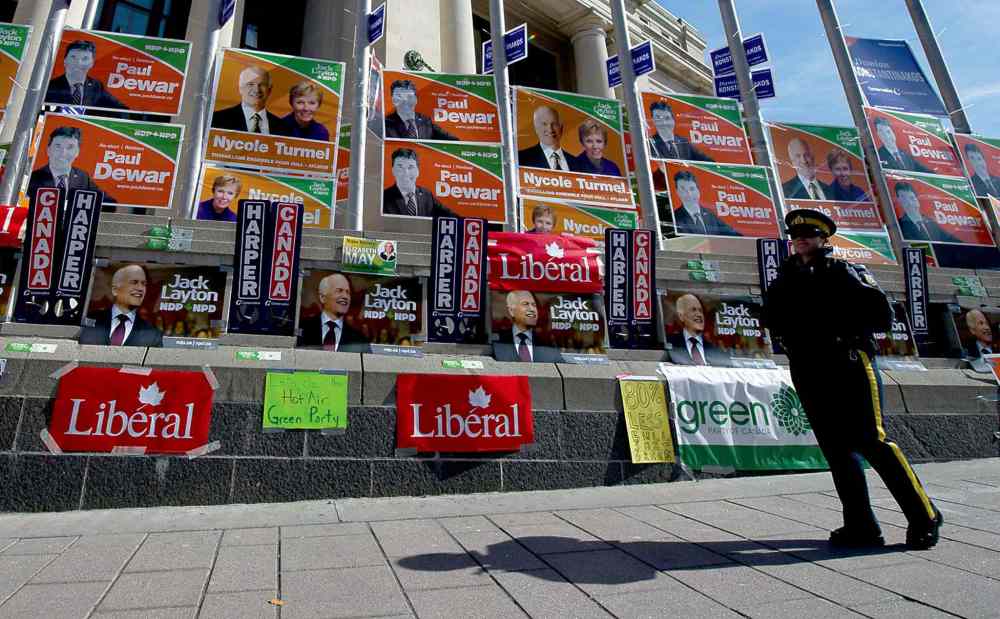
This is the first time the federal election will occur on a fixed election date, despite the fact the legislation enacting it is more than eight years old. Prime Minister Stephen Harper pulled the plug early in 2008, when his party held a minority government. Since 2011, Mr. Harper has had a majority and thus could abide by the terms of the fixed election laws.
Elections Canada has voiced concerns fixed elections mean both government and opposition parties can spend money on advertising without limits. Once the official writ is dropped, however, advertising spending is capped and additionally, there can be no funding announcements.
Thus, the recent spate of Conservative funding announcements and MP householder mail-outs along with party advertising buys are completely legal and legitimate.
Fixed election dates were meant to level the playing field for opposition parties. Constitutionally, there is a requirement that elections must be held no later than five years after the previous ballot, unless there were extenuating circumstances (such as war). Historically, that meant governments relied on internal polling and pork barrelling to shore up troubled ridings and they could pick the optimal opportunity to drop the writ. Governments could bide their time until they were certain the election results would be in their favour before making the walk to the governor general to dissolve government.
Now, with fixed election dates, there is no optimal time. It’s true, this means all parties now have a heads-up as to when the writ will be dropped, but it does so equally. There is no inside edge — the government doesn’t have the ultimate control.
And that’s a good thing.
Trying to set up limits as to what pre-election spending could be would only trample on the right to free speech, not only for parties but for interest groups as well. It would also impede government in its ability to provide funding for legitimate purposes — say for example if there were a disaster that required immediate government cash.
Let’s face it. The electorate isn’t stupid. Voters know when they’re being bought. At least with fixed election dates, the plethora of funding announcements can be viewed for what it is — attempts to buy the vote by a federal government on the ropes and desperate to get a bump in public opinion. And decisions at the polls can be made accordingly.
Related Articles
Liberals win 4th mandate as NDP vote collapses and Singh announces he will resign






Advertisement Advertise With Us
Advertisement Advertise With Us