I say kubasa, you say kielbassa…

'Walking, talking Ukrainian encyclopedia' weighs in on burning debate

Advertisement

Advertise with us

It's one of those bitterly divisive debates that can result in newspaper editors beating each other senseless with their abridged dictionaries.

Read this article for free:


or

Already have an account? Log in here »

To continue reading, please subscribe:

Subscribe and receive a limited-edition Free Press branded hat or tote.

Digital Subscription

One year of digital access for only $205*

  • Enjoy unlimited reading on winnipegfreepress.com
  • Read the E-Edition, our digital replica newspaper
  • Access News Break, our award-winning app
  • Play interactive puzzles

*First annual payment billed as $205.00 + GST for one year. This annual subscription will automatically renew at $233.00 + GST every 52 weeks (10% off the regular annual price of $259.35). Offer available to new and qualified returning subscribers only. Cancel any time.

To continue reading, please subscribe:

Add Free Press access to your Brandon Sun subscription for only an additional

$1 for the first 4 weeks*

  • Enjoy unlimited reading on winnipegfreepress.com
  • Read the E-Edition, our digital replica newspaper
  • Access News Break, our award-winning app
  • Play interactive puzzles
Start now

*Your next Brandon Sun subscription payment will increase by $1.00 and you will be charged $17.95 plus GST for four weeks. After four weeks, your payment will increase to $24.95 plus GST every four weeks.

Opinion

Hey there, time traveller!
This article was published 23/06/2012 (5193 days ago), so information in it may no longer be current.

It’s one of those bitterly divisive debates that can result in newspaper editors beating each other senseless with their abridged dictionaries.

I am referring to the unfortunate fact some words have roughly a billion different spellings, an awkward situation that causes the members of newspaper style committees to experience serious heart palpitations.

As a former copy editor, I understand their pain. There should be one word for one thing and it should have one spelling, a spelling that everyone agrees on.

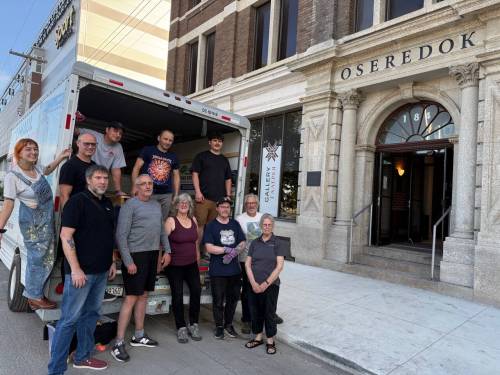
A simple wooden sign outside the Perogy Club at St. Ivan Suchavsky Uk Orthodox cathedral adverties doughy delights within. See Redekop story. June8, 2012 - (Phil Hossack Winnipeg Free Press)

Unfortunately, that’s not the way the world works. Take the simple European garlic sausage, for example.

To you, the reader, it’s likely just a sausage. But to the newspaper editor, it’s kubasa. Or is it kielbassa? Or kobvasa? What about kobasa? Possibly kolbassa? Not to mention klobassa, kobassa and a host of other variations.

Being a food lover, I was asked to bring sense to the chaos for our special Ukrainian edition, so I touched base with the University of Manitoba, which pointed me to Orysia Tracz, a 66-year-old retired library assistant who has lectured at the university, translated seven books from Ukrainian to English, been published in the Free Press and the Globe and Mail, and writes a regular column for the U.S.-based Ukrainian Weekly newspaper.

Orysia assured me I was speaking to the right person. “They say I’m the walking, talking Ukrainian encyclopedia,” she said, laughing. “If anybody needs anything, they phone me.”

When it comes to the garlic sausage, she said, almost every European country has one, along with its own unique spelling. Within some countries, there are different dialects, which can result in even more variations.

But the real problem results when a word travels to a country with a different alphabet. This results in a process known as “transliteration,” the spelling of a word in one language with the alphabet of another language.

“One thing that messes up spellings is Ukraine has a Cyrillic alphabet as opposed to the Latin or Roman one, the regular English alphabet,” Orysia explained.

“You have a problem in getting the letters to fit to bring across that pronunciation,” she noted. “What that means is different people will translate the same word differently, depending on how it sounds to them.

“It’s the way they hear it, plus they may pronounce it slightly differently and then it depends if they know how to put it down on paper in English.”

In Poland, the alphabet is based on the Latin alphabet, so their word for sausage (kielbasa) arrives here unchanged. Whereas it’s a different story in Ukraine, she said.

“In Ukrainian language, the correct word for smoked garlic sausage is kovbasa, with the accent on the last syllable,” Orysia said. “Sometimes people leave out the V.

“Somehow, in Manitoba and Saskatchewan, the accepted way of saying it is kubasa, with the accent on the first syllable. That’s a local thing. That’s how people pronounce it here. Who knows why? They like the way it sounds. Some people think you have to have two S’s for Ukrainian words like kubasa and it doesn’t need two S’s.”

It’s much the same drama with the humble stuffed dumpling, which also has enough different spellings — perogy, pierogy, pierogi, pirohy — to bring even hardened newspaper editors to their knees.

“The proper word for this dumpling in Ukraine is varenyk and the plural is varenyky,” Orysia noted. “In western Ukraine, long ago, varenyk became pyrih and the plural is pyrohy. The pioneers who came to Manitoba were from western Ukraine and their word was pyrih and pyrohy.”

In Manitoba, over the years and across generations, it seems the Ukrainian word and the Polish word (pierogy) collided and the end result was perogy, and its plural, perogies. “There are variations because some people don’t know how to write the word down properly or that’s they way they’ve always written it,” Orysia sniffs.

For her part, she insists while the various spellings of kubasa and perogy may be a source of friction for copy editors, there’s not much controversy in Winnipeg’s Ukrainian community.

“It’s not a heated debate,” she chortles. “They call it what they want to call it. At Tenderloin Meats on Main Street (where, by the way, their website spells garlic sausage “kobassa”) they have Kubi Dogs (hotdogs) and Kubi Sticks in pepperoni stick form — that’s a very Winnipeg thing.”

As a rule of thumb, Orysia recommends: “If you’re talking about Ukrainian sausages, use the Ukrainian spelling and if you’re talking about Polish sausage, use the Polish spelling.”

For her, that means, in Manitoba, the sausage is kubasa, the dumplings are perogies and the confusion over different spellings is a tempest in a teapot.

Everybody clear on that? Great! Put down your dictionaries!

doug.speirs@freepress.mb.ca

Report Error Submit a Tip

More Stories

Grieving families, local leaders want review of Interlake intersection after teens die in crash

Chris Kitching 8 minute read Preview

Grieving families, local leaders want review of Interlake intersection after teens die in crash

Chris Kitching 8 minute read Tuesday, Sep. 8, 2026

A two-vehicle crash that killed four teenage friends in the Interlake Sunday night prompted outpourings of grief in several communities and calls for safety improvements at the intersection, which was also the site of a death in July.

Recent high school graduates Maya Borsa and Chloe Vermette, both 18, were identified by their families as victims of the collision at Highway 8 and Provincial Road 229, just west of Winnipeg Beach.

“(Chloe) was a very bubbly, loving personality. Always giving, always caring. Her friends meant the world to her,” said her mother, Veronique Vermette, who struggled to comprehend the tragedy when she went to the scene Monday. “We sat in the rain for hours, and it blew my mind that four lives were taken.”

The teens’ parents are waiting for RCMP to provide more information about the cause of the crash. Chloe, who graduated from Windsor Park Collegiate in Winnipeg in July, was driving one of the vehicles, her mother said.

Read
Tuesday, Sep. 8, 2026

‘Huge resource gaps’: judge shortage leads to circuit court cuts

Dean Pritchard 4 minute read Preview

‘Huge resource gaps’: judge shortage leads to circuit court cuts

Dean Pritchard 4 minute read Wednesday, Sep. 9, 2026

A shortage of judges is forcing Manitoba’s provincial court to slash sittings across the province.

The court announced in a notice to the profession Wednesday that it will be reducing the number of annual court sittings at nine rural circuit locations and St. Boniface provincial court in Winnipeg by 68 sittings, effective April 1, 2027.

The reductions are necessary to balance “access to justice needs with the complement of judicial resources currently insufficient to maintain the current court schedule,” said the notice, signed by provincial court Chief Judge Ryan Rolston.

Affected circuit courts include Altona, Arborg, Beausejour, Easterville, Cranberry Portage, Lundar, Grand Rapids, Moose Lake, and Pine Falls.

Read
Wednesday, Sep. 9, 2026

Manitoba’s economic growth this year dogged by ‘uncertainty’: report

Gabrielle Piché 3 minute read Preview

Manitoba’s economic growth this year dogged by ‘uncertainty’: report

Gabrielle Piché 3 minute read Yesterday at 8:17 PM CDT

Manitoba’s economy is poised to grow 1.2 per cent this year, a report by Signal49 Research forecasts.

The firm formerly known as the Conference Board of Canada expects Manitoba will be bolstered by private-sector spending, largely in the mining sector and by public-sector projects over the next five years.

“Manitoba, it’s not unscathed from the trade war,” Richard Forbes, a Signal49 Research principal economist, said Thursday. “More … the uncertainty is affecting Manitoba than the direct trade impact.”

Forbes pointed to Alamos Gold’s Lynn Lake gold mine project and a consortium buying Vale Base Minerals’ Thompson nickel mine for up to $280 million. Global demand for minerals should benefit the Prairie province, Forbes said.

Read
Yesterday at 8:17 PM CDT

First wave of eligible students snap up more than 18,000 free annual Winnipeg Transit passes

Chris Kitching 6 minute read Preview

First wave of eligible students snap up more than 18,000 free annual Winnipeg Transit passes

Chris Kitching 6 minute read Updated: Yesterday at 9:20 PM CDT

More than 18,000 free Winnipeg Transit passes have been handed out to Grade 11 and 12 students so far as part of a provincial pilot program, the NDP government announced Thursday.

Schools started distributing annual youth passes (valid until Aug. 31, 2027) to those students this week, with children in grades 6 to 10 next in line as part of a staggered rollout.

“This youth pass can be used to get to school, to get to work, to visit your friends and, really, anything that you want to do,” Education Minister Tracy Schmidt told reporters at Grant Park High School Thursday.

City of Winnipeg spokesman David Driedger said 60,000 passes have been sent to schools. Winnipeg Transit initially planned for about 30,000 passes.

Read
Updated: Yesterday at 9:20 PM CDT

‘We’ll get there’: retired sportscaster Scott Oake determined as fundraising for women's addictions treatment facility enters home stretch

Melissa Martin 4 minute read Preview

‘We’ll get there’: retired sportscaster Scott Oake determined as fundraising for women's addictions treatment facility enters home stretch

Melissa Martin 4 minute read Yesterday at 7:08 PM CDT

For now, the patch of land just east of the Victoria Hospital doesn’t look like much: just a field of rocks, mounded dirt, and concrete piles driven into the earth. Yet when Scott Oake looks over the site, he can already imagine how it will look in just over a year’s time, when the new Anne Oake Family Recovery Centre is expected to open.

It’s easier to picture this time around. In 2020, when the recently-retired CBC sportscaster and his late wife, Anne, were building their first labour of intermingled grief and love, the Bruce Oake Recovery Centre for men, it was hard for him to wrap his mind around how a raw construction site could transform into a welcoming addictions treatment facility.

When that centre opened in 2021, Oake found it looked “almost identical” to the architect’s renderings. So it’s easy to hope the Anne Oake Centre will be the same. It will be the first facility of its kind, its founders believe, not only in Canada but in North America: a place where 50 to 70 women can pursue sobriety while staying with their children.

“At Bruce Oake there’s a culture of love, and most of all a culture of hope,” Oake said, speaking at the site Thursday after a media conference to announce the final push of the centre’s fundraising campaign. “I can feel it every time I walk into that building. And I know it will be the same here.”

Read
Yesterday at 7:08 PM CDT

Bombers rookies embracing rivalry in lead up to Banjo Bowl

Taylor Allen 6 minute read Preview

Bombers rookies embracing rivalry in lead up to Banjo Bowl

Taylor Allen 6 minute read Yesterday at 6:35 PM CDT

Dante Daniels has been doing his homework on the Battle of the Prairies.

The rookie tight end for the Winnipeg Blue Bombers recently went back and studied Labour Day Classics and Banjo Bowl games from previous years to better understand what the annual back-to-back series means to people around these parts.

“I want to know why it’s so important to the fans and why it’s so important in Winnipeg and I want to be a part of that,” Daniels told the Free Press after Thursday’s closed practice.

“I don’t want to be a person that comes in here and goes, ‘OK this is just another game.’ I want to be someone who embraces the rivalry.”

Read
Yesterday at 6:35 PM CDT