Processors feed appetite for traditional Ukrainian food Perogy paradise
Advertisement
Read this article for free:
or
Already have an account? Log in here »
To continue reading, please subscribe:

Digital Subscription
One year of digital access for only $205*
- Enjoy unlimited reading on winnipegfreepress.com
- Read the E-Edition, our digital replica newspaper
- Access News Break, our award-winning app
- Play interactive puzzles
*First annual payment billed as $205.00 + GST for one year. This annual subscription will automatically renew at $233.00 + GST every 52 weeks (10% off the regular annual price of $259.35). Offer available to new and qualified returning subscribers only. Cancel any time.
To continue reading, please subscribe:
Add Free Press access to your Brandon Sun subscription for only an additional
$1 for the first 4 weeks*
- Enjoy unlimited reading on winnipegfreepress.com
- Read the E-Edition, our digital replica newspaper
- Access News Break, our award-winning app
- Play interactive puzzles
*Your next Brandon Sun subscription payment will increase by $1.00 and you will be charged $17.95 plus GST for four weeks. After four weeks, your payment will increase to $24.95 plus GST every four weeks.
Read unlimited articles for free today:
or
Already have an account? Log in here »
Hey there, time traveller!
This article was published 23/06/2012 (5198 days ago), so information in it may no longer be current.
Relax, Baba.
According to people who should know — the ones selling it — Winnipeggers are not losing their appetite for traditional Ukrainian food.
One day last December, the four-member perogy crew at Transcona’s Sevala’s Ukrainian Deli & Catering set a new company record for the most perogies made and cooked in a single day.
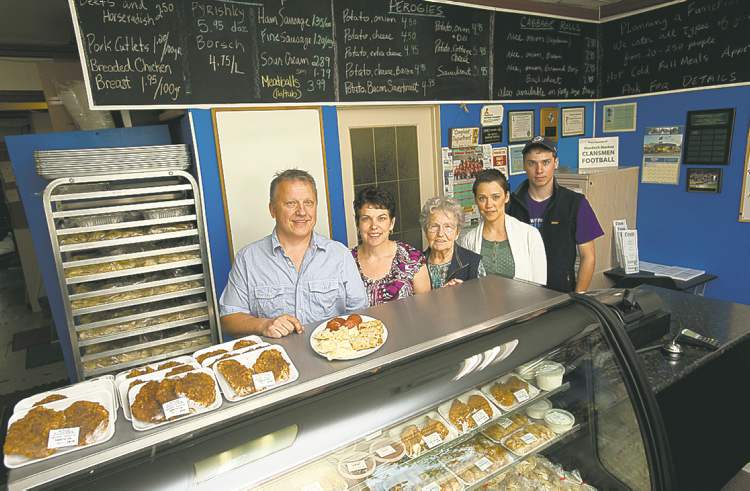
They made 13,200 of the dumplings (1,100 dozen) that day, and cooked 15,600 (1,300 dozen). That includes extras they had in the freezer.
Sevala’s owner Del Demchuk says 500 to 600 dozen is the average daily output for the 27-year-old business, although during the peak Christmas period that usually jumps to 700 to 800 dozen a day.
All of those perogies help to feed a thriving business that includes a store/deli operation that sells directly to the public, a wholesale food operation that supplies products to local grocery stores and food distributors, and a catering business that provides Ukrainian dishes and ready-made meals for luncheons, office parties, banquets, weddings and a variety of other events.
Demchuk said while all three divisions are enjoying a booming business these days, the real stallion is the store/deli operation. It generates twice the yearly revenues of the other two divisions.
“We have customers that will drive right across town to get their perogy or cabbage-roll fix for the week,” he said. “We even have customers who come from out of town.”
And Sevala’s isn’t the only one with a citywide following.
Julia’s Ukrainian Restaurant & Deli also attracts customers from all over Winnipeg. And that’s just the restaurant. Its catering business, which provides prepared meals and food trays for a variety of different events, is also going gangbusters.
“We’re getting so many orders every day,” owner Joanna Pacwa says. “If you could see me now, I’m all full of flour!”
Demchuk, who is a second-generation owner of Sevala’s, has a theory on why the demand for Ukrainian food continues to grow.
“The older generation (of Ukrainians) is dying off and nobody my age is making the stuff,” he says. “They don’t know how to make it themselves, but they still want it because it’s part of their heritage.”
And he’s not the only one who thinks that.
“He’s hit the nail right on the head,” says Dave Shambrock, executive director of the Manitoba Food Processors Association. “Not only for Ukrainian food, but for food in general. Most younger consumers don’t know how to cook.”
Shambrock says ethnic foods, in particular, are gaining in popularity. And traditional Ukrainian dishes such as perogies, he notes, also have something else going for them.
“They kind of fit into that category of comfort foods.”
It’s tough to get a handle on how many Ukrainian restaurants, caterers and food processors there are in the province. Even industry players such as Demchuk, Pacwa and Manitoba Restaurant and Foods Services Association executive director Scott Jocelyn said they couldn’t even hazard a guess.
Shambrock said he knows of at least three food processors — Sevala’s and Naleway Foods Ltd. in Winnipeg and Perfect Pierogies Ltd. in Garson — that manufacture perogies.
Naleway Foods bills itself as one of the largest perogy processors in Canada, as well as the country’s largest private-label processor of panzerottis. It sells its products to major grocery store chains, food wholesalers and distributors in both Canada and the United States, while Sevala’s sells mainly to smaller, local, independently owned grocers and food distributors.
A host of church groups and organizations around the province also make and sell perogies to the public, such as St. Ivan Suchavsky Ukrainian Orthodox Cathedral in Winnipeg.
One of Winnipeg’s most famous Ukrainian eateries was Alycia’s Restaurant on Cathedral Avenue. The family-owned operation closed its doors last year after more than three decades in business.
The list of celebrities who dined at Alycia’s included the late actor John Candy, who liked its perogies so much he’d have them flown to his home in Los Angeles; actor and singer Jim (Gomer Pyle) Nabors; singer Tommy Hunter; and boxer George Chuvalo.

It was Demchuk’s mother, Sylvia Beck, who started Sevala’s in 1985 as a home-based catering business. At one time the company also operated a couple of restaurants in the city, but they were closed in the mid-1990s to concentrate on its other three operations.
“The store was getting so busy and the wholesale was getting so busy and the catering. Something had to give,” Demchuk says. “And it was the restaurants.”
Pacqa says her catering business is doing so well the restaurant is no longer open during the evenings, just from 8 a.m. to 3 p.m. daily.
“We have to have some time to prepare everything.”
murray.mcneill@freepress.mb.ca