

Technology somehow dehumanizing
Should Beautiful Game put up beautiful resistance against VAR?
Advertisement
Read this article for free:
or
Already have an account? Log in here »
To continue reading, please subscribe:

Digital Subscription
One year of digital access for only $205*
- Enjoy unlimited reading on winnipegfreepress.com
- Read the E-Edition, our digital replica newspaper
- Access News Break, our award-winning app
- Play interactive puzzles
*First annual payment billed as $205.00 + GST for one year. This annual subscription will automatically renew at $233.00 + GST every 52 weeks (10% off the regular annual price of $259.35). Offer available to new and qualified returning subscribers only. Cancel any time.
To continue reading, please subscribe:
Add Free Press access to your Brandon Sun subscription for only an additional
$1 for the first 4 weeks*
- Enjoy unlimited reading on winnipegfreepress.com
- Read the E-Edition, our digital replica newspaper
- Access News Break, our award-winning app
- Play interactive puzzles
*Your next Brandon Sun subscription payment will increase by $1.00 and you will be charged $17.95 plus GST for four weeks. After four weeks, your payment will increase to $24.95 plus GST every four weeks.
Read unlimited articles for free today:
or
Already have an account? Log in here »
Hey there, time traveller!
This article was published 17/01/2020 (2453 days ago), so information in it may no longer be current.
Consider this scenario: it’s extra time in the 2022 World Cup final, England vs. Brazil. Roberto Firmino, spotting Neymar’s run to his left, puts his teammate through with a pass, and Neymar, having got well behind Trent Alexander-Arnold, cuts inside and clips the ball over an onrushing Jordan Pickford. Brazil are world champions.
The thing is, Neymar was offside — not by much, less than an inch; but FIFA, bowing to fan pressure, no longer uses video assistant referee technology, and the goal stands. It was too close to call in the moment. The English press are outraged. Images of the player’s offside run, highlighted with a line demarking the bit of his body that advanced beyond Alexander-Arnold, are printed on the next day’s front pages in that country and around the world. Similar images, and super-slow motion video captures, have been circulating on social media since the moment the ball went in.
Now, has the game been thrown into a state of disrepute, or was the judgment made by the linesperson’s eyesight an acceptable margin of error? And didn’t the fans willingly trade in VAR for continuity of play, never mind an affection for the passions that flowed through the sport before technology dammed them up? Is the resulting fury and frustration of England supporters an outpouring of those passions, a rage that will later be romanticized?
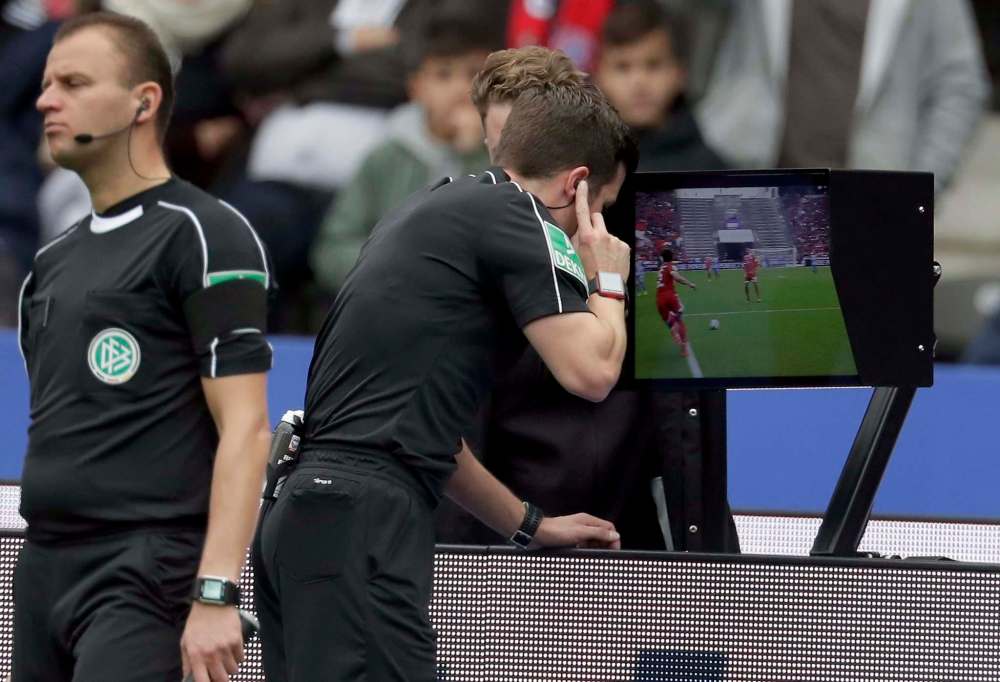
I’ve been thinking a lot about VAR lately. Given that it seems to be a factor in more matches than not, it’s hard not to think about it. The thing is, my thinking has taken me somewhere I wasn’t expecting to go.
As regular visitors to this column space will attest, I have long advocated for the use of technology in soccer, from the goal-line variety introduced in 2012 and implemented across the major European leagues in 2015 to video assistants, which made their FIFA debuts at the 2018 World Cup. My thinking: technology will minimize, even altogether eliminate, those grey areas where individual, human decision-making will occasionally get it wrong. And in the high-stakes context of professional and international soccer, what could be more straightforward than using technologies that already exist to remove the possibility of error?
It was never just about technology. Part of my rethink — and it admittedly goes well beyond VAR, although VAR is “the device to think with,” as translator and essaying Kate Briggs writes in This Little Art — involves technological advance as part of (perhaps the most tangible marker of) human progress, and a progress that supposedly arcs toward justice and optimism. It’s a very white, moneyed, Eurocentric assessment, but it’s one that also gets entangled with contemporary social issues. It’s how something as micro as VAR, as the supposed device of progress, can come to take on the same vitality of very important, actually vital advocacies.
Folks, this should not be a thing.
In his book What Technology Wants, Kevin Kelly writes that “technology wants what life wants,” citing ideals such as “increasing opportunity,” “increasing diversity” and “increasing freedom.”
And yes, my life does want those things. Life, itself, might even want them. But technology can also be harnessed to obstruct those ideals— and the players in the obstruction game are far more powerful than technology’s individual users, users who are increasingly finding that the convenience at their fingertips is making them less socialized to the point that it’s a social problem of its own.
“The share of Americans who believe that technology companies have a positive impact on society has dropped from 71 per cent in 2015 to 50 per cent in 2019,” The New York Times reported last week. The same article described a movement known as “techlash” that is targeting the giants of Silicon Valley. It seems Gen Z graduates have “ethical quandaries” about working in tech; one interviewee pointed out that “there’s more hesitation about the moral qualities of these jobs.” Incidentally, these are also the same young people who are trying to save the planet, so it should hardly be surprising that they’re opting out of the tech-force.
Can I opt out, too? I mean, can I bin technologies that may be efficient but that remove enjoyment, erase colour from my life? Understanding that I don’t have to conflate self-driving cars with meaningful firearm legislation, can I pick some technology to use while abstaining from others? Can I champion technology that diminishes child mortality and the spreading of disease while deleting Facebook and taking my groceries to the cashier instead of the self-checkout?

Can I opt out of VAR? Can soccer opt out of it?
It should be able to, if it wants. But will the money at stake, and those who stand to gain that money, allow it to? And what about people, the fans, the real drivers of the soccer economy? Can they make meaningful, intentional choices about technologies in their lived experience? Can they resist the precision of VAR in a knowing exchange for passion, colour and occasional bellyaching? And if not — and this is the broader matter — who or what is making their decision for them? Who or what is in control?
I’m not sure. But it’s something to think about. I know I am. And I also know this: it would be a beautiful resistance.
jerradpeters@gmail.com
Twitter @JerradPeters
Our newsroom depends on a growing audience of readers to power our journalism. If you are not a paid reader, please consider becoming a subscriber.
Our newsroom depends on its audience of readers to power our journalism. Thank you for your support.
Our newsroom depends on a growing audience of readers to power our journalism. If you are not a paid reader, please consider becoming a subscriber.
Our newsroom depends on its audience of readers to power our journalism. Thank you for your support.
Related Articles
Markus Babbel fired by A-League's Western Sydney Wanderers PSG in last 16 of French Cup with scrappy 1-0 win at Lorient







Advertisement Advertise With Us
Advertisement Advertise With Us