

Einarson-Gushue on a roll
Team Canada off to sensational start at mixed-doubles curling championship
Advertisement
Read this article for free:
or
Already have an account? Log in here »
To continue reading, please subscribe:

Digital Subscription
One year of digital access for only $205*
- Enjoy unlimited reading on winnipegfreepress.com
- Read the E-Edition, our digital replica newspaper
- Access News Break, our award-winning app
- Play interactive puzzles
*First annual payment billed as $205.00 + GST for one year. This annual subscription will automatically renew at $233.00 + GST every 52 weeks (10% off the regular annual price of $259.35). Offer available to new and qualified returning subscribers only. Cancel any time.
To continue reading, please subscribe:
Add Free Press access to your Brandon Sun subscription for only an additional
$1 for the first 4 weeks*
- Enjoy unlimited reading on winnipegfreepress.com
- Read the E-Edition, our digital replica newspaper
- Access News Break, our award-winning app
- Play interactive puzzles
*Your next Brandon Sun subscription payment will increase by $1.00 and you will be charged $17.95 plus GST for four weeks. After four weeks, your payment will increase to $24.95 plus GST every four weeks.
Read unlimited articles for free today:
or
Already have an account? Log in here »
Hey there, time traveller!
This article was published 18/05/2021 (1958 days ago), so information in it may no longer be current.
The Einarson-Gushue Experiment is like some kind of super-cool science project — a blend of elements that produces an explosive reaction and astonishes everyone in the lab.
Combining a pair of world-class skips in four-player curling has worked wonders in mixed-doubles, as Kerri Einarson of Camp Morton, Man., and Brad Gushue of St. John’s, N.L., continue to show remarkable chemistry on the ice.
Winners of the national title in late March in the Calgary bubble, the duo has won its first three contests at the world championship in Aberdeen, Scotland. Team Canada knocked off Germany 9-6 on Tuesday in the wee hours of the morning (Central Time) and then rolled past Hungary 7-5 on a later draw.
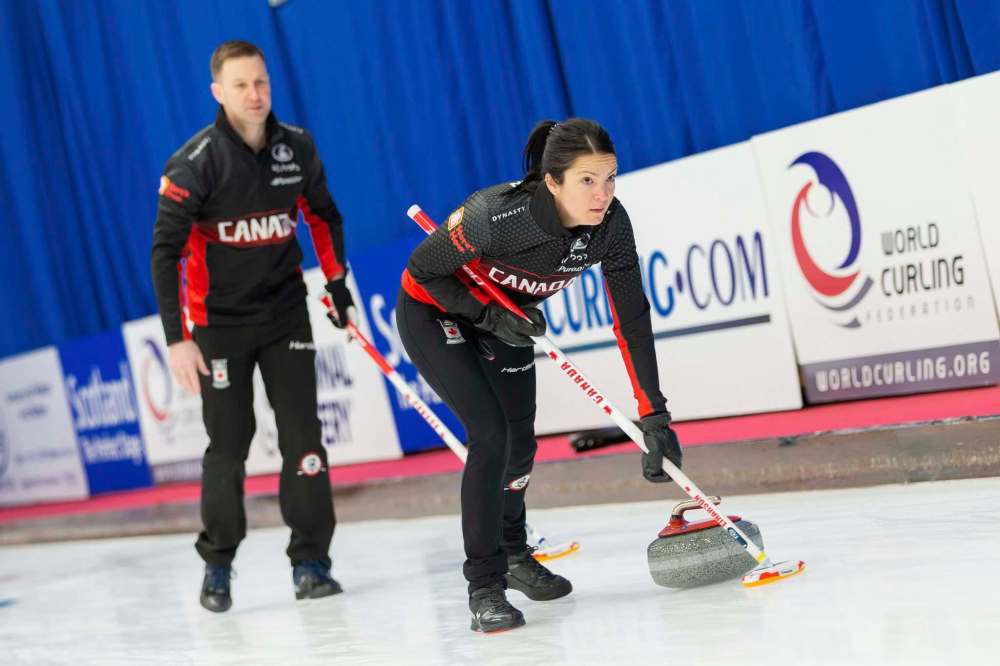
Einarson and Gushue are off to a sensational start, tied atop the 10-team Pool A standings with unbeaten Czech Republic and Scotland.
Not bad for a couple of household names in curling who’d barely uttered a word to each other before making a pact last year to join forces.
“I didn’t know Brad that well, just from seeing him at (Grand) Slam events and stuff, and never really had any conversations, either. So, when he approached me, it was like, ‘Of course, just a great opportunity.’ We just seemed to click right from the start,” Einarson said, in conversation with the Free Press after the victory over Hungary.
“We had never, ever played together. But we’re both pretty easy-going people and just want to go out, be ourselves and have fun. That’s what we’ve done, and I think that’s why we’ve had success.”
The initial connection was made by text in May 2020. Einarson and Gushue had each amassed enough Canadian Team Ranking System points through regular four-player competition to qualify as mixed-doubles partners for the 2020-21 season. But the COVID-19 pandemic wiped out all but the national championship, staged with six other events inside Calgary’s WinSport Arena.
The two combined to defeat Colton Lott and Kadriana Sahaidak — a skilled Manitoba team that specializes in mixed doubles — in the Canadian final.
In the Scottish host city, Einarson and Gushue are running up against partnerships with far more know-how in the unique version of the sport. However, the two-time reigning Scotties women’s champion and the 2006 Olympic gold medallist, world men’s champion (2017) and three-time Brier winner have unrivalled skill sets.
And with mounting experience, that makes them extremely dangerous.
“We’re still learning. This is still my second event and we’re still figuring out what works and what doesn’t, as far as strategies. Technically, we’re still newbies,” Einarson said. “Brad has played it a few times, he’s taken me under his wing and he’s showed me different types of shots, and I love that he asks my opinion and we see things the same way.
“The more we play together, the better we’ll get. We’re learning something new every day and really focusing on communication.”
Canada, among 20 teams, has yet to win gold in the event’s 13-year history — a fact not lost on the the 33-year-old married mom of twin girls, who works at Betel Home in Gimli.
“That would be pretty cool. Definitely, it’s crossed my mind,” she said. “But we’re taking things one game at a time and not looking too far ahead.”
On paper, a pair of tests Wednesday lean heavily in Canada’s direction. The twosome takes on Australia’s Tahli Gill and Dean Hewitt (0-3) at 3 a.m., and Korea’s Ji Yoon Kim and Si Woo Moon (1-2) at 10 a.m.
Three teams with the best records in each of the two pools qualify for the weekend playoffs, however, another major carrot exists as well. The seven teams with the best overall records earn spots for their respective countries in the mixed doubles event of the 2022 Olympics in Beijing.
Kaitlyn Lawes of Winnipeg and John Morris of Canmore, Alta., joined forces to win gold for Canada in the debut for mixed doubles at the 2018 Winter Games in PyeongChang.
The Canada vs. Korea matchup marks TSN’s first broadcast of the championship.
Challenging Dorottya Palancsa and Zsolt Kiss, former two-time world champions (2013, 2015) from Budapest, Canada simply couldn’t afford to be spotty with their deliveries and rock placement.
And they weren’t. In fact, the Canadians registered their finest outing of the event in terms of shooting accuracy. Einarson, tossing the first and fifth stones, finished at 82 per cent, while Gushue shot 85 per cent with the middle three rocks.
Canada was never under duress against Hungary, scoring deuces in the first and third ends and then stealing a single in the fourth to construct a 5-2 lead prior to the fourth-end break. Hungary closed the gap to two points by the eighth end, however, Canada carried the hammer and, despite a crowded house, didn’t have to throw its final stone.
“It was much more of a textbook game and I thought we played really well. But even though we played it real well, still textbook, it’s still real stressful in the last end of mixed doubles. There’s still so much that can happen and there’s no lead that’s really comfortable,” Gushue said, in comments to World Curling TV.

He knows of what he speaks.
Earlier in the day, Canada vaulted ahead 5-1 after three ends but gave up a deuce to the Germans in the fourth and then relinquished the lead in the fifth when Gushue botched a takeout try and Einarson missed an end-saving draw.
Using the power play — a rock is positioned in the wings behind a corner guard before the ends begins — in the sixth end, Canada generated a deuce to move back in front 7-6 and then immediately pilfered two more when Germany’s Pia-Lisa Schoell hit but rolled out with her last rock of the seventh.
Twitter: @WFPJasonBell
Related Articles
Einarson wraps memorable season with fourth-place finish



Advertisement Advertise With Us
Advertisement Advertise With Us