

World Cup hangover on tap
Qatar disruption expected to diminish quality as league play resumes
Advertisement
Read this article for free:
or
Already have an account? Log in here »
To continue reading, please subscribe:

Digital Subscription
One year of digital access for only $205*
- Enjoy unlimited reading on winnipegfreepress.com
- Read the E-Edition, our digital replica newspaper
- Access News Break, our award-winning app
- Play interactive puzzles
*First annual payment billed as $205.00 + GST for one year. This annual subscription will automatically renew at $233.00 + GST every 52 weeks (10% off the regular annual price of $259.35). Offer available to new and qualified returning subscribers only. Cancel any time.
To continue reading, please subscribe:
Add Free Press access to your Brandon Sun subscription for only an additional
$1 for the first 4 weeks*
- Enjoy unlimited reading on winnipegfreepress.com
- Read the E-Edition, our digital replica newspaper
- Access News Break, our award-winning app
- Play interactive puzzles
*Your next Brandon Sun subscription payment will increase by $1.00 and you will be charged $17.95 plus GST for four weeks. After four weeks, your payment will increase to $24.95 plus GST every four weeks.
Read unlimited articles for free today:
or
Already have an account? Log in here »
Hey there, time traveller!
This article was published 23/12/2022 (1376 days ago), so information in it may no longer be current.
Right, so where were we? Let’s see…
Arsenal, when men’s football paused for the World Cup last month, were top of the Premier League. Yep, still are. Five points clear of Manchester City, even. And if that comes as a surprise, don’t worry; it’s because it’s Arsenal.
Across the Channel, Paris Saint-Germain are still unbeaten. Not much of a title race there, although Lens and Rennes, in second and third, have at least made the Ligue 1 standings interesting. What about La Liga? Oh yeah! Barcelona have somehow conceded a mere quintet of goals through 14 rounds and are first place in Spain.
Abbie Parr/ The Associated Press files
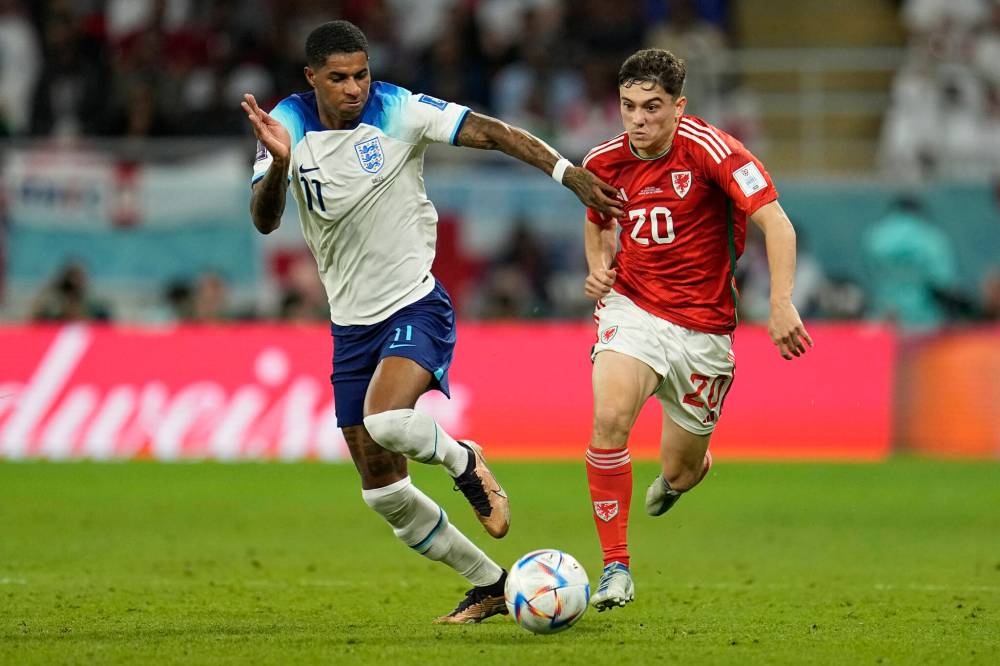
Marcus Rashford (left) had a pair of goals for England at the World Cup. He has already seen action for his club side, Manchester United, since returning from Qatar.
Now, it’s in Italy that things are really exciting. Napoli are at the fore of the Scudetto hunt, but the teams from second through seventh — AC Milan, Juventus, Lazio, Inter Milan, Atalanta and Roma — are separated by just six points.
Germany, finally, won’t be back up and running until the third week of January, and it looks as though Bayern Munich will win yet another Bundesliga shield. However, the likes of Freiburg, Eintracht Frankfurt and Union Berlin have added a refreshingly unexpected element to the European places.
Okay, now that that’s sorted, what happens now?
The simple answer is “football,” and a whole heck of a lot of it between the festive season and late spring.
That is, unless you represent Canada, the United States, Mexico or another CONCACAF nation internationally, in which case you’ll also have the Gold Cup, ending July 16. And by then, next season’s Champions League qualifying will have been underway for more than a month.
If it seems like too much, it’s because it is.
The English clubs have the worst of it, what with two days between the Final in Doha and the Carabao Cup’s round of 16, and eight dividing Argentina’s triumph from the Premier League restart. Not that it’s much easier in Portugal, where the third round of the Taca da Liga actually began before the World Cup closer.
Consider Porto’s schedule, for example. After facing Vizela last week Friday they hosted Gil Vicente on Wednesday and will take on Arouca four days from now.
He may have been speaking specifically to Manchester United’s situation, but in comments earlier this week Red Devils manager Erik Ten Hag surmised that it would take some time for players returning to their clubs from Qatar to adjust to the unique, and rigorous, demands of domestic football.
In other words, while those jam-packed schedules throw one game after another at already-exhausted players, managers will be challenged to reimpose their systems after a long lay-off, injuries will continue to mount and results will be even more squirrely than they were before mid-November.
Squad depth has never been so important, and teams that have it stand to gain considerably over the next few months. That’s good news for the likes of Manchester City, Real Madrid and Juventus; less so for Liverpool, Barcelona and Lazio.
What about the viewer? If sports are supposedly played for the fans, it should follow that more football benefits its audience. Right?
Not necessarily.
Whether in the stadium or watching on one of countless and increasingly-pricey streaming services, supporters pay to enjoy what they assume will be a product worth their outlay. They want to see games of a certain quality and superstars who satisfy the cost of admission. A surplus of football actually diminishes both.
What remains are matches between tired, stretched-out squads and featuring weary, overburdened athletes. And that’s if they’re not already injured or lacking the vigour to get them through the 90 minutes.

Who knows, for instance, how effective Ballon d’Or holder Karim Benzema will be upon his return to Real Madrid. Or when, and in what state, N’Golo Kante will make his Chelsea comeback. Villarreal could certainly use Giovani Lo Celso. When will he be available? And, to add to the list, Arsenal striker Gabriel Jesus, Liverpool attacker Diogo Jota, Inter Milan forward Joaquin Correa, AC Milan defender Simon Kjaer, RB Leipzig frontman Christopher Nkunku, Bayern Munich winger Sadio Mane and Sevilla midfielder Thomas Delaney? We could go on and on.
Fact is, all this football serves no one — at least, not those it’s intended for. Granted, the sponsors, rights holders and club owners stand to make a buck, for now anyway. Then there’s FIFA, preposterously suggesting a World Cup every three years. Seriously, read the room. Less, in this case, is certainly more.
So, where were we? It’s a question we really shouldn’t have to ask.
Twitter @JerradPeters
Our newsroom depends on a growing audience of readers to power our journalism. If you are not a paid reader, please consider becoming a subscriber.
Our newsroom depends on its audience of readers to power our journalism. Thank you for your support.
Our newsroom depends on a growing audience of readers to power our journalism. If you are not a paid reader, please consider becoming a subscriber.
Our newsroom depends on its audience of readers to power our journalism. Thank you for your support.
Related Articles
Kevin Payne, who led D.C. United to glory and was Toronto FC's first president, dies at 69



Advertisement Advertise With Us
Advertisement Advertise With Us