

The far-reaching shame of Saudi Arabia’s sportswashing
Advertisement
Read this article for free:
or
Already have an account? Log in here »
To continue reading, please subscribe:

Digital Subscription
One year of digital access for only $205*
- Enjoy unlimited reading on winnipegfreepress.com
- Read the E-Edition, our digital replica newspaper
- Access News Break, our award-winning app
- Play interactive puzzles
*First annual payment billed as $205.00 + GST for one year. This annual subscription will automatically renew at $233.00 + GST every 52 weeks (10% off the regular annual price of $259.35). Offer available to new and qualified returning subscribers only. Cancel any time.
To continue reading, please subscribe:
Add Free Press access to your Brandon Sun subscription for only an additional
$1 for the first 4 weeks*
- Enjoy unlimited reading on winnipegfreepress.com
- Read the E-Edition, our digital replica newspaper
- Access News Break, our award-winning app
- Play interactive puzzles
*Your next Brandon Sun subscription payment will increase by $1.00 and you will be charged $17.95 plus GST for four weeks. After four weeks, your payment will increase to $24.95 plus GST every four weeks.
Read unlimited articles for free today:
or
Already have an account? Log in here »
Hey there, time traveller!
This article was published 07/07/2023 (1186 days ago), so information in it may no longer be current.
In less than six years, the Asian Winter Games — organized by the continent’s Olympic Council — will take place in a city that doesn’t exist. In just over seven, that same imagined metropolis could host the World Cup Final.
Known as Trojena, it will function as the lake-and-mountain getaway for the ultra-rich residents of Neom: a futuristic, linear settlement in the Saudi Arabian desert, construction of which is in its very early phases.
Now, six or seven years might not seem sufficient for transforming a brand-new, ultra-glamourous colony from theory to reality, but we’ve already been watching the building blocks put in place, even if we didn’t know it. Which, as it happens, is exactly how its planners intended.
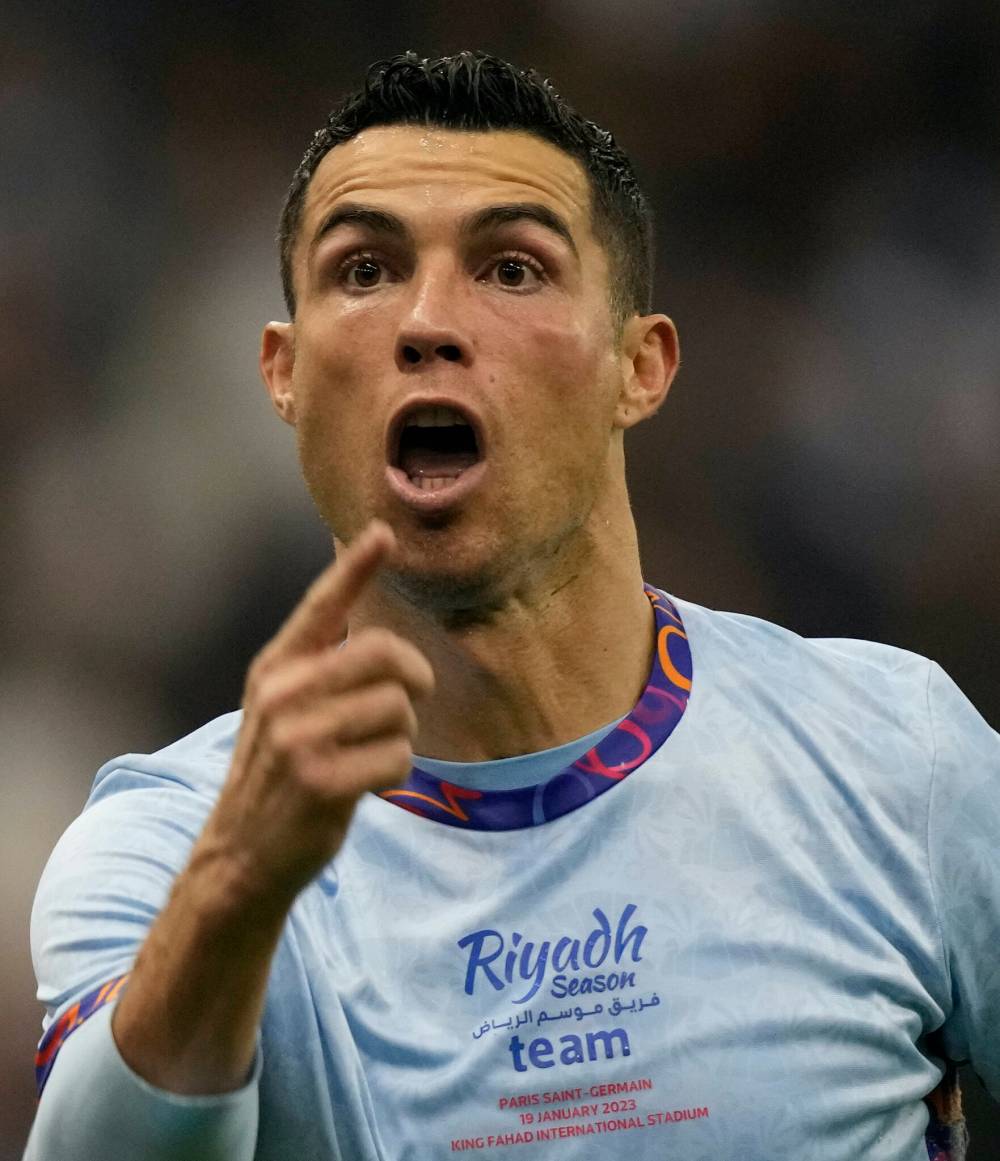
Hussein Malla / The Associated Press
Cristiano Ronaldo: Saudi ‘tourism ambassador’
It’s not a complicated blueprint. They start with something innocuous, inundate with the ridiculous, distract with money and circuses, and before you know it you’ve not only seen the towers rise up before you but have actually signed off on each step of their construction.
What seemed on its surface to be the curious transfer of Cristiano Ronaldo to Al-Nassr in January was only a brick — albeit a large one, maybe more a marble slab — in the floor of a structure meant to house, nurture and project a modern, affluent and progressive image of Saudi Arabia to the rest of the world.
Or, to borrow from the Kingdom’s Vision 2030 venture, a picture of vibrant societies, thriving economies and ambitious projects.
The initiative is the brainchild of Crown Prince Mohammad bin Salman, who, it goes without saying, is also its chief architect and supreme administrator. Cultural properties, most noticeably in sport, are foundational to its composition. And so you have LIV Golf, Formula One and those Asian Winter Games, as well as smaller interests in tennis, cricket and Esports.
Critics of the Saudi establishment, including Human Rights Watch, have accused bin Salman and the ruling elite of sportwashing, though the label is somehow insufficient when applied to such scale. This is sportwashing industrialized, and the workforce on the production line includes a host of high-profile athletes, predominantly footballers.
Of course, there’s nothing inherently wrong in staffing your national league with recognizable, foreign players. The United States and Canada do it through Major League Soccer, as does Australia to a lesser extent. If you want to sign a 32-year-old Kalidou Koulibaly to a long-term contract, have at it. He’d no doubt prefer to live in Riyadh than, with all due respect, Columbus or Salt Lake City.
The ex-Chelsea defender’s new team also happens to be operated by Saudi Arabia’s Public Investment Fund (PIF), which acquired controlling stake in the Roshn Saudi League’s four biggest clubs last month. Ronaldo’s Al-Nassr, which recently signed Marcelo Brozovic, is now kingdom-owned, as are Roberto Firmino’s Al-Ahli and Karim Benzema’s Al-Ittihad.
Which makes them, quite literally, employees of the state – though their overseers likely prefer the gentler “Tourism Ambassadors,” which is the sobriquet they used for Lionel Messi before he snubbed them for MLS.
Bin Salman is also investing in re-reputationing factories overseas, the most notable of which – so far – is St. James’ Park, home to Newcastle United of the English Premier League. The PIF is flush with capital and desperate to spend it. Representatives have already visited clubs in Portugal, Belgium and France with an eye to establishing a network similar to that of Qatar-owned Manchester City.
It’s not an accidental urgency. Vision 2030 makes no secret of the fact its mandate is to not only position Saudi Arabia for a post-oil future, but also to lead it. The PIF is its investment arm, using the purchasing power of oil wealth to acquire assets on which to rely when the wells stop pumping.
Image isn’t the only thing that needs a wash. Money must be cleaned as well, no matter the cost.
And the cost is staggering, and quantifiable.
Almost 600,000 people already live in the Belgium-sized corridor where Neom is being built. Unfortunately, as is so often the case when it comes to megaprojects, they’re the wrong kind of people: working class and disadvantaged, about half of whom are temporary foreign workers with few to no rights.
The authorities claim to have introduced a compensation process for the homes and businesses that have, and will be demolished, with the caveat that payment is made only after the structures have been razed. And foreign nationals don’t qualify. Dissent, predictably, is quashed.
In 2020, a member of the Huwaitat tribe recorded a video in which he alleged he was being evicted from his home. He predicted he’d be murdered for his remarks. He was right. More than 20,000 Huwaitat currently find themselves in Neom’s path. Three additional men who have resisted are due to be executed on terrorism charges, while another three face 50-year prison terms.
While it’s become almost commonplace for athletes, pop stars and other public figures to perform increasingly complex intellectual gymnastics to separate themselves from Saudi Arabia’s record of LGBTTQ+ repression, discrimination against women and girls and suppression of foreign workers, Vision 2030 enterprises such as Neom don’t leave room to hop, skip and jump around.
Association is direct, and as recently as May the United Nations’ Office of the High Commissioner for Human Rights urged all involved companies and stakeholders, including North American ones, “to ensure that they are not causing or contributing to, and are not directly linked to serious human rights abuses.”
Many are, of course, and by extension — a few degrees of separation from “direct” — so are we.
For example, among the hands-on partners in Neom is OceanX, whose founder also runs Bridgewater Associates and a portfolio including a prominent Canadian pension fund, U.S. Treasury Bonds, inflation-indexed bonds and emerging market debt. The PIF itself has stake in the likes of Uber, Boeing and video game giant Electronic Arts (EA Sports).

That many of the world’s challenges — and potential solutions — are held in suspension by a handful of powerful corporations is news to no one, and we won’t solve that in this space. Nevertheless, we can call it like we see it when injustice is taking place before our very eyes.
When people are killed, when homes are destroyed, when neighbourhoods are reduced to so much debris to be removed.
And when it’s Ronaldo, Benzema, Firmino et al with their hands on the shovels.
jerradpeters@gmail.com
Threads @JerradPeters
Our newsroom depends on a growing audience of readers to power our journalism. If you are not a paid reader, please consider becoming a subscriber.
Our newsroom depends on its audience of readers to power our journalism. Thank you for your support.
Our newsroom depends on a growing audience of readers to power our journalism. If you are not a paid reader, please consider becoming a subscriber.
Our newsroom depends on its audience of readers to power our journalism. Thank you for your support.
Related Articles
Sinclair leads Canada's squad into the Women's World Cup








Advertisement Advertise With Us
Advertisement Advertise With Us