

Passion keeping ice cross alive
Extreme sport struggles after main sponsor pulls out

Advertisement
Read this article for free:
or
Already have an account? Log in here »
To continue reading, please subscribe:

Digital Subscription
One year of digital access for only $205*
- Enjoy unlimited reading on winnipegfreepress.com
- Read the E-Edition, our digital replica newspaper
- Access News Break, our award-winning app
- Play interactive puzzles
*First annual payment billed as $205.00 + GST for one year. This annual subscription will automatically renew at $233.00 + GST every 52 weeks (10% off the regular annual price of $259.35). Offer available to new and qualified returning subscribers only. Cancel any time.
To continue reading, please subscribe:
Add Free Press access to your Brandon Sun subscription for only an additional
$1 for the first 4 weeks*
- Enjoy unlimited reading on winnipegfreepress.com
- Read the E-Edition, our digital replica newspaper
- Access News Break, our award-winning app
- Play interactive puzzles
*Your next Brandon Sun subscription payment will increase by $1.00 and you will be charged $17.95 plus GST for four weeks. After four weeks, your payment will increase to $24.95 plus GST every four weeks.
Read unlimited articles for free today:
or
Already have an account? Log in here »
Hey there, time traveller!
This article was published 20/01/2024 (949 days ago), so information in it may no longer be current.
Eric Milinkovic remembers what it was like at the starting gate of Red Bull Crashed Ice, looking down at the icy track with tens of thousands of boisterous fans lining the boards and eagerly waiting for him to pass.
“I got 100,000 people and I got Sportsnet, NBC, Fox Sports and Red Bull TV all on my ass just trying to film our races. Ugh, heart attack,” Milinkovic recalled.
“It was a big, different feeling — it was great.”
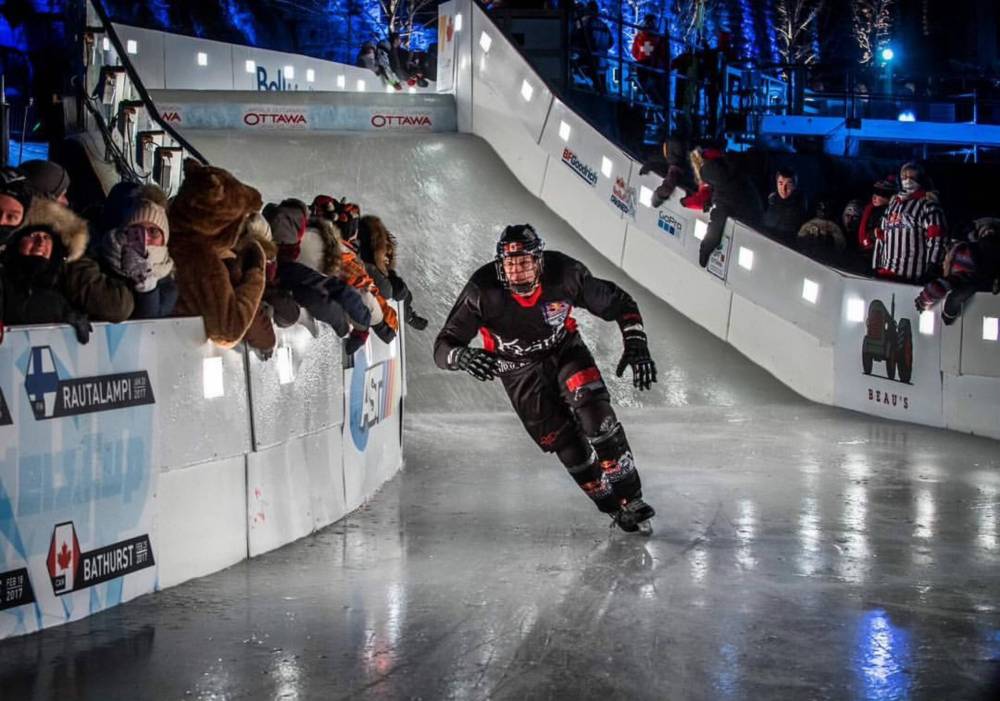
Michael Anderson photo
Winnipegger Eric Milinkovic says international TV coverage and 100,000 fans were the norm when ice cross was at its most popular.
Those days are a distant memory now. Milinkovic would be happy to see even a couple of hundred fans when he laces his skates for the season-opening race of the ASTX Ice Cross Championship series in Austria on Saturday.
No, ice cross isn’t what it used to be, but there’s been a concerted effort by its athletes to revive the sport and return it to its glory days.
“It’s gone, but it’s not completely gone,” Milinkovic said.
+++
Milinkovic is the 18th-ranked ice-cross skater in the world, but he isn’t competing for money these days. The sport has given the 36-year-old Winnipegger a reason to travel around the world while being an ambassador for a sport he’s come to love.
Ice cross is an extreme winter sport that typically sees five skaters race downhill on an ice track embedded with turns, berms and jumps while jockeying for position. Races range from 350 to 680 meters and can see skaters reach speeds of 65 km/h.
It’s months of training for about 60 seconds of action for the athletes.
The sport was most popular when it was known as Red Bull Crashed Ice from 2001 until the title sponsor disassociated itself in 2019, when the pandemic struck.
Canada has iced some of the sport’s most prolific athletes, including Ontario’s Kyle Croxall, who won a world championship in 2012, and Jacqueline Legere, who won three Crashed Ice races in the women’s division.
The country is still well-represented with 13 skaters — seven men, six women — inside the top 20 of their respective world rankings. Milinkovic, along with Skylar Diamond-Burchuk, the 38th-ranked skater in the world, are the only Manitobans still in the sport.
The All Terrain Skate Cross Federation sanctioned the sport in 2019, but without a big sponsor money has dried up, the cameras have disappeared and many of the best skaters have retired and taken the big crowds with them.
Most athletes tend to come from a hockey background, given the need to be a strong skater. That was the case for Milinkovic, who quit hockey in 2008 and decided to enter the Crashed Ice qualifier in Winnipeg. It took him seven years before he made it to the grand stage, but it was glamorous when he did.
Winners of the biggest events would walk away $5,000 richer and world champions could earn a cheque upward of $20,000. Races were held downtown in big cities on carefully manicured tracks and broadcast nationwide.
This week’s event in Winterleiten won’t have a cash prize and it’s up to the athletes to prepare each track, which could yield hazardous results if the calculations are wrong.
“Just imagine you’re making it in your backyard and being like, ‘I shouldn’t get too much speed to launch over the boards or over the bushes,’” Milinkovic said. “Now it’s just built by skaters, for skaters.
“Each race that Red Bull was hosting, like the big races you see downtown where there’s over 100,000 people in St. Paul, Minn., it’s (about) $6 million to have that race. And the funny thing is, now we don’t have money because there’s no more Red Bull,” he continued. “We’re trying to get the ball rolling, but it’s hard to get when you have no money.”
David Pereira, president of the Canadian Ice Cross Federation, maintains the extreme sport isn’t dead. He agreed that there is a large audience and great interest in competing in the sport, but that it always comes down to money.
“Sometimes it’s up to finding some sponsors and continue to make some events so the people can see that it’s alive,” said Pereira, who will also race this week in Austria.
Each race in the ASTX Ice Cross Championship will stream on YouTube this season, an addition Pereira hopes will draw some more viewership. The six-race circuit will tour Europe for the first four races, with stops in France, Czechia and Finland before arriving in Sainte-Angèle-de-Mérici, Que. and closing the season in Lost Valley, Maine.
Pereira formed the Canadian Ice Cross Federation in 2021 to ensure the sport doesn’t die in the Great White North. Now he has big plans to revive it. Ice Cross will soon open to athletes as young as 10 years old. Skaters could not race if they were younger than 16 under the old sponsor’s regulations.
“With this thinking, it’s to have more athletes at that age — it’s those people who are going to make the future of the sport, it’s not me,” said Pereira, 36. Canada saw more than 100 athletes — men, women and junior — and more than 400 athletes from around the world register with ASTX last season.
Pereira is also targeting big-name sponsors to bring the larger events — known as the 1,000 series — back to the circuit. The federation is targeting Edmonton, Ottawa, and Toronto — specifically BMO Field, which isn’t used during the winter months and can hold 18,000 fans — for a premier event in the coming years.
One athlete-led project that hopes to generate some buzz is the Ice Cross Life on the Edge documentary.
The idea sprouted when Brittan Morris, a skater from Texas, vlogged his experience at a race in 2021. After nailing down a few sponsors and generating some money in 2022, videographers documented the lives, training habits and personal stories of four ice cross athletes throughout the 2023 season as they travelled around the world for competitions and put their bodies on the line each week.

“After (losing a major sponson), there really wasn’t much media left around the sport, so I was trying to get something going to get more exposure for it,” Morris said.
The documentary will premiere at the Mammoth Film Festival on March 3 in California.
“It tells the story of the sport, where it’s at, where it was… what happened during COVID and the loss of its title sponsor, how the athletes are the heartbeat of the sport and the ones that are keeping it going and that it’s purely passion that’s keeping it alive.”
jfreysam@freepress.mb.ca
X:@jfreysam
Josh Frey-Sam reports on sports and business at the Free Press. Josh got his start at the paper in 2022, just weeks after graduating from the Creative Communications program at Red River College. He reports primarily on amateur teams and athletes in sports. Read more about Josh.
Every piece of reporting Josh produces is reviewed by an editing team before it is posted online or published in print — part of the Free Press‘s tradition, since 1872, of producing reliable independent journalism. Read more about Free Press’s history and mandate, and learn how our newsroom operates.
Our newsroom depends on a growing audience of readers to power our journalism. If you are not a paid reader, please consider becoming a subscriber.
Our newsroom depends on its audience of readers to power our journalism. Thank you for your support.
Josh Frey-Sam reports on sports and business at the Free Press. Josh got his start at the paper in 2022, just weeks after graduating from the Creative Communications program at Red River College. He reports primarily on amateur teams and athletes in sports. Read more about Josh.
Every piece of reporting Josh produces is reviewed by an editing team before it is posted online or published in print — part of the Free Press‘s tradition, since 1872, of producing reliable independent journalism. Read more about Free Press’s history and mandate, and learn how our newsroom operates.
Our newsroom depends on a growing audience of readers to power our journalism. If you are not a paid reader, please consider becoming a subscriber.
Our newsroom depends on its audience of readers to power our journalism. Thank you for your support.
Advertisement Advertise With Us
Advertisement Advertise With Us