

FIFA pushes football world to breaking point
Advertisement
Read this article for free:
or
Already have an account? Log in here »
To continue reading, please subscribe:

Digital Subscription
One year of digital access for only $205*
- Enjoy unlimited reading on winnipegfreepress.com
- Read the E-Edition, our digital replica newspaper
- Access News Break, our award-winning app
- Play interactive puzzles
*First annual payment billed as $205.00 + GST for one year. This annual subscription will automatically renew at $233.00 + GST every 52 weeks (10% off the regular annual price of $259.35). Offer available to new and qualified returning subscribers only. Cancel any time.
To continue reading, please subscribe:
Add Free Press access to your Brandon Sun subscription for only an additional
$1 for the first 4 weeks*
- Enjoy unlimited reading on winnipegfreepress.com
- Read the E-Edition, our digital replica newspaper
- Access News Break, our award-winning app
- Play interactive puzzles
*Your next Brandon Sun subscription payment will increase by $1.00 and you will be charged $17.95 plus GST for four weeks. After four weeks, your payment will increase to $24.95 plus GST every four weeks.
Read unlimited articles for free today:
or
Already have an account? Log in here »
Hey there, time traveller!
This article was published 22/11/2024 (670 days ago), so information in it may no longer be current.
Well, they did it. They really did it.
FIFA, that organization mandated to ensure the well-being of the world’s most popular sport, has somehow managed to convince everyone, finally, that they’ve had their fill of it. Of FIFA, yes, but of football, too. Which is ridiculous when you think about it. Not that they did.
No, the Swiss-based syndicate and its reliably cringe dad-influencer Gianni Infantino have heaped so many matches and even more Instagram stories on its supporters, players and stakeholders that heads are beginning to explode (figuratively, but only just) and ligaments to tear (not figuratively).
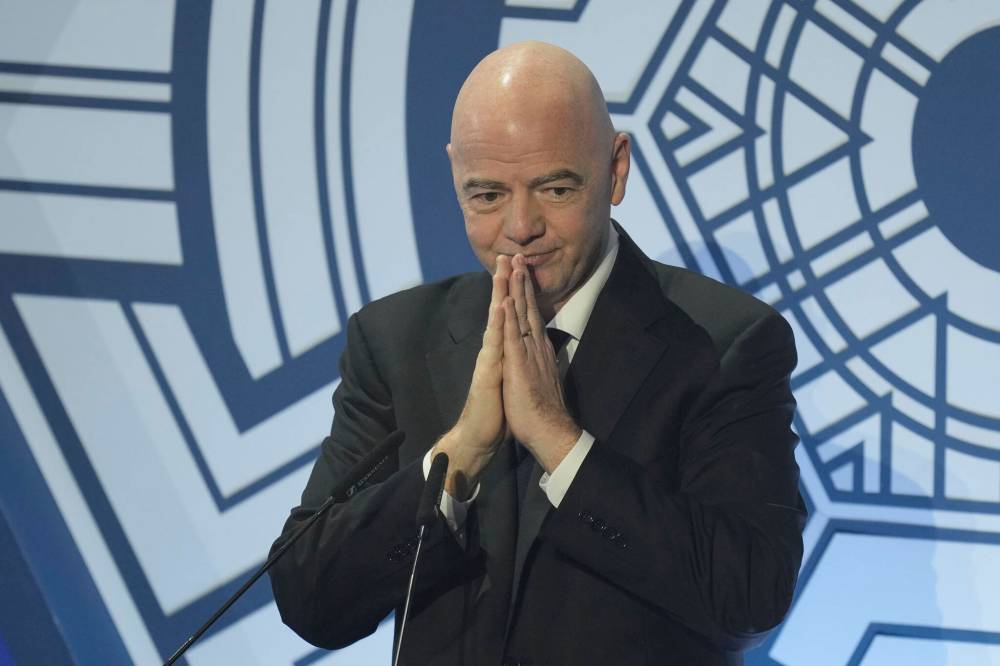
Lee Jin-man / The Associated Press
FIFA President Gianni Infantino
It was predictable in retrospect, yet surprisingly abrupt in the present, that FIFA’s Club World Cup would be the proverbial straw that broke the camel’s back, a worthy subject of the meme where Ross Geller, going full Ross Geller meltdown, exclaims, “It’s too much! I need to lie down.”
Everyone is Ross now. That is, the viewers and ticket-holders and merch-buyers — football’s entire fanbase, essentially — cannot possibly consume the volume of games, highlights, punditry (irony acknowledged) and social media content being hurled at them.
What happens when a bunch of things are thrown at someone? They get out of the way. Or try to. FIFA, however, exerts such control over anything and everything to do with football that it’s almost impossible to evade the barrage.
Though that may be changing. Take the lucrative world of video gaming, for example. When FIFA played hardball with licensing fees for the popular EA Sports franchise, the latter company simply walked away and launched EA Sports FC. The move was such a success that FIFA got openly mocked in, of all places, The Economist.
Understandably, the players have found the pile-on to be rather less amusing.
In prophetic remarks at the start of the season, Manchester City and Spain midfielder Rodri — winner of this year’s Ballon d’Or — mused a players’ strike would be on the table as long as FIFA wasn’t taking matches off it.
“It’s the general opinion of the players,” he said. “And if it keeps this way, there will be a moment where we have no other option.”
That moment may be here. In any event, it has certainly come for Rodri. Five days after making his strike suggestion, the 28-year-old suffered a torn ACL and meniscus damage in a match against Arsenal. Five days after that, he underwent season-ending surgery.
It wasn’t a one-off.
In mid-September, when asked about a new Champions League format that added additional fixtures to the schedule, Liverpool goalkeeper Alisson bluntly replied that the football authorities didn’t care what the players thought.
“Everyone knows what we think about having more games,” he said. “Everybody is tired of that.”
Three weeks later he sustained a hamstring injury against Crystal Palace. He hasn’t played since.
Now, when individual players pick up the inevitable ligament knocks that accompany fixture congestion, their experiences, like Alisson pointed out, don’t mean a whole lot. But when clubs — prestigious, money-making clubs — are having to go without key players for extended stretches, they tend to get heard. As in, heard in court.
Last month, the European Leagues group that represents 39 professional divisions and 1,130 clubs across 33 countries, together with the 60,000-member FIFPRO players’ union, filed a complaint to the European Commission in Brussels.
Among other allegations, it argued that an “oversaturated international football calendar risked player safety and well-being,” and FIFA’s imposition of decisions — such as its monthlong Club World Cup — constituted a violation of EU law.
Crucially, a Wednesday report from Katholieke Universiteit Leiden, which will be submitted to the EC as evidence, charges FIFA has also breached EU occupational safety and health regulations.
In other words, FIFA is in big, big trouble, because if there’s one thing the EU judicial system takes extremely seriously, it’s labour legislation. It doesn’t help that the EU courts already dislike FIFA, a lot. Because, who doesn’t?
In early October, the European Court of Justice handed Infantino & Co. a landmark defeat regarding player transfers. When confronted by hobbling footballers and a report from the oldest university in the Low Countries, the EC will almost certainly throw the book at FIFA — which, by the by, is a registered nonprofit despite holding US$4 billion in cash reserves.
Given the financial embarrassment that is the Club World Cup, they may soon need to make a withdrawal.
This latest event, bloated to nearly 500 per cent of its previous format, calls for 32 clubs to play a monthlong, World Cup-style tournament in the United States beginning June 15. Not quite a year later, the U.S., as well as Mexico and Canada, will host the actual World Cup, itself grown by 50 per cent since the last one.
No wonder prospective broadcasters, sponsors and other commercial partners have mostly stayed away, which they’ll continue to do until, at the very least, the EC proceedings have provided some clarity. FIFA, meanwhile, has been left so red-faced that its chest-thumping press releases now boast of a “logistics” deal with a freight provider. Important stuff that folks definitely care about.
What’s far more notable is the lawsuit Alajuelense is threatening to launch against FIFA, which, the Costa Rican club rightly claims, violated its own rules by awarding Club World Cup berths to two Mexican clubs with the same owner. Then there’s Inter Miami, which basically qualified because it has Lionel Messi in its squad.

Go down the list of problems and there’s also Real Madrid manager Carlo Ancelotti’s recent comment (which he later said was misinterpreted) that his club, and unnamed others, wouldn’t be going to the U.S. at all.
Whether or not Madrid turn up at the Club World Cup, this much is certain: no one, absolutely no one — not fans, not players, not clubs, not sponsors — asked that this tournament exist.
They didn’t want it, there was already enough — so much of it, actually, that what’s truly craved is a month, two even, where nobody has to think about FIFA.
jerradpeters@gmail.com
@jerradpeters.bsky.social
Our newsroom depends on a growing audience of readers to power our journalism. If you are not a paid reader, please consider becoming a subscriber.
Our newsroom depends on its audience of readers to power our journalism. Thank you for your support.
Our newsroom depends on a growing audience of readers to power our journalism. If you are not a paid reader, please consider becoming a subscriber.
Our newsroom depends on its audience of readers to power our journalism. Thank you for your support.
Related Articles
Ramiro Enrique, Pedro Gallese lead Orlando City past Atlanta United 1-0 for trip to conference final








Advertisement Advertise With Us
Advertisement Advertise With Us