

The scoop on cricket

Advertisement
Read this article for free:
or
Already have an account? Log in here »
To continue reading, please subscribe:
Digital Subscription
One year of digital access for only $1.44 a week*
- Enjoy unlimited reading on winnipegfreepress.com
- Read the E-Edition, our digital replica newspaper
- Access News Break, our award-winning app
- Play interactive puzzles
*Billed as $5.77 plus GST every four weeks. After 52 weeks, price increases to the regular rate of $19.95 plus GST every four weeks. Offer available to new and qualified returning subscribers only. Cancel any time.
To continue reading, please subscribe:
Add Free Press access to your Brandon Sun subscription for only an additional
$1 for the first 4 weeks*
- Enjoy unlimited reading on winnipegfreepress.com
- Read the E-Edition, our digital replica newspaper
- Access News Break, our award-winning app
- Play interactive puzzles
*Your next Brandon Sun subscription payment will increase by $1.00 and you will be charged $17.95 plus GST for four weeks. After four weeks, your payment will increase to $24.95 plus GST every four weeks.
Read unlimited articles for free today:
or
Already have an account? Log in here »

Need the scoop on cricket, but you’re not sure who to ask? Free Press mascot Scoop has you covered. Let’s break down the rules, plays and wickets of the second largest sport in the world.
● Cricket is played on a circular field (which must be at least 137-metres across) with the pitch in the middle. The pitch is the 22-yard rectangular strip where the wickets stand at each end. The three wickets are stumps topped by two smaller pieces called bails.
● Both teams have 11 players and there is one umpire refereeing the match.
● The fielding team – the team who is bowling (throwing the ball) – have all 11 players on the field at the same time, while the batting team only has two batsmen on the pitch at the same time stationed at the opposite ends in front of the wickets.
● A player from the fielding team (the bowler) bowls the ball from one end of the pitch towards the batsman at the other end of the pitch. The bowler must deliver the ball with a straight arm – in a windmill-like motion.
● The fielding team also has a designated wicketkeeper who stands behind the wickets the bowler is bowling to. They are also the only player on the fielding team who is allowed to wear gloves, the other players on the fielding team must catch the ball for an out with their bare hands.
● Each of the 10 fielding players have to bowl an over to the batter. An over consists of six deliveries by the same bowler. After an over is completed another player from the fielding team bowls six deliveries from the opposite end of the wicket.
● When the batsman hits the ball, they and the other batsman who wasn’t bowled to must run to the opposite end of the pitch. If they complete the switch, they score one run. They can run back and forth to score multiple runs on a single hit.
● If a ball is batted along the ground to the field boundary, four runs are automatically scored. And if the ball is batted over the boundary line in the air, six runs are automatically scored.
The fielding team has five ways to get a batsman out.
1. Bowled out: the bowler delivers the ball and it knocks the bails off the wicket.
2. Caught: the batsman hits the ball into the air and a fielder catches it before the ball can hit the ground.
3. Run out: while the batsmen are running between the wickets, a fielder throws the ball and hits the bails off the wickets before the batsman reaches the side.
4. Leg before wicket (LBW): the ball hits the batsman’s body and the umpire decides the ball would have gone on to hit the wicket if the body hadn’t been in the way.
5. Stumped: the batsman steps out of their crease to hit the ball and misses. The wicketkeeper catches the ball and knocks off the bails before the batsman can return to the safety of their crease.
Cosmos Cricket Club's Amrinder Dhillon at bat against the Winnipeg Blues at a recent game.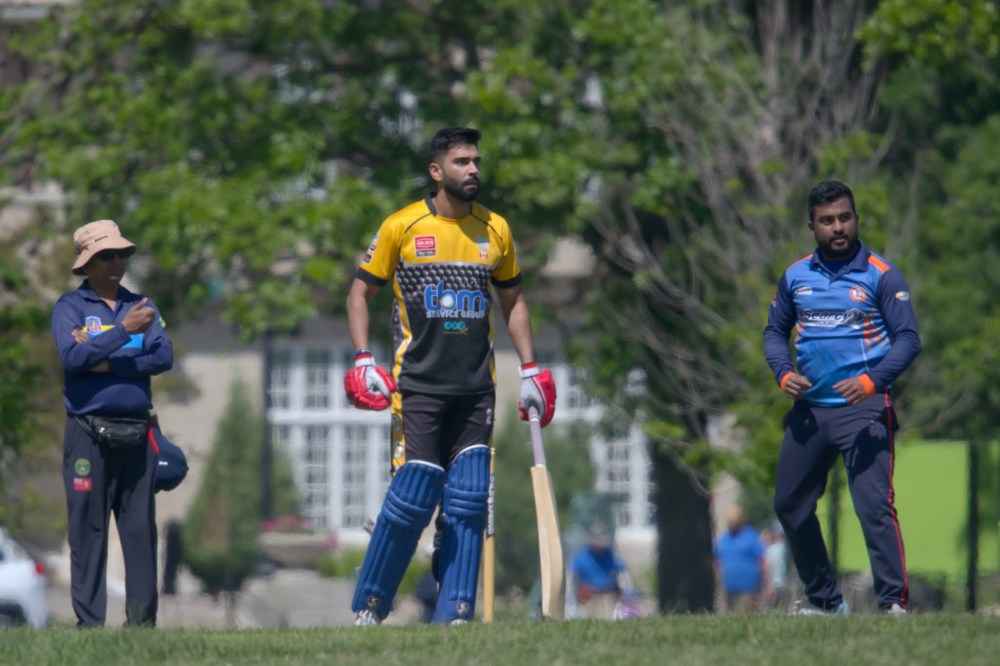
● An inning in cricket is a team’s batting time. An inning ends when 10 of the 11 batsmen are out, or when a set number of overs is reached. After an inning, team’s swap roles and the batting team becomes the fielding team.
Pro cricket has three main formats:
1. Test matches: played over five days with two innings per team. There are no over limits.
2. One Day Internationals (ODI): Each team gets a single inning lasting a maximum of 50 overs (300 total balls per team).
3. Twenty20 (T20): a shorter, fast-paced game where each team bats for only 20 overs (120 balls), which usually lasts between three to four hours.
● And, of course, the team with the most points wins the match.

Our newsroom depends on a growing audience of readers to power our journalism. If you are not a paid reader, please consider becoming a subscriber.
Our newsroom depends on its audience of readers to power our journalism. Thank you for your support.
Our newsroom depends on a growing audience of readers to power our journalism. If you are not a paid reader, please consider becoming a subscriber.
Our newsroom depends on its audience of readers to power our journalism. Thank you for your support.

Advertisement Advertise With Us
Advertisement Advertise With Us