

F1 leaders agree to make engine design change for 2027 season
Advertisement
Read this article for free:
or
Already have an account? Log in here »
To continue reading, please subscribe:

Digital Subscription
One year of digital access for only $205*
- Enjoy unlimited reading on winnipegfreepress.com
- Read the E-Edition, our digital replica newspaper
- Access News Break, our award-winning app
- Play interactive puzzles
*First annual payment billed as $205.00 + GST for one year. This annual subscription will automatically renew at $233.00 + GST every 52 weeks (10% off the regular annual price of $259.35). Offer available to new and qualified returning subscribers only. Cancel any time.
To continue reading, please subscribe:
Add Free Press access to your Brandon Sun subscription for only an additional
$1 for the first 4 weeks*
- Enjoy unlimited reading on winnipegfreepress.com
- Read the E-Edition, our digital replica newspaper
- Access News Break, our award-winning app
- Play interactive puzzles
*Your next Brandon Sun subscription payment will increase by $1.00 and you will be charged $17.95 plus GST for four weeks. After four weeks, your payment will increase to $24.95 plus GST every four weeks.
Read unlimited articles for free today:
or
Already have an account? Log in here »
PARIS (AP) — Formula 1 leaders have agreed to an engine design change for 2027 that will slightly increase internal combustion output.
F1 started the year with big changes including a 50-50 split in power between a traditional engine and the onboard battery pack, but driver criticism was immediate.
Governing body the FIA said it met with teams and F1 officials in an online session Friday and that the changes were agreed in principle.
“The measures agreed in principle today for 2027 would see a nominal increase in internal combustion engine (ICE) power by (tilde)50kW alongside a fuel-flow increase and a nominal reduction of the energy recovery system (ERS) deployment power by (tilde)50kW,” the FIA statement said.
The changes, it added, will be “intuitive for drivers and teams.”
After just three grands prix this season, tweaks were made that slightly curbed the influence of the electrical power. They answered driver criticism by promoting pure driving skill over electrical recharging, especially in qualifying.
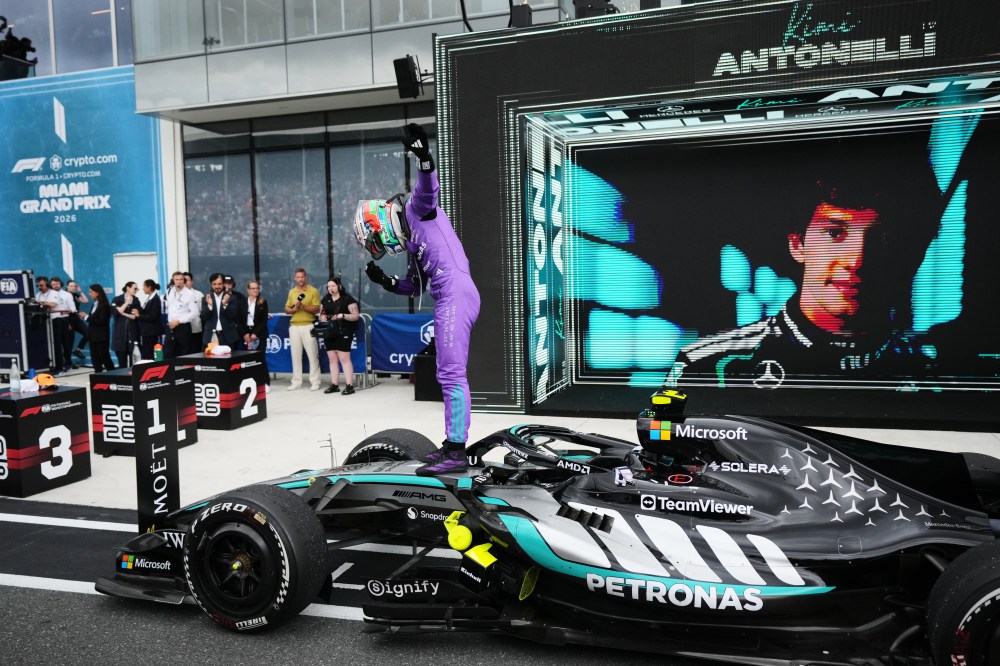
Last weekend’s Miami Grand Prix was the first under those changes. Sunday’s race was one of the most wide open in recent F1 history with drivers from four different teams leading before Kimi Antonelli took his third win of 2026 for Mercedes.
F1 has used V6 engines with electrical hybrid power since 2014 and an increase in the amount of electrical power has forced drivers to adjust. Timing the electrical boost and recharging is the key to tactical racing. Four-time world champion Max Verstappen loathes it so much he’s questioned his future in F1.
The FIA said Friday’s session began with a review of the changes put in place before Miami.

“The conclusion from the deployment of modifications in Miami, designed to improve safety and reduce excessive harvesting, was that they resulted in improved competition and were a step in the right direction,” it said.
“Evaluation of the Miami package is ongoing with a view to the introduction of further adjustments at future events.”
Next on the calendar is the Canadian Grand Prix on May 24.
___
AP auto racing: https://apnews.com/hub/auto-racing