

Pitch clock coming for spring training games
Advertisement
Read this article for free:
or
Already have an account? Log in here »
To continue reading, please subscribe:

Digital Subscription
One year of digital access for only $205*
- Enjoy unlimited reading on winnipegfreepress.com
- Read the E-Edition, our digital replica newspaper
- Access News Break, our award-winning app
- Play interactive puzzles
*First annual payment billed as $205.00 + GST for one year. This annual subscription will automatically renew at $233.00 + GST every 52 weeks (10% off the regular annual price of $259.35). Offer available to new and qualified returning subscribers only. Cancel any time.
To continue reading, please subscribe:
Add Free Press access to your Brandon Sun subscription for only an additional
$1 for the first 4 weeks*
- Enjoy unlimited reading on winnipegfreepress.com
- Read the E-Edition, our digital replica newspaper
- Access News Break, our award-winning app
- Play interactive puzzles
*Your next Brandon Sun subscription payment will increase by $1.00 and you will be charged $17.95 plus GST for four weeks. After four weeks, your payment will increase to $24.95 plus GST every four weeks.
Read unlimited articles for free today:
or
Already have an account? Log in here »
Hey there, time traveller!
This article was published 17/02/2019 (2764 days ago), so information in it may no longer be current.
WEST PALM BEACH, Fla. – Major League Baseball is unilaterally starting the use of pitch clocks for spring training games, while brushing off complaints from players about the slow free agent market.
With the sport looking for ways to speed the pace of play, pitchers generally will have 20 seconds to deliver to the plate when teams play exhibition games in Arizona and Florida beginning this week. The intention is to get players and umpires accustomed to the clock in the event MLB makes the rule change for the upcoming regular season.
“We will start getting ready for the possibility that we’re going to use the pitch clock on opening day,” Commissioner Rob Manfred said Sunday at spring training media day in Florida. “We have to get going.”
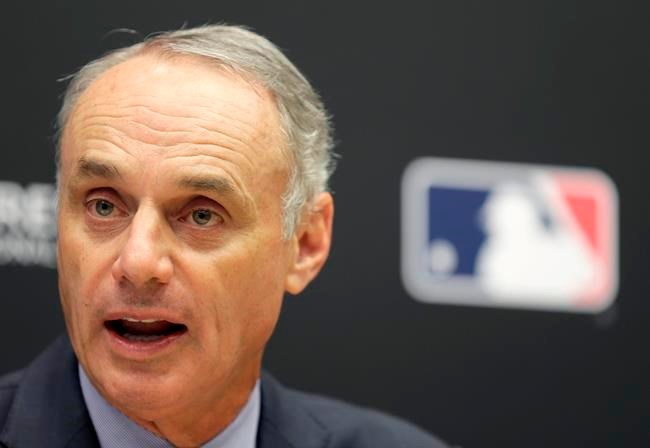
After the 2016 and 2017 seasons, players rebuffed management’s proposal for a pitch clock. Owners have the right to implement one this year without consent, but Manfred has been reluctant to initiate on-field modifications without agreement from players and their union head, Tony Clark.
“We’re still hopeful that we’re going to make an agreement with Tony on pace-of-play initiatives,” Manfred said. “I just think that whether it’s by agreement or otherwise, the only prudent course for us at this point is to be in a position to proceed if in fact we have an agreement or decide to do it … under our collectively bargained right to do that.”
MLB made a unilateral decision on clocks for the exhibition season.
“We were recently notified by the commissioner’s office that the pitch clock will be tested in spring games,” the players’ association said in a statement. “This is not the result of an agreement with the players’ association. Discussions regarding several on- and off-field issues remain ongoing.”
Manfred said the rules involving the clock will be “phased in” and won’t start immediately with ball and strike calls. But there will be a “functional” clock in Grapefruit League and Cactus League games. Management’s proposals have said a clock would not be used after foul balls.
Pitch clocks have been used in the high minors since 2015.
With spring training underway and exhibitions scheduled to start Thursday, several players around the majors have taken issue with a second consecutive slow market for free agents. They question why more teams aren’t trying to win.
“It would be nice to start with the facts on this topic. There has been no meaningful change in the distribution of winning percentages in Major League Baseball,” Manfred said. “Our teams are trying. Every single one of them wants to win. It may look a little different to outsiders because the game has changed, the way that people think about the game, the way that people think about putting a winning team together has changed, but that doesn’t mean they’re not trying.”
Two of the game’s biggest stars, Bryce Harper and Manny Machado remain unsigned — along with closer Craig Kimbrel and dozens of other accomplished veterans.
“There are 11 players who had a WAR (wins above replacement) above 1 last year that are unsigned. I believe that just like last year, that market is going to clear. At some point here in the next few weeks, those players are going to get signed,” Manfred said. “We negotiated a system that allows the market to operate and I have every confidence that for those players that I just described, that market is going to clear before we get to playing real games.”
The current economy for players is all part of the game, he insisted.
“I think it’s important to remember that the Major League Baseball Players Association has always wanted a market-based system. And, markets change. Particularly when the institution around those markets change. We’ve had a lot of change in the game. People think about players differently. They analyze players differently. They negotiate differently. Agents negotiate differently,” Manfred said.
“I think there’s lots and lots of offers out there and it’s a bilateral process. Players haven’t accepted those offers yet. That’s how a market works. So you know, we bargained for a market system, that market’s out there operating, and I don’t have any choice but to live with that right now.”
Manfred said just because clubs don’t spend big doesn’t mean they aren’t attempting to win.
He pointed out that Oakland and Tampa Bay, two low-payroll clubs expected to struggle in 2018, both had excellent seasons. The Athletics reached the playoffs with 97 wins, and the Rays won 90 games.
“I reject the notion that payroll is a good measure for how much a team is trying or how successful that team is going to be,” he explained.

That drew the ire of Houston Astros ace Justin Verlander, who tweeted: “Agreed… finally we’re on the same page! Awesome! Removal of the luxury tax it is.”
___
AP Baseball Writer Ronald Blum contributed to this rpeort.
___
More AP MLB: https://apnews.com/MLB and https://twitter.com/AP_Sports
Related Articles
Rangers SS Andrus in much different spot with Beltre retired




Advertisement Advertise With Us
Advertisement Advertise With Us