

MLB players, owners start collective bargaining, 6 1/2 months ahead of contract’s expiration
Advertisement
Read this article for free:
or
Already have an account? Log in here »
To continue reading, please subscribe:

Digital Subscription
One year of digital access for only $205*
- Enjoy unlimited reading on winnipegfreepress.com
- Read the E-Edition, our digital replica newspaper
- Access News Break, our award-winning app
- Play interactive puzzles
*First annual payment billed as $205.00 + GST for one year. This annual subscription will automatically renew at $233.00 + GST every 52 weeks (10% off the regular annual price of $259.35). Offer available to new and qualified returning subscribers only. Cancel any time.
To continue reading, please subscribe:
Add Free Press access to your Brandon Sun subscription for only an additional
$1 for the first 4 weeks*
- Enjoy unlimited reading on winnipegfreepress.com
- Read the E-Edition, our digital replica newspaper
- Access News Break, our award-winning app
- Play interactive puzzles
*Your next Brandon Sun subscription payment will increase by $1.00 and you will be charged $17.95 plus GST for four weeks. After four weeks, your payment will increase to $24.95 plus GST every four weeks.
Read unlimited articles for free today:
or
Already have an account? Log in here »
NEW YORK (AP) — Negotiators for baseball players and owners began what figures to be lengthy and acrimonious collective bargaining negotiations Tuesday to replace their labor contract that expires Dec. 1, with management likely to propose a salary cap system the union has vowed never to accept.
An initial session took place at the office of the Major League Baseball Players Association, a five-minute walk from Major League Baseball’s headquarters in Manhattan’s Rockefeller Center. The meeting lasted about two hours and was scheduled for initial presentations from each side on their view of the sport and its economics. No proposals were made.
Players who attended included Mets infielder Marcus Semien, a member of the union’s eight-man executive subcommittee, along with Mets teammates Clay Holmes, David Peterson, Austin Slater and Sean Manaea. Several Detroit Tigers players, who were in town to play the Mets, also were at the meeting and additional players joined via video conference.
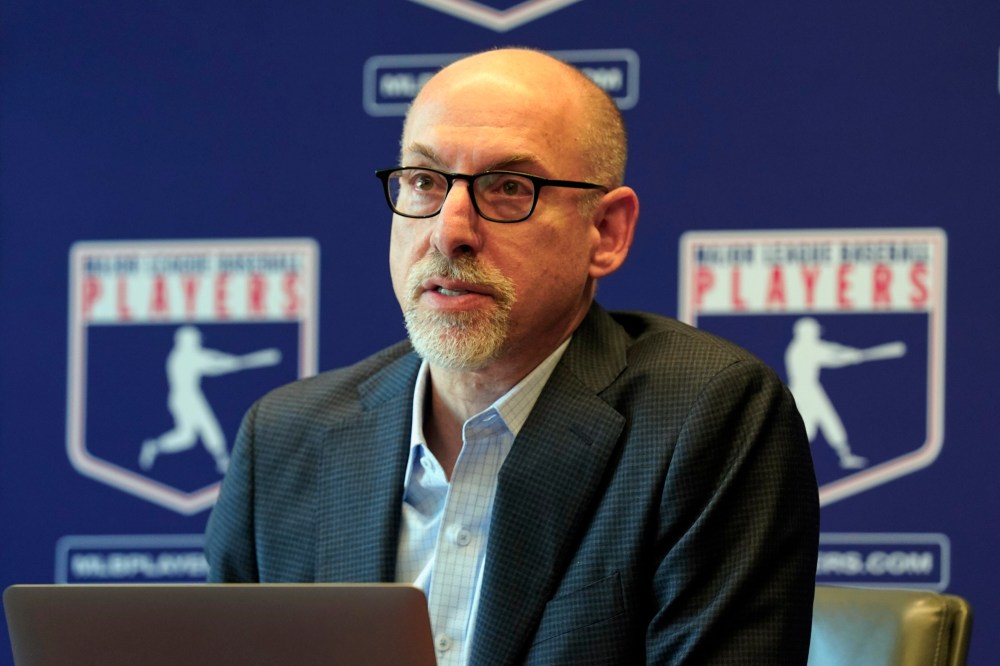
“It’s the first one I’ve been at, so I don’t really have much to compare it to,” Holmes said. “It was just kind of initial meetings, first time the sides were getting together and kind of sharing their thoughts on kind of where they thought things were at and what they thought was best for kind of the game moving forward.”
The sport’s five-year labor contract expires Dec. 1, and baseball Commissioner Rob Manfred has said repeatedly that management prefers offseason lockouts to in-season strikes, aiming to prevent the loss of regular-season games. Baseball has not lost regular-season games to a work stoppage since a 7 1/2-month strike in 1994-95 that caused the first cancellation of the World Series in 90 years.
Talks for the last agreement began in April 2021 and ended with a deal on March 10, 2022, that preserved the 162-game schedule only after the sides bargained past several deadlines and Manfred announced the cancellation of 184 games, which were restored.
Bruce Meyer will lead negotiations for the union, as he did in 2021-22, but in his new role as interim union head. He moved up from deputy director in February after the forced resignation of Tony Clark, a former All-Star first baseman who took over following the death of Michael Weiner in 2013.
Deputy Commissioner Dan Halem heads MLB’s negotiations team, as he did in talks for the previous two agreements.
MLB and Meyer declined to comment on the session.
“I think just player engagement as a whole, it just seems like there’s a lot of it right now,” Holmes said. “Guys are wanting to hear and guys are wanting to be there and so, just to be able to kind of be there and pass along things that you may see or learn or just have conversations there.”
Some major league owners have said a salary cap system that also contains a floor is needed and would improve the sport. MLB, unlike the NFL, NBA and NHL, has not had a cap system but since 2003 has had a luxury tax designed to slow spending.
“When I talk to the players, I don’t try to convince them that a salary cap system would be a good thing,” Manfred told the Baseball Writers’ Association of America last summer. “I identify a problem in the media business and explain to them that owners need to change to address that problem. I then identify a second problem that we need to work together and that is that there are fans in a lot of our markets who feel like we have a competitive balance problem.”
Restraints had not appeared to have had much impact on the Los Angeles Dodgers and New York Mets in recent years. The Dodgers shattered MLB’s spending records with a combined $515 million in payroll and luxury tax last year en route to their second straight World Series title, according to final figures compiled by the commissioner’s office, and Los Angeles is projected for the highest total again in 2026. The ratio of the five highest spenders to the five lowest increased from 3.6 in 2021 to a record-high 4.7 last year.
The union maintains a cap system decreases spending on players, while management argues a cap and a floor would benefit most players.

Players increased their potential war chest of cash and investments ahead of collective bargaining to $415 million heading into 2026. MLB also has been accumulating cash ahead of bargaining, about $75 million per club in withheld central fund distributions.
___
AP Baseball Writer Mike Fitzpatrick contributed to this report.
___
AP MLB: https://apnews.com/mlb
Related Articles
Yankees lefty Max Fried pulled from his start at Baltimore after only 3 innings with a sore elbow






Advertisement Advertise With Us
Advertisement Advertise With Us