

Faster than hockey, you say?
City hosting ringette nationals
Advertisement
Read this article for free:
or
Already have an account? Log in here »
To continue reading, please subscribe:
Monthly Digital Subscription
$1 per week for 24 weeks*
- Enjoy unlimited reading on winnipegfreepress.com
- Read the E-Edition, our digital replica newspaper
- Access News Break, our award-winning app
- Play interactive puzzles
*Billed as $4.00 plus GST every four weeks. After 24 weeks, price increases to the regular rate of $19.95 plus GST every four weeks. Offer available to new and qualified returning subscribers only. Cancel any time.
Monthly Digital Subscription
$4.99/week*
- Enjoy unlimited reading on winnipegfreepress.com
- Read the E-Edition, our digital replica newspaper
- Access News Break, our award-winning app
- Play interactive puzzles
*Billed as $19.95 plus GST every four weeks. Cancel any time.
To continue reading, please subscribe:
Add Free Press access to your Brandon Sun subscription for only an additional
$1 for the first 4 weeks*
*Your next subscription payment will increase by $1.00 and you will be charged $16.99 plus GST for four weeks. After four weeks, your payment will increase to $23.99 plus GST every four weeks.
Read unlimited articles for free today:
or
Already have an account? Log in here »
Hey there, time traveller!
This article was published 04/04/2018 (2907 days ago), so information in it may no longer be current.
This is a column about ringette.
Wait — come back!
Let’s try again — this is a column about amateur female athletes.
Wait — come back!
One more time: this is an underdog story about a bunch of bad-ass Canadian girls and women who don’t care what anyone else thinks and are keeping alive a quirky Canadian sport despite long odds — and the full weight of the hockey industrial complex — against them.
Finally hooked you? Good. Now, I want you to meet someone.
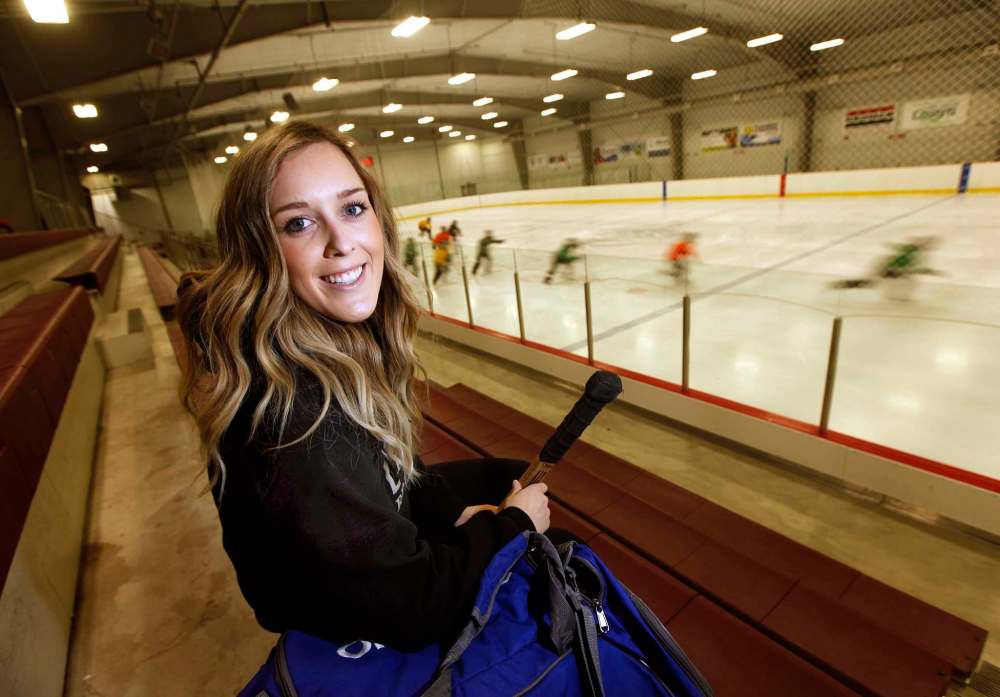
Samantha Sampano could have played women’s hockey. She probably could have played it a high level. She’s been told she probably could have even parlayed it into a scholarship to a big Canadian or American university. Who knows — maybe with a few breaks, she could have even played for Canada at a Winter Olympics.
But Sampano didn’t do any of those things because the 25-year-old Winnipegger chose instead to play at the highest level of ringette, a sport that has none of hockey’s scholarships and no medal status at the Olympics but continues to exist because tens of thousands of Canadian girls and women prefer a sport that does not require a modifying adjective for them to play it.
“I have always been proud of the fact that in women’s hockey, they are always playing ‘women’s’ hockey, never just hockey,” Sampano, 25, who plays with the Manitoba Intact of the National Ringette League and will represent her home province at the upcoming Canadian Ringette Championships in Winnipeg, told me this week.
“In ringette, we are never second to men.”
Put another way, in an age of #MeToo, ringette remains for women in this country what it has always been — #MeFirst.
Right up there with crokinole for its uniquely Canadian quirkiness, ringette was invented in North Bay, Ont., in 1963 by a guy named Sam Jacks, a local recreation director who wanted to give Canadian girls who weren’t allowed to play hockey at that time a winter sport of their own.
If hockey didn’t want them, ringette did and for decades afterward in this country, we segregated our kids at birth: boys to hockey, girls to ringette.
That built some deep loyalties in Canadian homes from coast to coast, which partly explains why 20 years after women’s hockey made its debut as a full medal Olympic sport in Nagano, there are as of this winter still 30,717 women in this country — and 2,565 in this province — who continue to refuse to attach a blade to their sticks or fill the hole in the middle of their weird-looking pucks.
Now, that’s still less than one-half of the 86,295 registered women’s hockey players in Canada, according to the most recent IIHF numbers. And make no mistake, ringette took a big hit in this country after women’s hockey became an Olympic sport and universities and colleges all over the continent began setting up women’s hockey programs with scholarships attached.
Consider: in 1998, there were 10 registered ringette players in Canada — 25,951 — for every one registered women’s hockey players — 2,405. Today, that ratio is 2.5:1 — in the opposite direction.
But while ringette registrations in Canada declined in the immediate years after Nagano, they have recovered over the past decade and are slowly growing again to the point where registrations in ringette today are now about 20 per cent above where they were in 1998 when women’s hockey had its Olympic debut.
That’s slow progress and there’s still a lot of work to be done if ringette players such as Sampano are ever going to have anything like the perks women’s hockey players enjoy.
But they don’t need me to tell them that.
“I have been dreaming about the day that ringette is included in the Olympics since I was four years old. I think it’s every ringette player’s dream,” says Sampano. “It would really take our sport to the next level, although we have survived this long without it.
“(But) we need to make smaller strides first: bring ringette to more countries; a more recognized university league — there is currently just a University Cup; find funding…”
In some ways, ringette has the same challenge as women’s hockey — it’s only played at an elite level in two countries.
Women’s hockey is dominated by Canada and the U.S., the only two countries to win world championships and Olympic gold medals.
It’s a similar story in ringette, where the two international powerhouses are Canada and Finland, who have together won every world ringette championship ever contested. (Finland has eight world titles; Canadian teams have won four.)
Women’s hockey has gotten away with its parochialism because it’s hugely popular at the Winter Olympics and the big TV ratings force the IOC to ignore the fact they’re basically staging a hockey tournament for just two countries every four years.
But if ringette is going to grow in any serious way, the sport is first going to have to sell itself to the great big world that exists beyond the borders of Canada and Finland as a sport that stands on its own merit.
That case goes something like this: ringette is a better game than hockey.
I’ll wait here while you clean up that coffee.
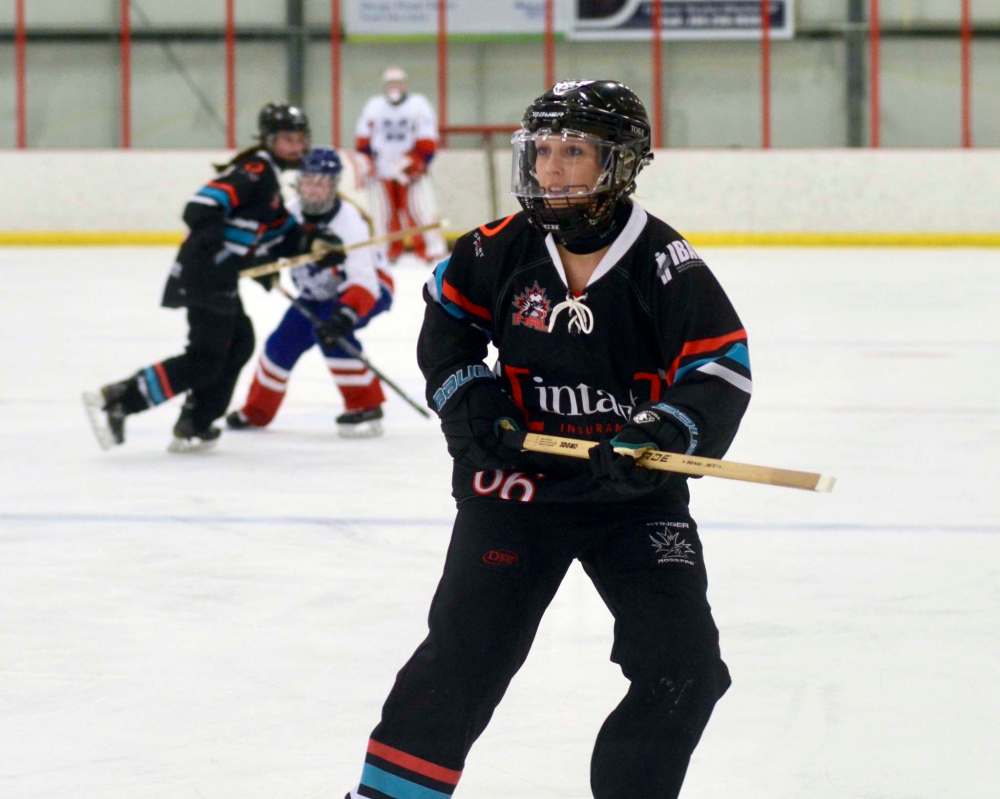
I’m serious: while both sports consist of five skaters and one goaltender, the rules of ringette make it a faster game than hockey and one that, as Sampano explains, has “better flow” thanks to a couple of unique rules.
Rule 1 is that players cannot carry the ring over either blue line, which makes for a lot more passing in ringette than hockey. But the biggest difference between hockey and ringette is that in ringette, rule 2 states that only three players from either team, plus the defending goalie, are allowed in the offensive zone, which puts a premium on speed, agility and playmaking.
Picture what NHL hockey looks like in overtime — ringette is always like that. Fun, right?
The one rap on ringette always used to be that with so much room to work in your opponent’s zone — and a ring that can be corralled with a bladeless stick in a way a puck cannot — the attacking team could skate and pass the ring among themselves forever until the defenders finally got exhausted.
But the sport addressed that problem in 2000 with the introduction of a 30-second shot clock.
Put it all together and ringette at its best today looks like the NHL in overtime, but with an NBA-like shot clock.
That makes for a great game to watch, but the challenge is most Canadians have never actually seen a ringette game, a problem that will be rectified locally next week when 47 of the country’s best teams descend on Winnipeg for the Canadian Ringette Championships.
“People really fall in love with the sport — they get intrigued — when they see high-level ringette being played,” says Sampano.
If it’s fun to watch, how much fun is it to play? Well, consider this: five decades after Jacks invented ringette as a winter sport for girls who weren’t being allowed to play hockey, there are 700 men in this country who are registered ringette players.
That’s just two per cent of the total, but it says something about the difference between the sexes that the same women who were once excluded from minor hockey programs in this country have welcomed the men into ringette with open arms.
As for Sampano, she’s now playing ringette and hockey.
She will be a part of the Manitoba Intact team that will represent this province next week in the premiere division at the Canadian Ringette Championships.

And in hockey? Well, Sampano has joined up with a former National Ringette League team called the Prairie Fire on a reconstituted hockey team that plays at the Canlan Ice Sports complex. “We are a top team in the Women’s A-Division,” says Sampano. “A group of ringette players!”
Great story, right?
Aren’t you glad you stuck around?
email: paul.wiecek@freepress.mb.caTwitter: @PaulWiecek