

This could get loud
Banjo Bowl has potential to set an all-time noise record
Advertisement
Read this article for free:
or
Already have an account? Log in here »
To continue reading, please subscribe:

Digital Subscription
One year of digital access for only $205*
- Enjoy unlimited reading on winnipegfreepress.com
- Read the E-Edition, our digital replica newspaper
- Access News Break, our award-winning app
- Play interactive puzzles
*First annual payment billed as $205.00 + GST for one year. This annual subscription will automatically renew at $233.00 + GST every 52 weeks (10% off the regular annual price of $259.35). Offer available to new and qualified returning subscribers only. Cancel any time.
To continue reading, please subscribe:
Add Free Press access to your Brandon Sun subscription for only an additional
$1 for the first 4 weeks*
- Enjoy unlimited reading on winnipegfreepress.com
- Read the E-Edition, our digital replica newspaper
- Access News Break, our award-winning app
- Play interactive puzzles
*Your next Brandon Sun subscription payment will increase by $1.00 and you will be charged $17.95 plus GST for four weeks. After four weeks, your payment will increase to $24.95 plus GST every four weeks.
Read unlimited articles for free today:
or
Already have an account? Log in here »
Hey there, time traveller!
This article was published 10/09/2011 (5481 days ago), so information in it may no longer be current.
It is perhaps most fitting that when the final history of Canad Inns Stadium is written, the superlatives will be reserved for the first and the final years of Winnipeg’s professional football facility.
The first year — 1953 — will stand alone as the only season that the building’s primary tenant, the Winnipeg Blue Bombers, sold out every single regular-season game. Eight times the Bombers played at what was then known as Winnipeg Stadium during that 1953 season — and eight times every single ticket in the house was sold.
And what now appears imminent — with yet another sellout already in the books for Sunday’s Banjo Bowl versus the Saskatchewan Roughriders — is that the final year of the stadium will also now likely stand alone as having the highest overall attendance in the 58-year history of the place.
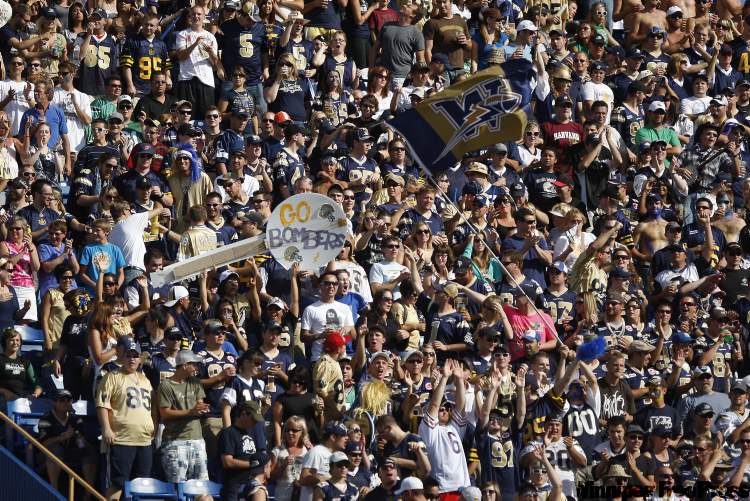
With an average attendance of 28,986 through five home dates this season, the Bombers are already drawing better than at any previous time in franchise history.
And that average will continue to grow. Sunday’s crowd for the annual Banjo Bowl will be in excess of 30,000 fans for the second straight game as the club has once again supplemented a regular sellout by also selling out temporary stands they installed last month to cope with the ticket demand.
Begging the obvious question Friday: Might Sunday’s game, with the stadium overflowing and the Bombers most reviled rival in town, be the loudest football game in Winnipeg history?
“I’m sure there’s going to be some Riders fans here, no?,” wondered Bombers head coach Paul LaPolice. “Some of them might have snuck over the border. I think it will be loud and I think it will be an enjoyable game.”
A similar overflow crowd is also now all but assured for the Bomber’s next home game after tomorrow — a Sept. 30 clash with East Division rival Montreal Alouettes.
Jerry Maslowsky, the Bombers vice-president of marketing, said Friday there are just a few hundred seats remaining — all of them singles — for that game, which is still three weeks away.
And it already looks like it will be more of the same in October when the Bombers play their final two regular-season home games at Canad Inns Stadium before moving to a new facility on the grounds of the University of Manitoba next year. Maslowsky said over 25,000 tickets to the Oct. 22 game against Montreal have already been sold and over 23,000 tickets have been sold to the final home game of the season, Oct. 28 versus the Toronto Argonauts.
“This is an absolute pinnacle moment in the history of this football team,” Maslowsky said. “With us moving into the new stadium next year and what’s been happening with ticket sales this season, I can’t recall a more exciting time to be around here. And before I started this job, I’d been a fan of this team for many, many years.”
Should the Bombers sell out the rest of the season, which is entirely conceivable and probably even likely given the current sales numbers, they will have sold out seven of nine regular-season home games this season.
To put that number in perspective, consider that including Sunday’s Banjo Bowl, the Winnipeg Blue Bombers have sold out just 73 games in the entire history of Winnipeg Stadium, meaning the club has a chance to generate almost 10 per cent of those sellouts in this season alone.
That would be a remarkable achievement in a facility which is long since past its best before date and which has not hosted a championship winning football team for two decades and counting.
The big crowds this season, just like they did way back in 1953, have delivered lasting memories.
The question as we head into fall is whether this remarkable Bombers team will reward them by delivering the most lasting memory of all — a championship.
paul.wiecek@freepress.mb.ca
Top seven all-time average attendance totals at Canad Inns Stadium
1. 2011 (through five home games) — 28,986
2. 1985 — 28,739
3. 1982 — 28,596
4. 1984 — 28,321
5. 2001 — 28,089
6. 1991 — 27,757
7. 2007 — 27,701
Most sellouts in a single season
1. 1953 — 8
2. 1972 — 7
3. 2007 — 5
4. 1975, 1977, 2011 — 4
Number of sellouts from 1978-2000 inclusive — 10
Number of sellouts this season (including Sunday) — 4
A brief timeline of Winnipeg Stadium
Winnipeg Stadium underwent multiple major renovations in its history. Here’s a quick timeline:
1953 — Stadium opens. Original capacity is 16,411.
1954 — Stadium expanded to 17,995.

1966 — Stadium expanded again with addition of north end zone seats.
1972 — Upper deck added to west side, adding 4,300 more seats.
1978 — Upper deck added to east side, adding 4,800 more seats, bringing total capacity to 32,946.
1987 — Stadium reconfigured to accommodate baseball, total capacity hits peak of 33,675.
1999 — Retrofit undertaken for 1999 Pan Am games; bench seats in grandstands replaced with regular seats, capacity drops to 29,533.
Related Articles
Roughriders pound Bombers in Banjo Bowl








Advertisement Advertise With Us
Advertisement Advertise With Us