

Concussion? Who me?
Players routinely ignore symptoms, lie to doctors to keep playing
Advertisement
Read this article for free:
or
Already have an account? Log in here »
To continue reading, please subscribe:

Digital Subscription
One year of digital access for only $205*
- Enjoy unlimited reading on winnipegfreepress.com
- Read the E-Edition, our digital replica newspaper
- Access News Break, our award-winning app
- Play interactive puzzles
*First annual payment billed as $205.00 + GST for one year. This annual subscription will automatically renew at $233.00 + GST every 52 weeks (10% off the regular annual price of $259.35). Offer available to new and qualified returning subscribers only. Cancel any time.
To continue reading, please subscribe:
Add Free Press access to your Brandon Sun subscription for only an additional
$1 for the first 4 weeks*
- Enjoy unlimited reading on winnipegfreepress.com
- Read the E-Edition, our digital replica newspaper
- Access News Break, our award-winning app
- Play interactive puzzles
*Your next Brandon Sun subscription payment will increase by $1.00 and you will be charged $17.95 plus GST for four weeks. After four weeks, your payment will increase to $24.95 plus GST every four weeks.
Read unlimited articles for free today:
or
Already have an account? Log in here »
Hey there, time traveller!
This article was published 04/10/2012 (5089 days ago), so information in it may no longer be current.
For all the heightened awareness these days surrounding the dangers of concussions, the fact is many football players continue to regard brain injuries as just another part of the job in an intensely physical game.
In an extraordinarily frank interview following his team’s light practice at Canad Inns Stadium on Wednesday, all-star slotback Terrence Edwards discussed a “win at all costs” attitude that continues to permeate football and leads athletes such as himself to play through head trauma — and even lie to the team’s doctors — in service of victory.
“I think that we think about the short-term goal instead of the long-term goal. Right now, you want to play. You feel like you can still play even if it jeopardizes your long-term status,” said Edwards, who’s in his eighth CFL season.

“I’ve been in positions where I might not always have been right (healthy) but I didn’t say anything because I wanted to continue to play because I wanted to help my team win. I think every guy has been a little woozy at some time — probably sustained some small or mild concussion — and you (leave the game), you get some water and you go back in…
“People call us gladiators and all that. I really don’t use those terms. But it’s like that. You’re going to do whatever it takes at all costs to win. Even if that means lying to the doctors, that’s what you’re going to do.”
Indeed, Edwards even took it a step further, citing his faith and describing what sounds like a sense of mission.
“This is what you do. This what God put you on this earth to do. I think he put me on this earth to be an athlete. He gave me a talent to do it and at the end of the day, we’re going to go out and do everything we can to win and win at all costs. I know even myself, I’ve been a little woozy and got up and shook it off.”
And if not in service to God, offensive lineman Glenn January described a sense of obligation to the overall good of the group in describing how players will subjugate their own health interests to the broader needs of the team, even if that team is 3-10 and dead last in the CFL right now.
“We make a lot of sacrifices, obviously,” said January.
“We have a job to do. I’m paid to go out there and block people. And I’m paid to come to work and practise hard. And you can’t let a record dictate that… At a certain point, whenever the season does get difficult, character comes out. And I feel like difficult situations — sometimes you can learn from them.”
Edwards says he’s had two concussions that have caused him to miss action — once in the CFL and the other time during a brief stint in the NFL. But, perhaps illustrating the extent to which players hide their head injuries, Edwards was coy when asked if those two concussions are the only ones he’s had.
“Documented, yeah,” said Edwards.
Prompted to expand on that comment, Edwards offered a definition of concussions that would probably alarm any doctor.
“You get woozy, but if it’s not to the point of being knocked out or you can’t remember, then you’re going to keep playing. I know people hit the ground all the time and you see spots and you’re a little off, but they’re not going to come out of the game.
“If it’s significant enough, everyone is going to come out of the game.”
Of course, only the sufferer knows how significant it is — and if he isn’t honest with the medical people, then it remains a secret.
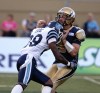
There have been conflicting versions, for instance, on whether Bombers quarterback Buck Pierce was suffering a headache immediately after he sustained a vicious helmet-to-chin hit from Toronto Argonauts linebacker Brandon Isaac last Saturday, or whether the headache didn’t start until after he went back into the game.
Bombers head coach Tim Burke said there is little reason for players in the current environment not to be comfortable telling medical staff the truth about their conditions.
“A lot more comfortable today than they were when I was playing,” said the 58-year-old Burke. “Back then, they told you to tape an Aspirin to your ankle and get back out there. It’s a totally different mindset today than it was back in the days of leather helmets.”
Maybe. Maybe not.
paul.wiecek@freepress.mb.ca
NHL’S CONCUSSION PROTOCOL
The NHL uses the SCAT2 neuropsychological test and as of 2011, has mandated that it, and a thorough exam of a player with a suspected concussion, be removed from the bench and sent to a quiet place, free from distraction, for the examination by a physician, not a trainer alone.
Symptoms include loss of consciousness, motor inco-ordination or balance problems, a blank or vacant look, being slow to get up after a hit to the head, disorientation, clutching of the head after a hit or visible facial injury in combination with another symptom.
Player must be free of all symptoms and return to baseline at rest before return to play is allowed.
Players must undergo baseline before contact.
A player’s recovery is monitored over time referring to the initial baseline test, mandating a gradual increase in activity in steps; each must be symptom-free to progress to the next and eventual return to play.
NFL’S CONCUSSION PROTOCOL
Mandates a hybrid, NFL-developed three-pronged sideline exam — a cognitive test, neurological test, by athletic trainer or doctor examining eye movement and other physical symptoms, and a balance test.
Players who exhibit any of six obvious signs are to be disqualified from game or practice and cannot return to any play until cleared by team physician and independent neurologist.
Includes the Madden Rule, which requires any player diagnosed with concussion to be escorted to the locker-room and remain there under observation, if he does not require hospitalization. No return to the field under any circumstances; no exceptions.
A third game directive, “When it doubt, leave them out, to always err on the side of caution.” (NFL health and safety memo).
The league also requires a certified athletic trainer in the press-box to monitor games for possible head injuries.
CFL’S CONCUSSION PROTOCOL

As of 2010, all teams must follow SCAT2, including prior baseline testing.
All player-concussion assessments are left solely and strictly in the hands of team medical personnel and therapists; coaches have no influence over when an athlete is to be cleared to play.
— Tim Campbell
Related Articles
Burke has a heart-to-heart talk with players





Advertisement Advertise With Us
Advertisement Advertise With Us