

Tiger has 14 clubs in bag, 1,400 shots
He tries things no other PGA Tour player would even dream of
Advertisement
Read this article for free:
or
Already have an account? Log in here »
To continue reading, please subscribe:

Digital Subscription
One year of digital access for only $205*
- Enjoy unlimited reading on winnipegfreepress.com
- Read the E-Edition, our digital replica newspaper
- Access News Break, our award-winning app
- Play interactive puzzles
*First annual payment billed as $205.00 + GST for one year. This annual subscription will automatically renew at $233.00 + GST every 52 weeks (10% off the regular annual price of $259.35). Offer available to new and qualified returning subscribers only. Cancel any time.
To continue reading, please subscribe:
Add Free Press access to your Brandon Sun subscription for only an additional
$1 for the first 4 weeks*
- Enjoy unlimited reading on winnipegfreepress.com
- Read the E-Edition, our digital replica newspaper
- Access News Break, our award-winning app
- Play interactive puzzles
*Your next Brandon Sun subscription payment will increase by $1.00 and you will be charged $17.95 plus GST for four weeks. After four weeks, your payment will increase to $24.95 plus GST every four weeks.
Read unlimited articles for free today:
or
Already have an account? Log in here »
Hey there, time traveller!
This article was published 16/06/2009 (6280 days ago), so information in it may no longer be current.
FARMINGDALE, N.Y. — While a few of his rivals are still sleeping, the best player in the world keeps getting better.
Not by the usual leaps and bounds, the length of a fairway, nor even a few feet.
Today we’re talking millimetres.
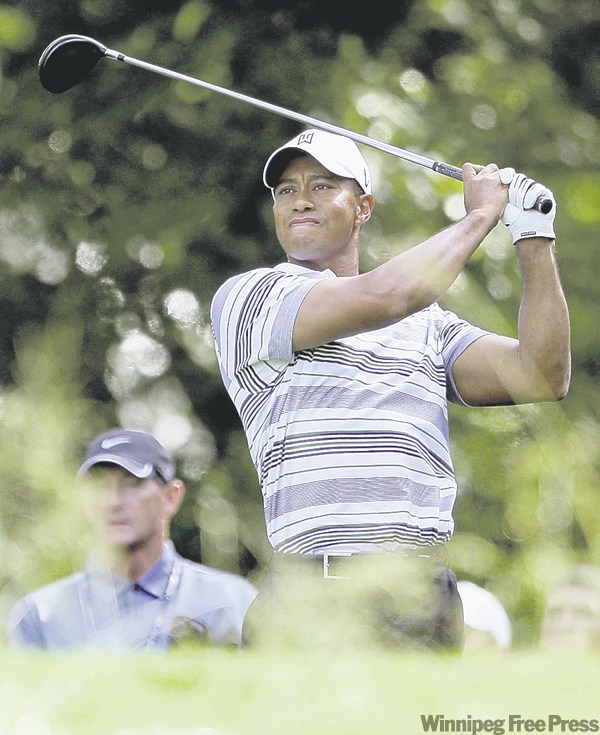
Tiger Woods is standing behind the practice green in front of the clubhouse early Monday at Bethpage Black, lining up golf balls tight against the collar of rough surrounding the putting surface. His tee time is still three days off.
Woods has already played nine holes, putted for a half-hour and hit two dozen chips out of the thick stuff. This last bit of practice is to settle on what kind of shot he wants to hit if one of his approaches rolls off a green and nestles up against the 2-inch high collar. It’s a scene only a golf junkie could love.
Woods first tries “blading” the shot — using the leading edge of his wedge to strike the ball and start it rolling like a putt. Then he tries a more conventional chip, popping the ball softly in the air. As Woods realizes there’s a danger he might hit the ball a second time, even as it’s taking off, he modifies his swing, quickly pulling the club back a heartbeat after striking the ball.
It requires the kind of strength and dexterity few possess. But the same guy who can stop his driver dead in the middle of his downswing — something Woods does on tee boxes when he hears a hummingbird take off two fairways over — makes it look easy.
Hank Haney, Woods’ coach, watches nearby with his arms crossed and a quizzical smile. Woods takes in Haney’s reaction and responds with an embarrassed smile of his own. Then he offers, almost defensively, “It’s like T.C. Chen.”
Chen was a Taiwanese golfer who came out of nowhere to grab the lead at 1985 U.S. Open. At the fifth hole on the final day, he tried to chip from brutal greenside rough, popped the ball straight up, then hit it a second time when it was thigh-high. A penalty stroke was added to the two he’d already wasted on that fateful shot, leading to a quadruple-bogey 8 and a second-place finish.
While T.C. actually stood for Tze-Chung, he was immortalized in golf lore as “Two-Chip” Chen.
Woods’ place in golf lore is already secure, but it hasn’t dulled his competitive edge. Like nearly all the other parts of his foundation, Woods’ desire was unveiled as a kid and carefully nurtured by his father, Earl, a former Green Beret who died in 2006.
Earl was never one to waste a teaching moment, and during a phone conversation almost a decade ago, he recalled watching a Los Angeles Lakers game with his son:
“I used to tell Tiger, ‘You watch Magic next year and he’ll have at least one new shot.’ We would watch them next year, and Tiger would look for the shot Magic had been working on all summer. And he’s never forgotten that.”
Woods continues to experiment with shots nobody else on tour would touch. He’s taken the “knockdown” — typically a mid- to short-iron shot that bores through the wind — and adapted it for use with his 3-wood. He’s got one wedge shot with a stiff-armed swing that turns left upon landing, another where he cuts sharply across the ball to make it go right. All that’s missing are turn signals on his golf bag.

Woods developed those skills playing alongside his father when he was young. He wasn’t strong enough to hit his approach shots over a hazard in the distance, so he learned to carve out a path around them instead. He expanded that arsenal under former coach Butch Harmon, but since hooking up with Haney in 2004, he’s delved even deeper into the mechanics of the swing. The results have been so impressive the temptation to expand it further continues to this day.
Calling Woods a quick study is almost redundant, which may be why he’s usually the one to poke holes in the idea. After he finished practice, he turned to two reporters standing nearby and struck up a conversation that wound its way to college athletes.
Woods told a few jokes about his struggles with calculus and physics during his freshman year at Stanford, then made fun of the notion that everything comes easy to him.
“Anybody who took a class with me there should send me a check,” Woods joked, “because I lowered the curve in every one.”
— The Associated Press
Related Articles
We need a Mickelson miracle This U.S. Open is all wet Tiger out of the running, but we'll still see each shot

Advertisement Advertise With Us
Advertisement Advertise With Us