

McIlroy was great, sure, but Open was a pushover
Advertisement
Read this article for free:
or
Already have an account? Log in here »
To continue reading, please subscribe:

Digital Subscription
One year of digital access for only $205*
- Enjoy unlimited reading on winnipegfreepress.com
- Read the E-Edition, our digital replica newspaper
- Access News Break, our award-winning app
- Play interactive puzzles
*First annual payment billed as $205.00 + GST for one year. This annual subscription will automatically renew at $233.00 + GST every 52 weeks (10% off the regular annual price of $259.35). Offer available to new and qualified returning subscribers only. Cancel any time.
To continue reading, please subscribe:
Add Free Press access to your Brandon Sun subscription for only an additional
$1 for the first 4 weeks*
- Enjoy unlimited reading on winnipegfreepress.com
- Read the E-Edition, our digital replica newspaper
- Access News Break, our award-winning app
- Play interactive puzzles
*Your next Brandon Sun subscription payment will increase by $1.00 and you will be charged $17.95 plus GST for four weeks. After four weeks, your payment will increase to $24.95 plus GST every four weeks.
Read unlimited articles for free today:
or
Already have an account? Log in here »
Hey there, time traveller!
This article was published 22/06/2011 (5507 days ago), so information in it may no longer be current.
BETHESDA, Md. — The most famous comeback in the U.S. Open began with a question from Arnold Palmer as he tried to explain how he could win in 1960 at Cherry Hills despite being seven shots behind.
“Doesn’t 280 always win the Open?” he asked.
The U.S. Open usually plays as a par 70, and four rounds at even par was 280. That once was the standard for winning the major known as the toughest test in golf. Even as Ken Venturi talked about his 1964 win at Congressional, he noted becoming only the second player in U.S. Open history to break 280.
This year, such a score was barely enough to be in the top 10.
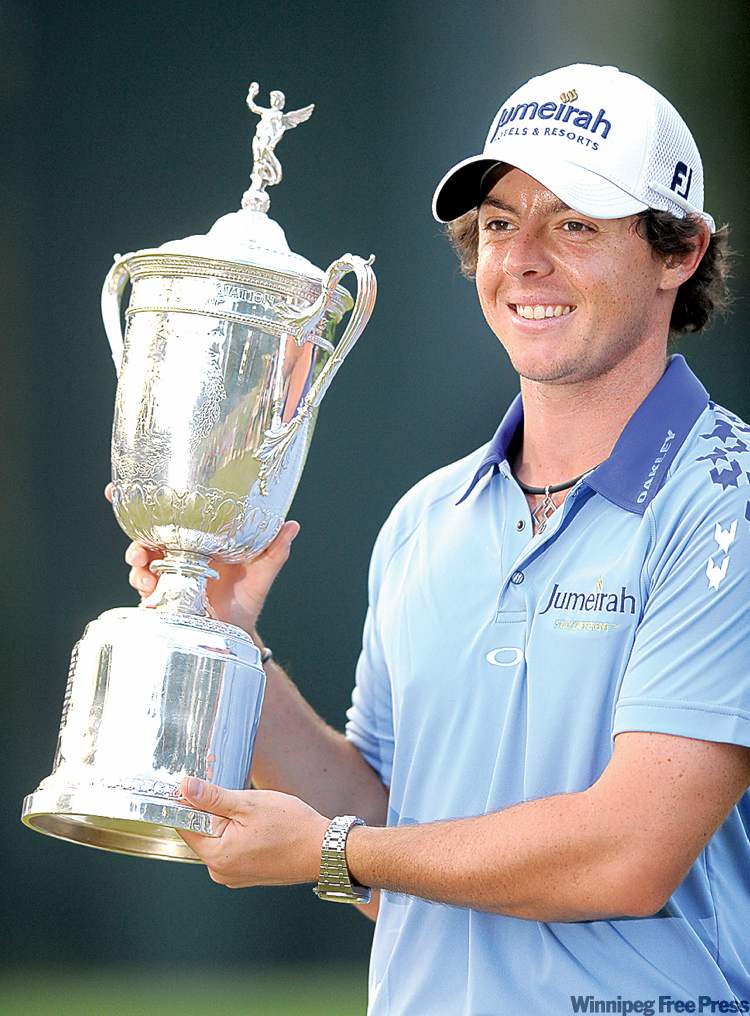
The 111th U.S. Open will be remembered foremost as the coming out party of Rory McIlroy, a supremely gifted 22-year-old from Northern Ireland. For all the records he broke, his most remarkable feat was making golf look easy. Few others can do that.
The other memory? All those red numbers on the scoreboard.
McIlroy finished at 16-under 268, two sets of numbers that are simply astounding for this major. The runner-up was Jason Day of Australia at 8-under, which would have been enough to win 46 of the previous 50 U.S. Opens and force a playoff in three others.
This was as easy as a U.S. Open gets.
“I don’t want to say anything to cheapen what Rory did, because if this were an old-school U.S. Open, he might have won by more,” said Andy North, a two-time winner of the “old-school” U.S. Open. “But he hit seven wedges into the green on the front nine. I guarantee you that’s never happened in a U.S. Open.”
Even USGA executive director Mike Davis said Congressional was a pushover.
“From 1 to 10 — with 1 being the easiest and 10 being the hardest — I’m not so sure Congressional wouldn’t have been a 1 or a 1 1/2,” Davis said Tuesday. “If we had another 10 U.S. Opens there, I don’t know how it would play any easier.”
That wasn’t an indictment of Congressional, but the hand the USGA was dealt.
Overnight rain kept the greens soft. Pitch marks returned to the U.S. Open. There was rarely more than a breeze all four days. And most curious of all, Davis said the rough didn’t grow.
“Even though the height of rough should have been enough, it wasn’t,” he said.

This isn’t the first time the turf was soft for a major designed to be hard.
It was like that at Baltusrol in 1980, when Jack Nicklaus and Tom Weiskopf both opened with rounds of 63, and it was like that at Baltusrol in 1993 when a record 10 players broke 280. North said the hardest course he ever saw was Medinah in 1990, and he figured something around 7-over par might be enough to win.
“It rained overnight, I came to the golf course Thursday morning and somebody was already 7-under,” he said.
— The Associated Press
Related Articles
Compton's heart has body of a champion


Advertisement Advertise With Us
Advertisement Advertise With Us