

Nobody’s favourite course
Royal St. George a 'looney' test
Advertisement
Read this article for free:
or
Already have an account? Log in here »
To continue reading, please subscribe:

Digital Subscription
One year of digital access for only $205*
- Enjoy unlimited reading on winnipegfreepress.com
- Read the E-Edition, our digital replica newspaper
- Access News Break, our award-winning app
- Play interactive puzzles
*First annual payment billed as $205.00 + GST for one year. This annual subscription will automatically renew at $233.00 + GST every 52 weeks (10% off the regular annual price of $259.35). Offer available to new and qualified returning subscribers only. Cancel any time.
To continue reading, please subscribe:
Add Free Press access to your Brandon Sun subscription for only an additional
$1 for the first 4 weeks*
- Enjoy unlimited reading on winnipegfreepress.com
- Read the E-Edition, our digital replica newspaper
- Access News Break, our award-winning app
- Play interactive puzzles
*Your next Brandon Sun subscription payment will increase by $1.00 and you will be charged $17.95 plus GST for four weeks. After four weeks, your payment will increase to $24.95 plus GST every four weeks.
Read unlimited articles for free today:
or
Already have an account? Log in here »
Hey there, time traveller!
This article was published 10/07/2011 (5553 days ago), so information in it may no longer be current.
No other links course in England has hosted the British Open more often than Royal St. George’s. No other course on the rotation can claim the first Open champion to not break 80 over four rounds and the first Open champion to shoot in the 60s all four rounds.
And when it comes to its terrain, Royal St. George’s is simply like no other.
“Almost like playing on the surface of the moon,” Justin Rose said.
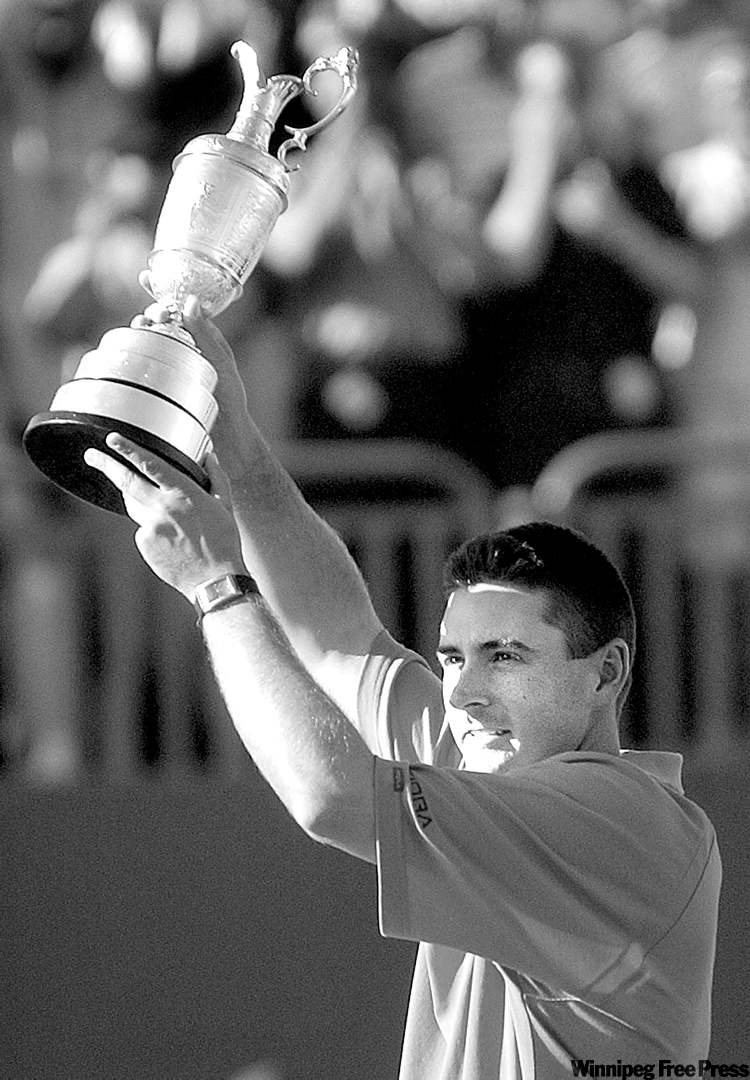
The British Open returns to this peculiar links in the southeast of England for the 14th time on July 14, and about the only certainty is that a claret jug will be awarded to one of the 156 players.
Getting from the opening tee shot to the final putt is not always that simple.
“I’d swear the Royal Air Force used a couple of the fairways for bombing runs,” Greg Norman said in 1993, days before he began dismantling the course with four rounds in the 60s to win his second British Open.
After closing with a 64 in the wind, Norman described it as “the world championship of imagination.”
How quirky are some of the bounces?
“We had a bet in a practice round on the 17th hole that you had to hit a driver, and if you hit the fairway, you got US$100 from everybody,” Justin Leonard said about his last trip to Royal St. George’s in 2003. “And nobody was worried about paying. Not one of us even checked to see if we had $100 in our pocket. It’s a little nutty in spots.”
Geoff Ogilvy spoke for dozens of players in a column for Golf World magazine that began, “The funny thing about Royal St. George’s is that it doesn’t seem to be anyone’s favourite course.”
Finding someone who lists it among his favourite links on the British Open rotation is about as easy as it was for Tiger Woods to find his tee shot in the rough right off the first fairway in 2003, which he never did.
“You haven’t asked Ben Curtis,” Jim Furyk said with a grin.
In his major championship debut, Curtis won the British Open at Royal St. George’s eight years ago. Upon finding him, Curtis rated it as his fifth favourite. And he’s only played seven of the Open courses.
Charles Howell III played his first British Open there in 2003, and while he can’t remember which player said it, the description stuck with him: “The world’s largest pinball machine.”
But there’s a reason this gem of a links course in Sandwich, a small town along the North Sea about an hour east of London, has hosted so many important championships.
“It’s a really good test,” Royal & Ancient chief executive Peter Dawson said.
Dawson took umbrage at the idea that no one likes Royal St. George’s, at first protesting that “you’re making up a story, there’s nothing there.” Moments later, however, he conceded that opinions are largely derived from the most recent experience.
Only one player managed to break par in 2003. That was Curtis, a PGA Tour rookie who was No. 396 in the world ranking, playing his first major and barely known outside his neighbourhood in Ohio. It was easy to suggest that a quirky course had a surprising winner, but that would be to ignore who else could have won: Vijay Singh, Thomas Bjorn, Woods, Davis Love III, Sergio Garcia, Kenny Perry. Most of golf’s best that year had a chance to win the claret jug.
Surely, Royal St. George’s does something right as it tries to define the champion golfer of the year.
Still, the R&A recognized some changes were in order. Only 30 per cent of the entire field found the fairway on the opening hole last time, so it has been widened by 12 yards. The 17th fairway also has been widened by about six yards, so Leonard better check his wallet.
In the week before the Open, Dawson watched as U.S. Open champions Rory McIlroy and Graeme McDowell, three-time major winner Ernie Els and four-time major champion Phil Mickelson played practice rounds. “They’ve all been raving about how good it is,” he said.
Dawson regards links courses in the rotation as children. He loves them all and refuses to play favourites, although he can discern their many differences.

“I suppose St. George’s has slightly more blindish shots than the others,” he said. “But it’s a golf course you need to get to know. It’s a wonderful piece of links land. And this is a very tough golf course.”
So why so many references to its lunar — some might even say “looney” — landscape?
“I think it’s do with its size,” Dawson said. “There’s nothing surrounding it, and apart from the 14th, there’s no real boundary.”
— The Associated Press
Related Articles
Pack chasing Hoge at Pine Ridge


Advertisement Advertise With Us
Advertisement Advertise With Us