

Resounding US Ryder Cup win could be start of something big
Advertisement
Read this article for free:
or
Already have an account? Log in here »
To continue reading, please subscribe:

Digital Subscription
One year of digital access for only $205*
- Enjoy unlimited reading on winnipegfreepress.com
- Read the E-Edition, our digital replica newspaper
- Access News Break, our award-winning app
- Play interactive puzzles
*First annual payment billed as $205.00 + GST for one year. This annual subscription will automatically renew at $233.00 + GST every 52 weeks (10% off the regular annual price of $259.35). Offer available to new and qualified returning subscribers only. Cancel any time.
To continue reading, please subscribe:
Add Free Press access to your Brandon Sun subscription for only an additional
$1 for the first 4 weeks*
- Enjoy unlimited reading on winnipegfreepress.com
- Read the E-Edition, our digital replica newspaper
- Access News Break, our award-winning app
- Play interactive puzzles
*Your next Brandon Sun subscription payment will increase by $1.00 and you will be charged $17.95 plus GST for four weeks. After four weeks, your payment will increase to $24.95 plus GST every four weeks.
Read unlimited articles for free today:
or
Already have an account? Log in here »
Hey there, time traveller!
This article was published 27/09/2021 (1817 days ago), so information in it may no longer be current.
SHEBOYGAN, Wis. (AP) — The kids are more than alright. After America’s youngest Ryder Cup team handed Europe its biggest beating ever, they’re more than a little cocky, too.
Two decades-and-counting worth of frustration poured out alongside plastic cups filled with champagne after the 19-9 final score was posted Sunday at Whistling Straits. Heading into the final-day singles, the U.S. players threatened to run up the score — something the Europeans did more than once while taking seven of the previous nine cup matches — and man, did they ever deliver.
Collin Morikawa, at 24 the youngest player on the team and already a two-time major champion, came up with the clinching blow. A 3-foot birdie putt at the 17th in his match against Viktor Hovland assured the Americans at least the 14 1/2 points they needed. Everything after that wasn’t just gravy; it was designed to send the Europeans a message.
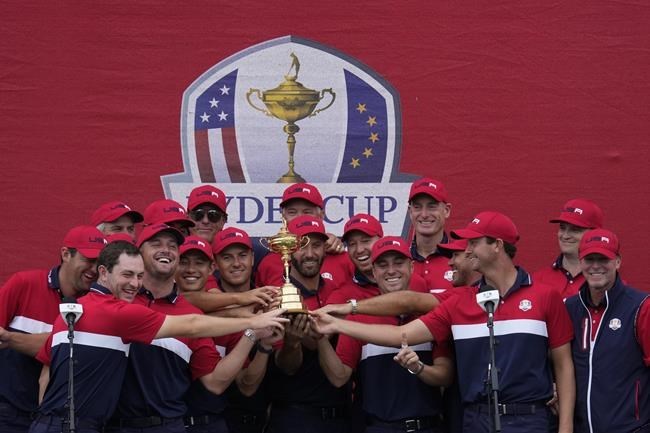
“This is a new era,” U.S. captain Steve Stricker said. “These guys are young. They want it. They’re motivated. They came here determined to win. I could see it in their eyes.”
His kids, cockier still, promised to do it again when the event shifts to Rome in two years. With six rookies, eight players under 30 and a core of superstars that appear to genuinely like playing together, it may not be an empty boast.
“It’s one thing to win it over here and it is a lot easier to do so. It’s harder to win over there,” said Jordan Spieth, who played on two previous losing U.S. sides. “But if we play like we did this week, the score will look the same over there in a couple years, and that’s what we’re here for.”
Spieth wasn’t alone. Stricker tried to set a different tone for the post-match news conference by talking about camaraderie and his players’ willingness to sacrifice for one another. A few minutes in, however, the players were showering each other with praise and the mood was more like a celebrity roast.
Dustin Johnson, who won all five of his matches and at age 37 served as the team’s elder statesman, quickly became a frequent target for the barbs.
“Poor guy went out there and tried to get six points, but all he could do was five,” Justin Thomas laughed, adding, “We’re following grandpa into the abyss.”
Asked whether he had the stamina to keep celebrating deep into the night alongside his teammates, Johnson guaranteed it.
“Is that even in question?” Patrick Cantlay howled.
“He’ll get started now,” Tony Finau concurred, raising his glass in a toast.
For all the fun and games, the goal Stricker set heading into the weekend — that this team could change the U.S. Ryder Cup culture in a meaningful way — appeared close to a done deal. Previous teams have come nearly as talented; eight Americans were ranked inside the top 10 this time, and only one outside the top 20 (Scottie Scheffler, at No. 21). But those stellar lineups were undone by bickering and clashing personalities.
This team was without Tiger Woods and Phil Mickelson, two of the most dominant golfers of the last 30 years. Yet it was considerably more unified. It certainly didn’t hurt that half the U.S. squad arrived without any lasting scars from nearly three decades of European dominance. Or that so many of them knew and played against each other in the upper echelons of junior golf. Or that Stricker made everything from the choice of playing partners to the outfits they wore a more collaborative effort.
In any case, it showed.
“It’s not just the strongest U.S. team I’ve seen, but they all played well this week,” said Lee Westwood, a European stalwart with 11 previous Cup appearances. “Everybody performed and turned up this week. Looks like they are a team.”
Perhaps to reinforce that notion, the U.S. players ended their news conference by insisting that Brooks Koepka and Bryson DeChambeau, who’ve been waging battles on social media and sniping at each other for nearly two years, bury the hatchet before they left.

Stricker had made a point earlier of having all dozen players gather and lay a hand on the small gold trophy. This time, Thomas directed Koepka and DeChambeau to the middle of the room, put the trophy between them and said, “To prove how much of a team we are, they are going to hug.”
It could have been awkward. Instead, the frenemies embraced to the accompaniment of Thomas singing, “Why Can’t We Be Friends.”
If that truce remains intact when the U.S. squad gathers again in Rome in 2023, the chances of the Americans once again dominating this event the way they did when Jack Nicklaus and Arnold Palmer played together are better than good.
___
More AP golf: https://apnews.com/hub/golf and https://twitter.com/AP_Sports
Related Articles
Burns gets 2nd win of the year, Boutier rallies to win LPGA


Advertisement Advertise With Us
Advertisement Advertise With Us