

US Open barranca offers beauty, danger at LA Country Club
Advertisement
Read this article for free:
or
Already have an account? Log in here »
To continue reading, please subscribe:

Digital Subscription
One year of digital access for only $205*
- Enjoy unlimited reading on winnipegfreepress.com
- Read the E-Edition, our digital replica newspaper
- Access News Break, our award-winning app
- Play interactive puzzles
*First annual payment billed as $205.00 + GST for one year. This annual subscription will automatically renew at $233.00 + GST every 52 weeks (10% off the regular annual price of $259.35). Offer available to new and qualified returning subscribers only. Cancel any time.
To continue reading, please subscribe:
Add Free Press access to your Brandon Sun subscription for only an additional
$1 for the first 4 weeks*
- Enjoy unlimited reading on winnipegfreepress.com
- Read the E-Edition, our digital replica newspaper
- Access News Break, our award-winning app
- Play interactive puzzles
*Your next Brandon Sun subscription payment will increase by $1.00 and you will be charged $17.95 plus GST for four weeks. After four weeks, your payment will increase to $24.95 plus GST every four weeks.
Read unlimited articles for free today:
or
Already have an account? Log in here »
Hey there, time traveller!
This article was published 14/06/2023 (1208 days ago), so information in it may no longer be current.
LOS ANGELES (AP) — It will be everywhere the players look at this year’s U.S. Open. Chances are, if they’re in it, they really don’t want to be.
The word of the week at Los Angeles Country Club: barranca.
Lined with sand and dotted with native grasses and ball-entangling plants, the barranca at LACC winds through most of the first nine holes and part of the back nine, as well.
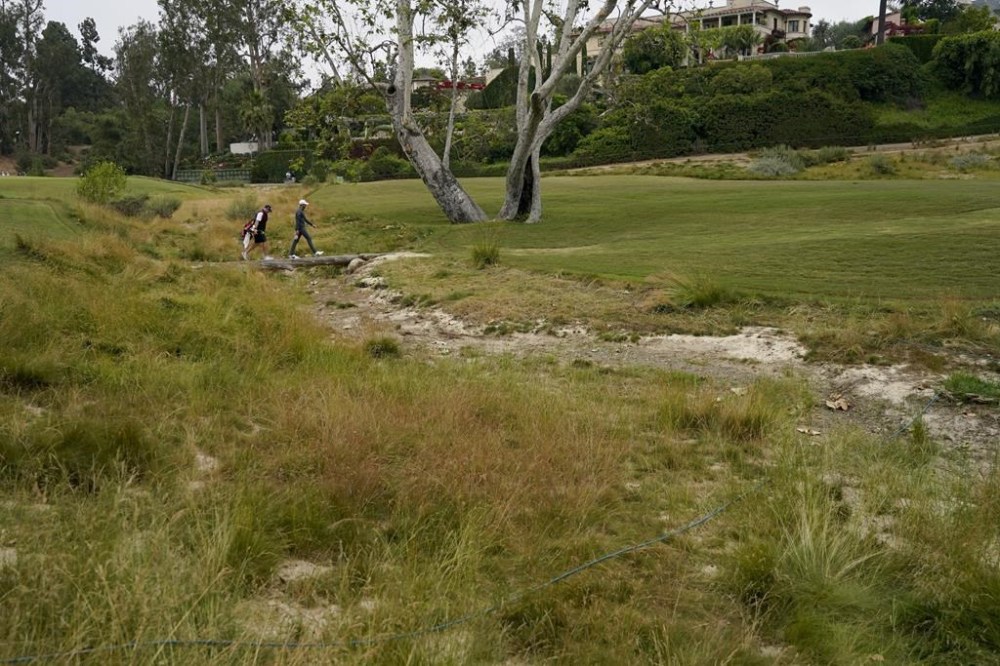
Much like the seawall cliffs at Pebble Beach or the church pew bunker at Oakmont, it’s the barranca that stands out as the most feared and talked-about feature for the U.S. Open’s first return to LA since 1948.
The word itself stems from the Spanish word meaning cliff, precipice, gully or ravine. Merriam-Webster defines it as “a deep gully or arroyo with steep sides.”
Use it in a sentence: “The barranca down below where the bunker is, it is very bad,” Collin Morikawa said when asked how he might approach the short par-4 sixth, a hole with options.
One of those options is driving over trees right of the fairway and going for the green. But that brings the risk of spraying it into barranca that forms a 180-degree semicircle around the left side of the putting surface. Land in the wrong spot there, and a potential eagle 2 could morph into any number.
“It’s the risk-reward part of this golf course,” USGA chief championships officer John Bodenhamer said.
Walking through this natural-looking, brown-greenish landscape hardly feels like being in the heart of modern-day LA. But it’s the contrast of the course’s features set against the skyscrapers and Beverly Hills glitz on the horizon that makes LACC one-of-a-kind.
The barranca first comes into play on the par-4 second hole, which is listed at 497 yards. It runs in front of the green, meaning any player who misses the fairway will have to decide whether to try to carry the expanse or lay up behind it.
That choice, like so many others involving barranca on this course, isn’t necessarily an all-or-nothing proposition.
“You can get a very bad lie, but you can also get a lie that’s all right to where you can hack it out to the middle of the green,” Morikawa said.
During a practice round this week, after hitting a drive into a clump in the barranca to the right of the 17th fairway, Justin Thomas took time to assess the situation, took a stance in the slippery silt and, with his foot sliding, nailed a low liner back into play.
That was a good result. Other shots, as USGA agronomist Darin Bevard noted in a story on the association website, lead to situations “where, if you hit it in there, you get what you deserve.”
Some areas inside the barrancas are marked as red-lined hazards, but others aren’t, meaning a drop from an unplayable lie is still only a one-shot penalty, but with no guarantee the lie that results from a drop will be pure.
When architects Gil Hanse and Jim Wagner began renovating LACC in 2009, they accessed pictures taken not long after the course’s first big overhaul. That was in 1928 by acclaimed designer George C. Thomas, who also designed two of LA’s other landmark layouts, Riviera and Bel-Air Country Club.
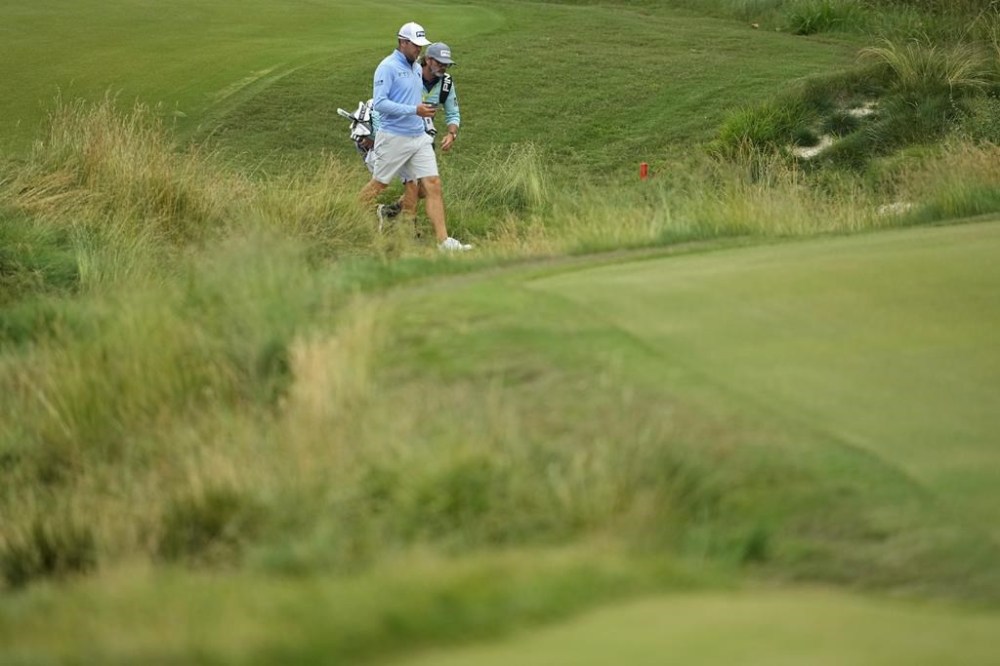
Before Hanse’s renovation, most of the barranca area had been overgrown with grass and the course as a whole resembled a tree-heavy parkland layout. Hanse insisted on trying to bring LACC back to what Thomas envisioned.
Barrancas, by their nature, are unpredictable, since they primarily serve as drainage. During a historically wet winter and spring in Los Angeles this year, the barrancas at LACC sometimes had up to 3 feet of water surging through them. Much of the sand forming the base of the barrancas got washed away. In other places, vegetation grew too high.
Nobody wanted the barrancas to resemble running streams or completely unplayable hazards. Course workers used a weed whacker, hundreds of rakes and some strategic tree planting to thin some areas and make others less susceptible to erosion.
The planners sought a sandy look. In some places, wildflowers sprouted up.
“But the biggest part of the project was getting back to a California native feel instead of manufactured,” said journalist and author Geoff Shackelford, who consulted with Hanse on the redesign. “We wanted it not just for the risk-reward playability thing, we wanted it to be beautiful and a nicer environment.”

On days when 22,000 fans aren’t on site for a major championship, club members are likely to see more birds and butterflies fluttering through the barrancas than in the past, “and it’s kind of like a little Audubon sanctuary through the course,” Shackelford said.
A beautiful layout.
But for the 156 men trying to work their way through it this week, a classic case of look but don’t touch.
___
AP golf: https://apnews.com/hub/golf and https://twitter.com/AP_Sports
Related Articles
Rose Zhang seeking to follow win in her pro debut with a major at the Women's PGA Championship





Advertisement Advertise With Us
Advertisement Advertise With Us