

A golf course with a 6-lane highway? Welcome to the US Open at Oakmont, where I-76 somehow blends in
Advertisement
Read this article for free:
or
Already have an account? Log in here »
To continue reading, please subscribe:

Digital Subscription
One year of digital access for only $205*
- Enjoy unlimited reading on winnipegfreepress.com
- Read the E-Edition, our digital replica newspaper
- Access News Break, our award-winning app
- Play interactive puzzles
*First annual payment billed as $205.00 + GST for one year. This annual subscription will automatically renew at $233.00 + GST every 52 weeks (10% off the regular annual price of $259.35). Offer available to new and qualified returning subscribers only. Cancel any time.
To continue reading, please subscribe:
Add Free Press access to your Brandon Sun subscription for only an additional
$1 for the first 4 weeks*
- Enjoy unlimited reading on winnipegfreepress.com
- Read the E-Edition, our digital replica newspaper
- Access News Break, our award-winning app
- Play interactive puzzles
*Your next Brandon Sun subscription payment will increase by $1.00 and you will be charged $17.95 plus GST for four weeks. After four weeks, your payment will increase to $24.95 plus GST every four weeks.
Read unlimited articles for free today:
or
Already have an account? Log in here »
Hey there, time traveller!
This article was published 13/06/2025 (476 days ago), so information in it may no longer be current.
OAKMONT, Pa. (AP) — For a six-lane interstate carving its way through a world-famous golf course, the Pennsylvania Turnpike at Oakmont is surprisingly unintrusive.
From an overhead view, the sight is somewhat jarring — a wide expressway and railroad track dividing the course essentially in half. At ground level, however, the road is not much of a distraction. In fact, it can’t be seen from much of Oakmont’s layout.
“And honestly, you don’t even really hear it,” Oakmont historian David Moore said. “It’s amazing how quiet it really is.”
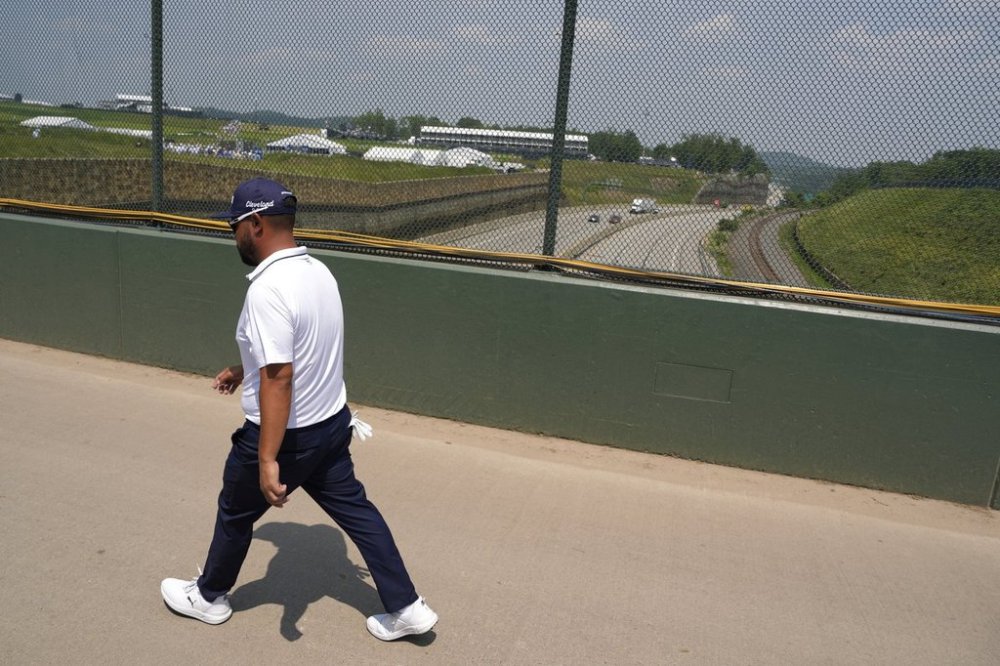
Moore is an expert on this small stretch of the Turnpike — or Interstate 76, if you prefer. Its path through the course at Oakmont — the site of the U.S. Open this week — was originally just a train track.
“One of the old history books here talks about how until diesel-powered trains came through, there’d be soot all over the first green, the ninth tee and all that,” Moore said. “They’d be driving by and set off all the smoke and just cover the place.”
This is not the Road Hole at St. Andrews. There’s nothing quaint about the Turnpike at Oakmont. It also isn’t — or at least, it shouldn’t be — a factor in the course of play.
With its slick greens and ferocious rough, Oakmont is difficult enough without adding a forced carry over a bunch of 18-wheelers.
Holes Nos. 2-8 are to the east of the highway and all the rest are to the west. The first green and ninth tee, as well as the second tee and eighth green, converge on the two sides of the Turnpike, near a couple footbridges that allow fans to cross over the road.
The biggest reason the roadway blends in when you’re on the course is because there’s an elevation change down to the highway. So the Turnpike presents largely as a gap in the middle of the course — if it’s perceptible at all.
There is no giant screen to prevent wayward balls from flying onto the road. The holes closest to the highway on the west side are generally perpendicular to it. Those on the east are more parallel, but it would take a pretty extraordinary miss to reach the Turnpike.
That’s not to say it can’t happen. Moore tells the story of Cary Middlecoff hitting a ball toward the highway on No. 10 before withdrawing in disgust in 1953. Thirty years later, it was Tom Weiskopf on No. 8 working his way into Oakmont lore.
“He flared one off to the right, it landed in a passing train, and it ended up in Cleveland,” Moore said. “The running joke around here: It was the longest tee shot ever hit.”
The more realistic concern the highway creates is for fans. Even with a second footbridge added between the 1994 and 2007 U.S. Opens, there’s still a potential bottleneck in that area as fans cross over the traffic below — which on Thursday included some drivers honking their horns as they passed by golf’s third major of the year.
Foot traffic wasn’t excessively slow, but it was enough of a slog that bouncing back and forth between one side and the other wasn’t advisable.
Near the bridges, the highway is flanked by a wall on the west side and some fencing on the east. The wall seems to do a better job of suppressing the noise from below, but on both sides, you might hear the road before you can see it.

If you’re looking for a decent view without crowding onto a bridge, the area behind the 10th green has a nice vantage point of the highway as it descends north toward the Allegheny River. A grandstand at the green on No. 12 offers a view of the Turnpike going the opposite direction.
For the most part, the sheer size of Oakmont turns even a major roadway — which can take cars all the way to Philadelphia in one direction and Akron, Ohio, in the other — into something of an afterthought.
“You don’t really see it,” Moore said. “Twelve is really like the only hole where you look over it.”
___
AP golf: https://apnews.com/hub/golf
Related Articles
Jeeno Thitikul stays patient and goes on a birdie streak to take first-round lead at Women's PGA



Advertisement Advertise With Us
Advertisement Advertise With Us