

At Shinnecock, the forecast calls for a windy, wild US Open
Advertisement
Read this article for free:
or
Already have an account? Log in here »
To continue reading, please subscribe:

Digital Subscription
One year of digital access for only $205*
- Enjoy unlimited reading on winnipegfreepress.com
- Read the E-Edition, our digital replica newspaper
- Access News Break, our award-winning app
- Play interactive puzzles
*First annual payment billed as $205.00 + GST for one year. This annual subscription will automatically renew at $233.00 + GST every 52 weeks (10% off the regular annual price of $259.35). Offer available to new and qualified returning subscribers only. Cancel any time.
To continue reading, please subscribe:
Add Free Press access to your Brandon Sun subscription for only an additional
$1 for the first 4 weeks*
- Enjoy unlimited reading on winnipegfreepress.com
- Read the E-Edition, our digital replica newspaper
- Access News Break, our award-winning app
- Play interactive puzzles
*Your next Brandon Sun subscription payment will increase by $1.00 and you will be charged $17.95 plus GST for four weeks. After four weeks, your payment will increase to $24.95 plus GST every four weeks.
Read unlimited articles for free today:
or
Already have an account? Log in here »
SOUTHAMPTON, N.Y. (AP) — The sight of workers dragging a garden hose onto the seventh green in the middle of the final round at Shinnecock Hills in 2004 has long been remembered as the equivalent of the USGA waving a white flag. The message: We’ve officially lost the golf course.
This year, with the U.S. Open returning to one of the country’s most difficult and windswept layouts, the USGA sent a message before the tournament began: It will be watering the greens and it’s not a sign of surrender.
It is, however, the reality of what’s shaping up to be a rough week at what is traditionally the season’s roughest major — America’s national championship. Sustained wind near the eastern tip of Long Island was expected to rise beyond 30 mph at times for the opening round.
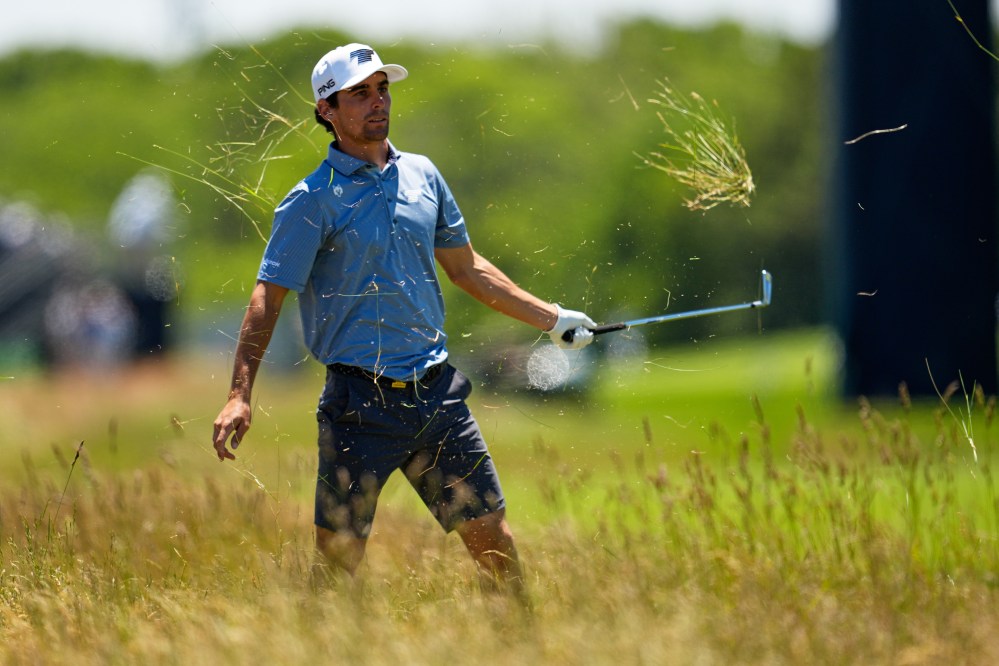
The 126th edition of U.S. Open began ominously Thursday morning when the large American flag atop the clubhouse was crackling at 6:30 a.m. Fog began to roll in, prompting James Nicholas to ask the starter if they were on time.
“I just wanted to make sure,” Nicholas said. “I can’t see the fairway.”
But he had plenty of room to see the flight of his 3-iron. To give the players a chance, the USGA has made the fairways wide and is trying to keep the greens soft and slower than usual.
That’s all part of the plan to keep it tough but fair.
“When we start to talk about numbers in the mid-30s, that becomes problematic in a number of ways,” John Bodenhamer, the USGA official in charge of course setup, said in referencing the wind forecast.
Shinnecock, considered one of America’s true cathedrals of golf, has also been the scene of some of its more jarring debacles.
In 2018, Phil Mickelson, frustrated with a ball he putted past the hole on No. 13 that just kept rolling, jogged toward the ball and swatted it back up the hill while it was still moving. That was a two-shot penalty that left the left-hander “embarrassed and disappointed by my actions.”
In 2004, organizers had to water the heavily sloped Redan green on No. 7 in between groups on Sunday — the signature moment on a fiasco of a day in which not a single player broke par.
Bodenhamer outlined a plan for the first two days, in which the USGA built in more time between the morning and afternoon waves to “syringe” the greens. He described that as applying a light mist on top of the surfaces, sort of like what happens when they water vegetables in the produce section at the grocery store.
He said course workers would wait until as late as possible before the start of the weekend rounds to water, in hopes they would remain receptive throughout the day. Saturday’s forecast calls for heavy wind out of the north and northwest, which is the opposite of normal at Shinnecock and can blow balls from the back to front of what Bodenhamer called “the problematic greens — or the more severe greens, not problematic.”
He said the speeds of the greens could be set to measure around 10 on the stimpmeter. A normal reading for a major would be around 13. If that’s the case, these could be the slowest U.S. Open putting surfaces he can recall since 1995, when Corey Pavin won at Shinnecock with a score of even par.
But when asked what this year’s trip around Shinnecock could look like, Bodenhamer brought up 1992, when Tom Kite used a 6-iron on the 102-yard seventh hole, then chipped in from left of the green to set up a win in gale conditions at Pebble Beach.
“We think Thursday could look a little bit like that, with what we’re seeing in the forecast,” Bodenhamer said. “We’ve given that some thought.”
The USGA has been transparent with the players about the watering plan.
“When I first heard of it, my first reaction was, ‘That’s stupid, why are they doing that?’” Rory McIlroy said. “Then, once you actually listen and you’ve let them break it down to you, you’re, like, ‘Yeah, that makes sense.’”
Since Bodenhamer took over the course setup job in 2019, the USGA has more or less stopped using par as a benchmark for a winning score. The year before he took over, Brooks Koepka won at Shinnecock with a score of 1 over. Since then, the average winning score has been nearly 7 under, even with notoriously tough courses like Winged Foot and Oakmont in the mix.

This year, the goal, in Bodenhamer’s words, is to “let Shinnecock be what it’s supposed to be.”
If the wind kicks up, as expected, it will be the toughest test in golf. If it doesn’t and the USGA sticks with its watering plan, it could turn into something totally different.
“It is a very unique site. It is up on top of the hill. It does get battered by the elements,” Justin Rose said. “The course changes dramatically from morning to afternoon. What I’m hearing is some slightly different protocols this week make sense to me, and I think it’s set up to be a great tournament.”
___
AP golf: https://apnews.com/hub/golf
Related Articles
Nelly Korda is 2 for 2 in major titles this season. The Women's PGA at Hazeltine National is next




Advertisement Advertise With Us
Advertisement Advertise With Us