

Drilling down into NHL’s wild-card battle in the west
Advertisement
Read this article for free:
or
Already have an account? Log in here »
To continue reading, please subscribe:

Digital Subscription
One year of digital access for only $205*
- Enjoy unlimited reading on winnipegfreepress.com
- Read the E-Edition, our digital replica newspaper
- Access News Break, our award-winning app
- Play interactive puzzles
*First annual payment billed as $205.00 + GST for one year. This annual subscription will automatically renew at $233.00 + GST every 52 weeks (10% off the regular annual price of $259.35). Offer available to new and qualified returning subscribers only. Cancel any time.
To continue reading, please subscribe:
Add Free Press access to your Brandon Sun subscription for only an additional
$1 for the first 4 weeks*
- Enjoy unlimited reading on winnipegfreepress.com
- Read the E-Edition, our digital replica newspaper
- Access News Break, our award-winning app
- Play interactive puzzles
*Your next Brandon Sun subscription payment will increase by $1.00 and you will be charged $17.95 plus GST for four weeks. After four weeks, your payment will increase to $24.95 plus GST every four weeks.
Read unlimited articles for free today:
or
Already have an account? Log in here »
Hey there, time traveller!
This article was published 13/03/2019 (2720 days ago), so information in it may no longer be current.
With the Nashville Predators and Winnipeg Jets both running hot and cold heading into the last stretch of games in the 2018-19 regular season, the Jets’ advantage in points with fewer games played is starting to look like enough of a buffer to maintain their spot on top of the Central Division.
That means they’re most likely going to face a wild-card team, and right now there’s a four-way battle for those two Western Conference wild-card spots, with a lot of uncertainty about who will win out.
The Dallas Stars and Arizona Coyotes (yes, really) currently occupy the spots, but the Minnesota Wild are just one point behind Arizona, and the Colorado Avalanche are a little further back, three points behind the Coyotes.
Looking at the season-long numbers might not be the best indicator of which teams are most likely to win out the rest of the way, so let’s look how each of these prospective wild-card teams are performing since the calendar turned to 2019.

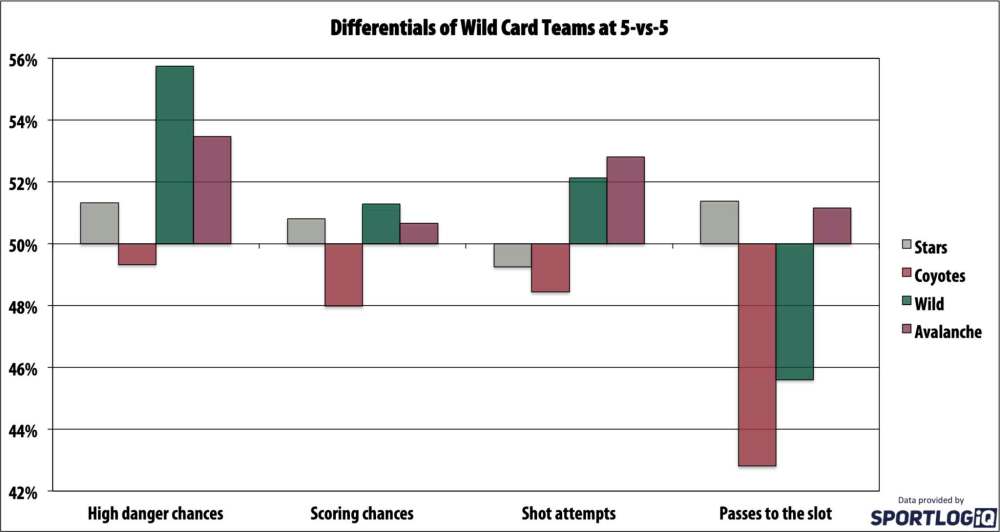
First looking at even strength, what draws the eye is that the Wild are absurdly good at controlling high-danger scoring chances, but fall apart when it comes to pre-shot movement. The Wild have typically been a low-event team over the last few years, limiting the dangerous chances that Devan Dubnyk has had to face, but in 2019 they’ve been a high-volume team, for and against.
That has led to a ton of scoring chances for, but also left them out of position more often, making the chances against that they do allow very difficult for their goaltenders. They still protect the net front really well, but there’s lots of puck movement in the slot for them to deal with.
Arizona is the other team that struggles defending passes at even strength, and they’re actually being outplayed by every metric here, so that hot streak they’re currently riding certainly isn’t due to strong play at five-on-five.
The Dallas Stars are similar to what the Wild were last season; an extremely low-event team that was outplayed on the surface at even strength, giving up more shot attempts than they get, but in terms of quality plays they’re getting more than they give up.
The margins for the Stars aren’t that big, though, so the advantage they have in points at the moment will likely be a big factor for them.
Only one team is in the positive range all across the board here, and it’s the team that’s lowest in the standings of the group in the Colorado Avalanche. I’ve been watching the Avalanche closely this season as an underrated team, because they’ve been strong all year long, but they haven’t had the luck they’ve had in previous years, and they’ll need a reversal in fortunes to make up the points gap.
Outside of even strength is still a factor for all these teams though, so how much does everything change if we look at all situations?
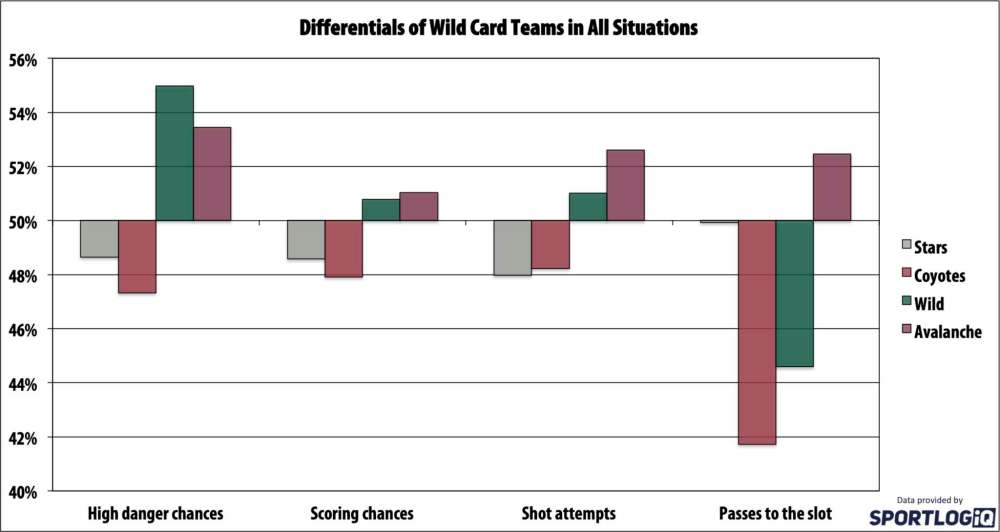
Factoring in special teams, the Stars drop off big-time, while the Coyotes look even weaker, and the Wild continue to struggle with pass defence but remain strong elsewhere.
The Colorado Avalanche however, are still above 50 per cent in each metric, and when you look at the raw totals, they have generated more high danger scoring chances in 2019 than any other team in all situations.
That’s a promising thing for the Avs, but it also means that their nearly 54 per cent differential in high-danger chances includes a huge number of chances against, and therein lies the risk for them; they play a run-and-gun style.
The Avalanche put up more offence than their opponents on a consistent basis in every situation, but if they lack finish or their goaltenders struggle, they remain vulnerable.
The fact is, some of what’s afflicted the Avs this season has simply been poor luck, but in the smattering of games we have left on the schedule, random variance and good or bad fortune can be as big of a determining factor in making the playoffs as on-ice performance.
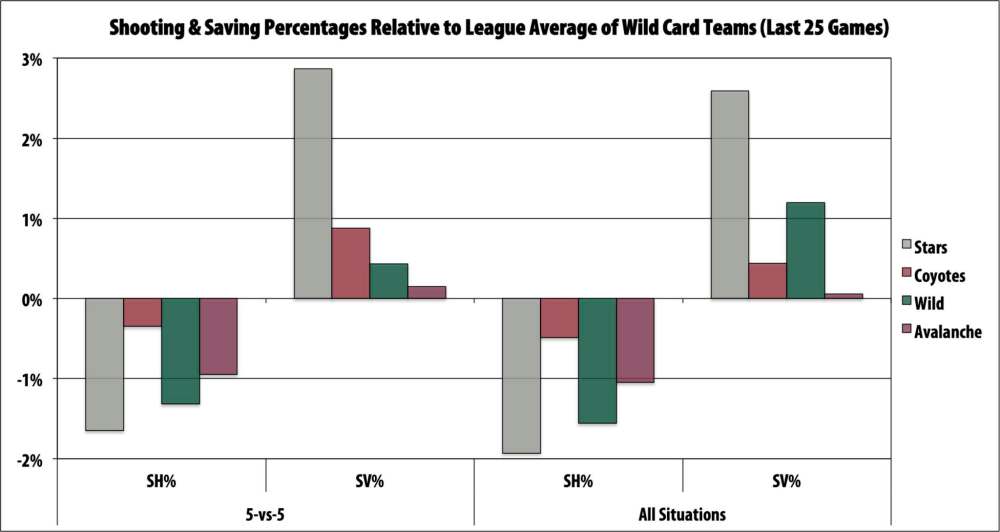
Knowing that, we can use Natural Stat Trick’s public database to see how each team is trending in shooting and save percentage relative to league average over their previous 25 games.
At both even strength and in all situations, all four teams are scoring on a lower percentage of their shots on goal than league average, which is problematic in particular for the Minnesota Wild and Colorado Avalanche, who are both creating tons of high danger chances,
The Stars are the lowest percentage shooting team in the league over their last 25, but the highest save percentage team at 5-vs-5 and third-highest overall. They’re being held in by goaltending more than anything right now.
Unfortunately for the Avalanche, they’re struggling in scoring just like everyone else, but they’re not getting the goaltending performances that the other three teams are, which means they’re swimming against the tide every game. Their skaters are putting up great performances, but it’s all for naught if they can’t finish, and their goaltenders are outplayed by their rivals here.
Given a large enough sample size I would always go with performance metrics over the highly unreliable things such as shooting and save percentages, but we don’t have a large sample size left this season.
Given the advantage Dallas has in the points already accumulated, general good play at evens strength and the performance of Ben Bishop, you have to think that Dallas is nearly locked in.
I just don’t believe in the Coyotes, despite their hot streak; their play is just too poor. The Wild and Avalanche are both good, but flawed, teams. The main difference between them is the Wild are getting good goaltending and the Avs are getting average goaltending, and there probably isn’t enough time left for that to change.
History
Updated on Thursday, March 14, 2019 8:53 AM CDT: Corrects typo