

Hard work no problem, mon
Jamaican grooms look for better life in Winnipeg
Advertisement
Read this article for free:
or
Already have an account? Log in here »
To continue reading, please subscribe:

Digital Subscription
One year of digital access for only $205*
- Enjoy unlimited reading on winnipegfreepress.com
- Read the E-Edition, our digital replica newspaper
- Access News Break, our award-winning app
- Play interactive puzzles
*First annual payment billed as $205.00 + GST for one year. This annual subscription will automatically renew at $233.00 + GST every 52 weeks (10% off the regular annual price of $259.35). Offer available to new and qualified returning subscribers only. Cancel any time.
To continue reading, please subscribe:
Add Free Press access to your Brandon Sun subscription for only an additional
$1 for the first 4 weeks*
- Enjoy unlimited reading on winnipegfreepress.com
- Read the E-Edition, our digital replica newspaper
- Access News Break, our award-winning app
- Play interactive puzzles
*Your next Brandon Sun subscription payment will increase by $1.00 and you will be charged $17.95 plus GST for four weeks. After four weeks, your payment will increase to $24.95 plus GST every four weeks.
Read unlimited articles for free today:
or
Already have an account? Log in here »
Hey there, time traveller!
This article was published 26/08/2011 (5487 days ago), so information in it may no longer be current.
The late Bob Marley is credited with saying, “every man gotta right to decide his own destiny.”
If you listen carefully as you walk through the barns of Assiniboia Downs, it’s almost as if you could hear Marley’s reggae music wafting through the stalls.
The Jamaican and Barbadian foreign workers who ply their trades as grooms and exercise riders here are no stranger to their countryman’s music. Marley’s songs speak about spiritual freedom and liberation and convey his belief that there is more to life than our own selfishness.
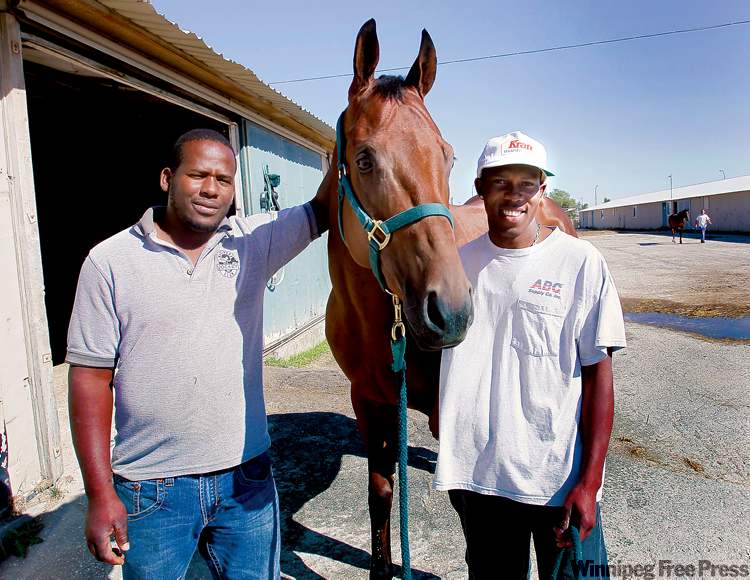
For many of these men, of which approximately 40-50 work at the Downs, Marley might possibly have provided the incentive to leave their homes and families in search of a better life for them all. Or, as Marley put it, “to decide his own destiny.”
“It is very lonely here,” said Romando Ricketts, 27, who has been a groom for trainer Blair Miller for three years now, and has a wife and child back home in Jamaica. “I talk to them every day on my cell phone.” He laughed when asked what his phone bill was like, and said, “sometimes it’s up, and sometimes it’s down.”
He’d like to bring his family here, but on a groom’s pay ($500 a week tops), he sighs and says, “I’ll have to wait.”
Anthony Nelson, 28, is in his fourth year with Miller. A little more than a year ago, he received his landed immigrant status. “I am not going to lie to you,” said Nelson, who hopes to become a trainer and have his own stable of horses one day. “Back home is nice, but it’s a better opportunity. I have two kids and want a better future for them. I live here with my wife, but my kids are still back home.”
Miller, who is also on the board of directors of the Horsemen’s Benevolent and Protective Association, and serves as head of its foreign workers committee, says, “Grooms and exercise riders are very important parts of our industry. Without them we just wouldn’t be able to function.”
Before any foreign worker can work here, the HBPA must run ads across Canada for Canadians who are interested in their groom school. “We put them through the school, and after they graduate, we place them with a trainer. We don’t turn away any Canadians who want the job. That’s the law.”
Very few Canadians, however, seem to want these kinds of jobs.
The foreign workers do not need to go through groom school. “They have to have been licensed as grooms and exercise riders in Jamaica,” said Miller. “That’s the only way they can get their visas to come here and work.”
The HBPA will front them the airfare, and some spending money if they need it when they get here, but they pay it all back through their wages. The Canadian dollar is worth about 2.5 Jamaican dollars.
Many of the foreign workers live in the small one-room huts that the Downs rents out. “It’s not the Taj Mahal,” said Miller, “but I lived in one once. They do a lot of their own cooking, and now they put in air conditioners. They use a community washroom, but $150 rent for the year is pretty reasonable.

“Let’s face it, Canadian kids are spoiled. This is a tough job. It’s seven days a week and split shifts. These guys are up at 5 a.m., but have most of the afternoons are off, and we race three nights a week. But if you have a horse in the last race on Friday night, you are not done until 1 a.m., and then you are back at it at 5 a.m., the next day.”
Nelson said it’s all about choices. “What will I say? Back home you have to be educated to get a really good job, but if you get the opportunity to do racing, you will take it. Most people here don’t really have to do it because they have different choices. Back home you don’t have much choice, so you take the racing.”
“You have to know the horses,” said Ricketts. “The way they think, move, show pain. You have to get into their head. Their mind is your mind. You have to understand them.”
Would horse racing die out if it weren’t for the foreign workers? “The easy answer is yes,” said Miller. “But race track people are a pretty hardy bunch. They would adapt, and find other ways, but it wouldn’t be as good, or as professional.”
allan.besson@freepress.mb.ca
Jon’s biggest race
TWO-YEAR-OLD thoroughbred Jon’s Golden Run, named for Olympic skeleton gold medalist Jon Montgomery, will run the biggest race of his young life tonight at Assiniboia Downs.
Jon, who finished second to River Dance by a neck in his debut on July 20, is entered in the six-furlongs $40,000 Sales Stakes for two-year-olds, and is ranked second in the morning line at 5-2. Danger Rules, who Jon finished in front of on July 20, is the favourite at 8-5.
Also on tonight is the 1 1/6 miles, $50,000 Distaff for Manitoba-bred fillies and mares three years old and up. On Saturday the 1 1/6 miles $25,000 Jack Hardy Stakes for three-year-old fillies is the featured race.
Post time both nights is 7:05 p.m.
Related Articles
Besson a finalist for a second Sovereign Award
Advertisement Advertise With Us
Advertisement Advertise With Us