

World Cup will be a BLAST
90,000 B-flats will provide deafening cacophony
Advertisement
Read this article for free:
or
Already have an account? Log in here »
To continue reading, please subscribe:

Digital Subscription
One year of digital access for only $205*
- Enjoy unlimited reading on winnipegfreepress.com
- Read the E-Edition, our digital replica newspaper
- Access News Break, our award-winning app
- Play interactive puzzles
*First annual payment billed as $205.00 + GST for one year. This annual subscription will automatically renew at $233.00 + GST every 52 weeks (10% off the regular annual price of $259.35). Offer available to new and qualified returning subscribers only. Cancel any time.
To continue reading, please subscribe:
Add Free Press access to your Brandon Sun subscription for only an additional
$1 for the first 4 weeks*
- Enjoy unlimited reading on winnipegfreepress.com
- Read the E-Edition, our digital replica newspaper
- Access News Break, our award-winning app
- Play interactive puzzles
*Your next Brandon Sun subscription payment will increase by $1.00 and you will be charged $17.95 plus GST for four weeks. After four weeks, your payment will increase to $24.95 plus GST every four weeks.
Read unlimited articles for free today:
or
Already have an account? Log in here »
Hey there, time traveller!
This article was published 11/06/2010 (5959 days ago), so information in it may no longer be current.
JOHANNESBURG, South Africa — The soundtrack of this summer’s World Cup will be played on a cheap yard-long plastic horn capable of just a single note — a thudding B flat.
Played alone, it sounds like an elephant. Play a few dozen in concert, and it sounds like a swarm of angry bees.
But put 90,000 of them together in the enclosed space of a World Cup stadium for two hours? Well, then you have a potential health hazard.
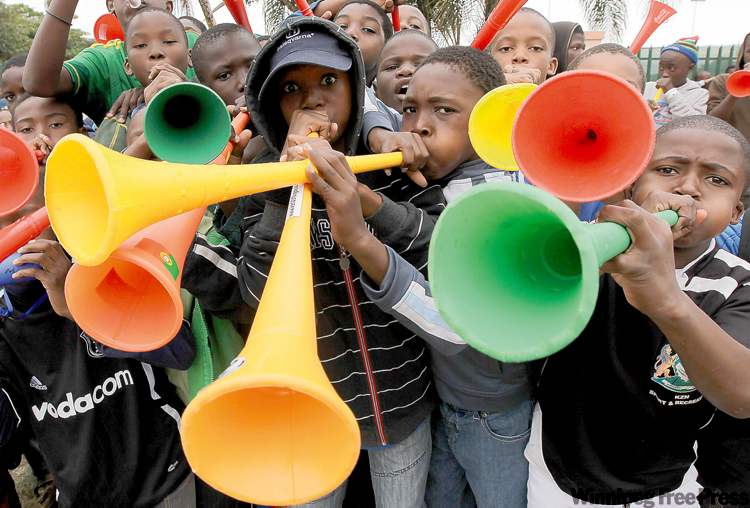
"They can really hurt your ears," says South Africa soccer fan Candice Meyer, a vuvuzela tooting just behind her.
"People from outside aren’t used to this," says another fan, Trevor Bongani. "It could be a problem."
Yet after months of debate, World Cup officials recently turned a deaf ear to complaints from opposing teams and public safety officials and gave their blessing to the ubiquitous South African horns, guaranteeing, according to Danny Jordaan, chief executive of the local organizing committee, "the noisiest World Cup ever."
So noisy viewers at home might want to watch the games with the volume turned down.
"My first thought was ‘Wow.’ It is a remarkable sound," said Jed Drake, who oversaw ESPN’s coverage of last summer’s Confederations Cup in South Africa. "Boy oh boy was it loud."
How loud? About as loud as a jet engine at full throttle. And louder than a NASCAR race, a rock concert or a jackhammer, according to researchers who studied the noise level at a South African Premier League match and found it peaked at 144 decibels.
The U.S. government considers two hours of exposure to anything over 100 decibels to be dangerous.
"Just the buzz, you can’t even talk, they’re so loud," says U.S. defender Jonathan Bornstein, who has played half a dozen matches in South Africa over the last year. "It’s even sometimes hard to think. Cause it’s like raaaawwwww."
The vuvuzelas will be part of the World Cup because they’re as much a part of soccer tradition in South Africa as bongo drums and chants are in other countries, tournament organizers said. Which is true if you believe soccer tradition in South Africa began about the time Nelson Mandela got out of prison and not 150 years ago, when the sport was first introduced by British soldiers.
Although the instrument’s history is a little fuzzy, some here say the vuvuzela was inspired by the kudu horn African villagers once used to summon neighbors. But they didn’t reappear in South African until around 1990, and they didn’t become popular at soccer stadiums until the end of the decade.

Not everybody buys that timeline, however.
"The vuvuzela is embedded in South African soccer culture," insists Firdoze Bulbulia, director of an entertainment company based in Johannesburg. "It is like the drums or the wave for fans from Latin America or Europe."
— Los Angeles Times
more world cup coverage C2
Related Articles
Wavin' Flag: World Cup fever takes Afghanistan's Kandahar Airfield by storm Green's WCup gaffe against US puts him on list of blundering England goalkeepers Green's blunder hands US 1-1 draw with England in World Cup Group C opener
Advertisement Advertise With Us
Advertisement Advertise With Us