

Impoverished nation watches on lone TV channel
Advertisement
Read this article for free:
or
Already have an account? Log in here »
To continue reading, please subscribe:

Digital Subscription
One year of digital access for only $205*
- Enjoy unlimited reading on winnipegfreepress.com
- Read the E-Edition, our digital replica newspaper
- Access News Break, our award-winning app
- Play interactive puzzles
*First annual payment billed as $205.00 + GST for one year. This annual subscription will automatically renew at $233.00 + GST every 52 weeks (10% off the regular annual price of $259.35). Offer available to new and qualified returning subscribers only. Cancel any time.
To continue reading, please subscribe:
Add Free Press access to your Brandon Sun subscription for only an additional
$1 for the first 4 weeks*
- Enjoy unlimited reading on winnipegfreepress.com
- Read the E-Edition, our digital replica newspaper
- Access News Break, our award-winning app
- Play interactive puzzles
*Your next Brandon Sun subscription payment will increase by $1.00 and you will be charged $17.95 plus GST for four weeks. After four weeks, your payment will increase to $24.95 plus GST every four weeks.
Read unlimited articles for free today:
or
Already have an account? Log in here »
Hey there, time traveller!
This article was published 22/06/2010 (5948 days ago), so information in it may no longer be current.
CAPE TOWN, South Africa — North Korea picked the wrong moment to allow its people to see a bit more of the outside world.
The authoritarian regime was so proud of its soccer team in the World Cup that it allowed an unprecedented live broadcast back home of the match against Portugal — a rarity for the communist nation that normally exerts strict control over the media.
What ensued was a different sort of history: North Koreans, used to seeing only positive news about their reclusive country, watched as their soccer team received the worst drubbing so far in this year’s tournament and was prevented from advancing to the next round.
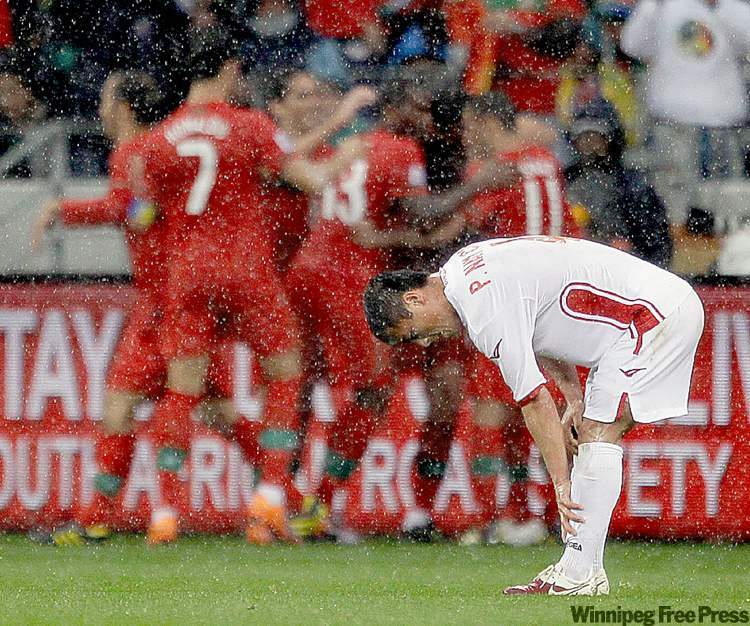
As the 7-0 loss to Portugal concluded, the North Koreans quickly halted Monday’s coverage. "The Portuguese won the game and now have four points," the Korean Central Broadcasting commentator said. "We are ending our live broadcast now."
It then cut to factory workers and engineers praising North Korean leader Kim Jong Il.
Dejected and dispirited, the North Korea team quickly left the stadium in Cape Town with heads bowed.
Star forward Jong Tae Se dropped to his knees as the game ended. He said he was upset they had made so many errors and apologized to his nation for failing to fulfil its World Cup hopes. The normally loquacious Jong later slipped out another entrance.
Portugal’s Tiago, who scored twice, wished the North Koreans well in their final game against Ivory Coast but said he wasn’t sorry about the lopsided score, since getting lots of goals can help a team advance to the next round.
"It’s just football," he said.
But it’s more than a game for North Korea, an impoverished nation struggling to feed its people. The isolated country is locked in a standoff with world powers over its nuclear program and has been hauled before the UN Security Council over the deadly sinking of a South Korean warship in March.
It is the first time in 44 years that North Korea has qualified for the World Cup, a rare point of pride for a nation increasingly at odds with the outside world.
North Korea’s players were feted as heroes when they returned home last year after qualifying for the World Cup. The sport is North Korea’s most popular and has one exceptionally important fan: leader Kim Jong Il.

Kim, 67, used North Korea’s 1966 World Cup success as political capital in his campaign to take over leadership from his father, Kim Il Sung, according to Moon Ki-nam, a former national coach for North Korea who defected to South Korea in 2004.
Kim was officially anointed his father’s heir in 1974 and assumed leadership upon his father’s death in 1994. He’s believed to be grooming his youngest son, Kim Jong Un, to take over.
Kim and his totalitarian leadership allow only one state-run TV channel, ban shortwave foreign radio broadcasts and restrict outside Internet access to the elite.
— The Associated Press
Related Articles
So long, beloved Bafana Bafana 'It is funny, France is worthless'
Advertisement Advertise With Us
Advertisement Advertise With Us