Victory eases Spain’s pain, for a bit
Economy, regional strife set aside in post-World Cup ecstasy
Advertisement
Read this article for free:
or
Already have an account? Log in here »
To continue reading, please subscribe:

Digital Subscription
One year of digital access for only $205*
- Enjoy unlimited reading on winnipegfreepress.com
- Read the E-Edition, our digital replica newspaper
- Access News Break, our award-winning app
- Play interactive puzzles
*First annual payment billed as $205.00 + GST for one year. This annual subscription will automatically renew at $233.00 + GST every 52 weeks (10% off the regular annual price of $259.35). Offer available to new and qualified returning subscribers only. Cancel any time.
To continue reading, please subscribe:
Add Free Press access to your Brandon Sun subscription for only an additional
$1 for the first 4 weeks*
- Enjoy unlimited reading on winnipegfreepress.com
- Read the E-Edition, our digital replica newspaper
- Access News Break, our award-winning app
- Play interactive puzzles
*Your next Brandon Sun subscription payment will increase by $1.00 and you will be charged $17.95 plus GST for four weeks. After four weeks, your payment will increase to $24.95 plus GST every four weeks.
Read unlimited articles for free today:
or
Already have an account? Log in here »
Hey there, time traveller!
This article was published 13/07/2010 (5931 days ago), so information in it may no longer be current.
MADRID, Spain — Spain erupted with its biggest fiesta in memory Monday when its soccer team returned to a jubilant nation after winning the World Cup.
The victory has given elated Spaniards a break from months of economic gloom and political squabbling as nationalist regions fought for greater autonomy from the central government.
Hundreds of thousands of people — if not more — jammed Madrid’s historic avenues as an open-air bus ferried the national team down stately avenues to cheers from Spaniards decked out in a sea of red and yellow, the colours of the Spanish flag.
The celebration in Madrid, where national unity is at its strongest, was expected. But there were striking examples of support from unlikely places: The well-off Catalonia region, which has long sought greater autonomy, and the separatist Basque region, where anything pro-Spain is often shunned.
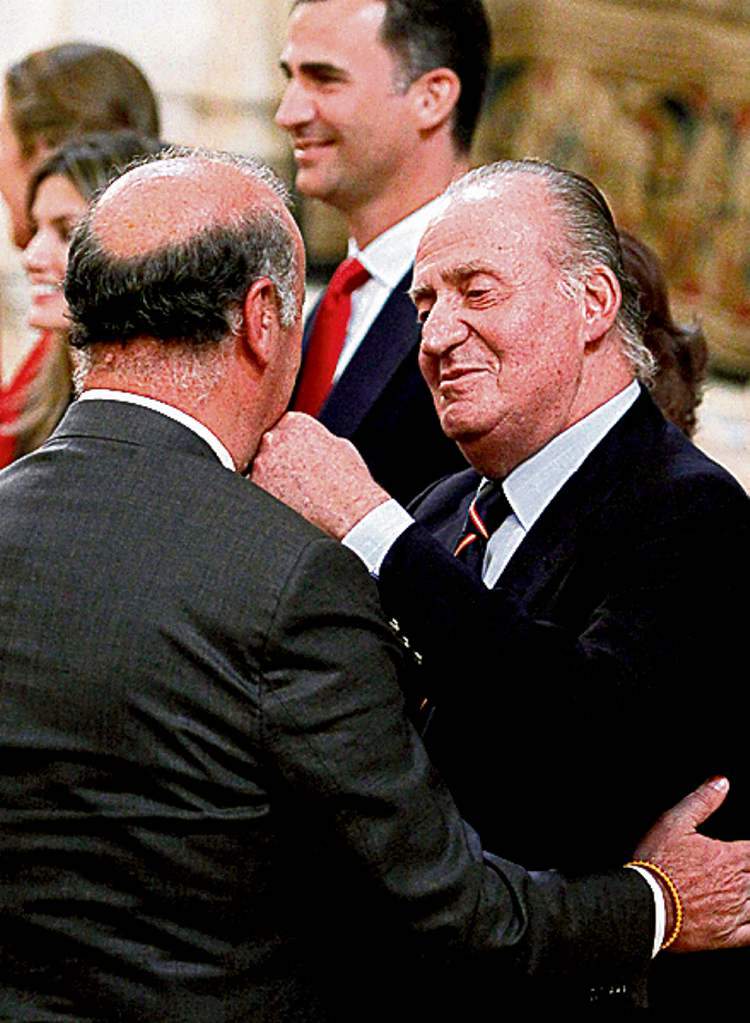
The massive Madrid street party came after players visited Madrid’s Royal Palace, normally used only for dreary state affairs. But team chatted and had drinks with King Juan Carlos, who hugged many players and gave coach Vicente del Bosque friendly punches on the cheek and the chest.
“You are an example of sportsmanship, nobility, good play and team work,” said the king.
Team members then travelled to government headquarters, where they were greeted by Prime Minister Jose Luis Rodriguez Zapatero, ministers and hundreds of ecstatic children invited to the event.
“They won the cup but it belongs to all Spaniards,” shouted a delighted Zapatero.
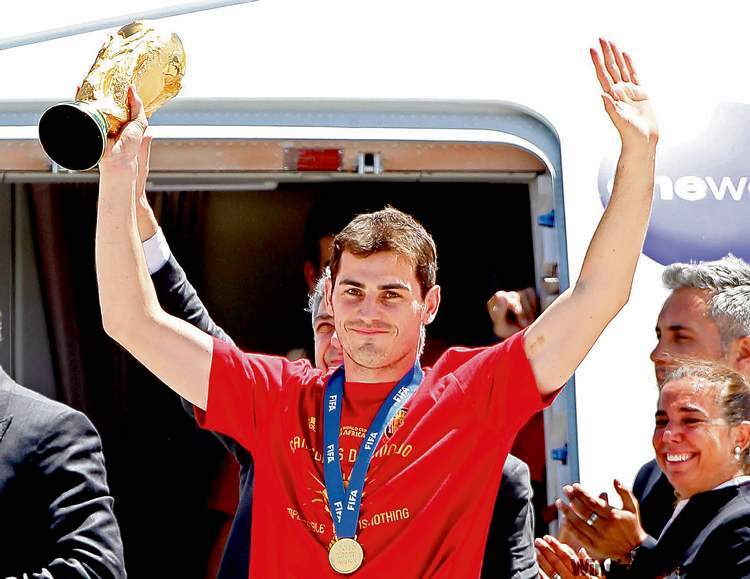
Next came an open-air bus ride through Madrid’s historic centre, the epicentre of the celebration for the second day in a row. Crowds overflowed into the street and surrounded the team bus, virtually all sporting the red and yellow national colours along the five-kilometre route as the bus crawled through the crowd with the players waving and raising the gold World Cup trophy into the air. At the route’s end, firefighters hosed down fans sweltering in 36 Celsius evening heat.
The party started when the players’ plane touched down, flying Spanish flags from its cockpit windows, with dozens of airport workers cheering from the runway.
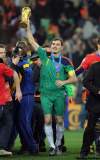
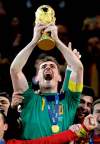
A roar of approval rose as team captain and goalkeeper Iker Casillas stepped from the plane and raised the trophy. The crowd chanted “Campeones! Campeones!” (Champions! Champions!). Then the players in their team jerseys walked from the plane to a waiting Spanish football federation bus.
The spectacle was “very important, it helps us forget a lot of things, like the economic crisis, for example, or people’s domestic issues,” said Javier Sanchez, a 42-year-old photographer from Madrid.
But will the ecstasy last? Could this be Spain’s moment to unite under a single flag? Or is it a fleeting instance of patriotism following near economic chaos when the country was targeted as one of the European nations most likely to default on debt like Greece?
Spain has been depressed by a debt crisis, 20 per cent unemployment and nationalist regions fighting to separate from the country or at least win greater autonomy and near-nation status.
While the spotlight was on Madrid, the win led to a rare sight in the Catalonia region’s capital of Barcelona: Spanish flags waving side-by-side with Catalonia’s own red and yellow flag.
“It has been very strange, but now it is being tolerated,” said Saray Lozano, a 31-year-old taxi driver from Barcelona. “If it weren’t for football, you might get rocks thrown at you” for displaying Spain’s national symbol.
About 75,000 people celebrated the win in Barcelona, and about 2,000 people waved Spanish flags and wore the team jersey in the Basque city of Bilbao — actions rarely seen because of the violent campaign led by the separatist group ETA since 1968 to gain independence from Spain.
But experts said the idea of Spain overcoming its internal divisions and economic woes because of the World Cup is unlikely to become reality. In and around Bilbao, authorities blamed sabotage for an electrical outage that cancelled an open air broadcast of the final game, and several people supporting the national team were attacked by separatists.
“I wouldn’t have thought the euphoria over the football will last very long,” said Paul Preston, a Spain expert and history professor at the London School of Economics.
As for Spain’s fragile economy, the win “may soften the blow of the economic news, but it won’t have a long-lasting effect,” Preston said.
— The Associated Press

Octopus oracle retires
BERLIN — No more World Cup, no more octopus oracle.
Paul, the octopus who became a pop culture sensation by correctly predicting the outcome of as many World Cup matches as he has legs — all seven of Germany’s games plus Sunday’s Spain-Netherlands final — is going to retire.
The intuitive invertebrate will “step back from the official oracle business,” said Tanja Munzig, a spokeswoman for the Sea Life aquarium in Oberhausen, Germany.
— The Associated Press