

Bundesliga aim to restart in May without fans hit by order
Advertisement
Read this article for free:
or
Already have an account? Log in here »
To continue reading, please subscribe:

Digital Subscription
One year of digital access for only $205*
- Enjoy unlimited reading on winnipegfreepress.com
- Read the E-Edition, our digital replica newspaper
- Access News Break, our award-winning app
- Play interactive puzzles
*First annual payment billed as $205.00 + GST for one year. This annual subscription will automatically renew at $233.00 + GST every 52 weeks (10% off the regular annual price of $259.35). Offer available to new and qualified returning subscribers only. Cancel any time.
To continue reading, please subscribe:
Add Free Press access to your Brandon Sun subscription for only an additional
$1 for the first 4 weeks*
- Enjoy unlimited reading on winnipegfreepress.com
- Read the E-Edition, our digital replica newspaper
- Access News Break, our award-winning app
- Play interactive puzzles
*Your next Brandon Sun subscription payment will increase by $1.00 and you will be charged $17.95 plus GST for four weeks. After four weeks, your payment will increase to $24.95 plus GST every four weeks.
Read unlimited articles for free today:
or
Already have an account? Log in here »
Hey there, time traveller!
This article was published 16/04/2020 (2361 days ago), so information in it may no longer be current.
BERLIN – Extending the ban on large gatherings in Germany to the end of August threatens soccer officials’ aim of restarting the Bundesliga in May without spectators.
Chancellor Angela Merkel’s announcement on Wednesday, maintaining gatherings of no more than two people in public to to try and contain the coronavirus, also ensures that the next Bundesliga season cannot begin as planned in August.
After talks between Merkel and the 16 state governors about easing restrictions, Bavaria’s Markus Söder said the “Bundesliga wasn’t an issue,” meaning they have far bigger priorities than soccer.
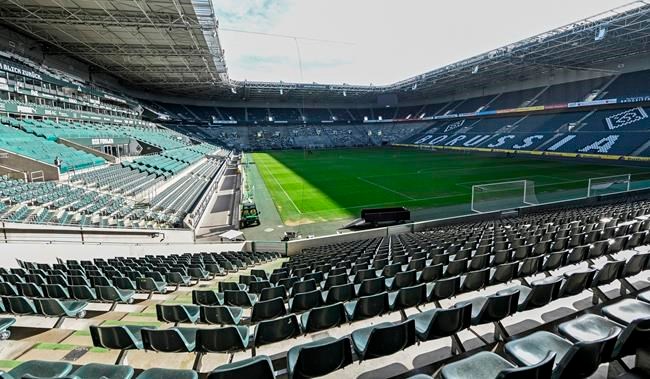
The Bundesliga, last played on March 11, was hoping to resume in May without spectators, but the number of people needed at venues — two teams, substitutes, coaches, medical staff, security to ensure fans stay away — means even games in almost empty stadiums look like a tall order.
Complicating the issue for the German soccer league (DFL), is that each of the country’s 16 states can set their own conditions. It’s very likely they will differ, meaning some games could be allowed and others not.
German soccer federation president Fritz Keller is expecting momentous fallout.
“I don’t think the landscape in soccer will be the same after the corona crisis,” Keller said last week. “We’re going to miss a few (clubs), and I think that the longer it continues, the more bankruptcies we’re going to have in professional soccer.”
Schalke and Paderborn in the Bundesliga are reportedly facing insolvency, while Kicker magazine says 13 clubs in the second division are also under existential threat if a delayed installment payment for television rights is not made to the DFL.
The magazine reports that Sky, DAZN and ARD missed a payment of 304 million euros ($331 million) — the last of four installments for TV rights for the two divisions — to the league on April 10, but the broadcasters have agreed to pay on May 2.
“We can manage another one or two months, but then we’re out of air,” Paderborn managing director Martin Przondziono told broadcaster Sport1. “If the TV money doesn’t come, it will be tight for us.”
Schalke has made no secret of its financial problems caused by the pandemic despite a sponsorship arrangement with Russian energy giant Gazprom reportedly worth 30 million euros per season.
Schalke communications director Alexander Jobst last month asked holders of boxes in the stadium to waive partial repayment for the club’s last home games.
“It’s about existence!” Jobst wrote in an email on March 17.
Schalke finance director Peter Peters warned club fans this week that its situation was precarious.
“We’re trying to reduce costs, have reduced employees’ working hours and agreed wage cuts with the players,” Peters said on Facebook. “But of course everything depends on when we can take in income and play football again.”
The clubs are to meet again on April 23 to discuss how they can end the season as planned by June 30.

As of Thursday, Germany had nearly 135,000 registered cases of COVID-19, with 3,804 deaths attributed to the disease, according to Johns Hopkins University.
___
More AP soccer: https://apnews.com/Soccer and https://twitter.com/AP_Sports
___
Ciarán Fahey on Twitter: https://twitter.com/cfaheyAP
Related Articles
NWSL had momentum heading into now suspended season





Advertisement Advertise With Us
Advertisement Advertise With Us