

Soccer commentator forced to call German games from London
Advertisement
Read this article for free:
or
Already have an account? Log in here »
To continue reading, please subscribe:

Digital Subscription
One year of digital access for only $205*
- Enjoy unlimited reading on winnipegfreepress.com
- Read the E-Edition, our digital replica newspaper
- Access News Break, our award-winning app
- Play interactive puzzles
*First annual payment billed as $205.00 + GST for one year. This annual subscription will automatically renew at $233.00 + GST every 52 weeks (10% off the regular annual price of $259.35). Offer available to new and qualified returning subscribers only. Cancel any time.
To continue reading, please subscribe:
Add Free Press access to your Brandon Sun subscription for only an additional
$1 for the first 4 weeks*
- Enjoy unlimited reading on winnipegfreepress.com
- Read the E-Edition, our digital replica newspaper
- Access News Break, our award-winning app
- Play interactive puzzles
*Your next Brandon Sun subscription payment will increase by $1.00 and you will be charged $17.95 plus GST for four weeks. After four weeks, your payment will increase to $24.95 plus GST every four weeks.
Read unlimited articles for free today:
or
Already have an account? Log in here »
Hey there, time traveller!
This article was published 23/05/2020 (2296 days ago), so information in it may no longer be current.
LONDON – The resumption of the German soccer league has put players back on the field, coaches back on the sideline, and commentators back in the booth.
The booth, however, could be just about anywhere.
Dan O’Hagan is a veteran soccer commentator who has called games at the World Cup, in the English Premier League, the Italian league, and even the Japanese league, among many others. He also does Bundesliga matches in English, but on Saturday he was working from a small studio in north London because of restrictions on travel during the coronavirus pandemic.
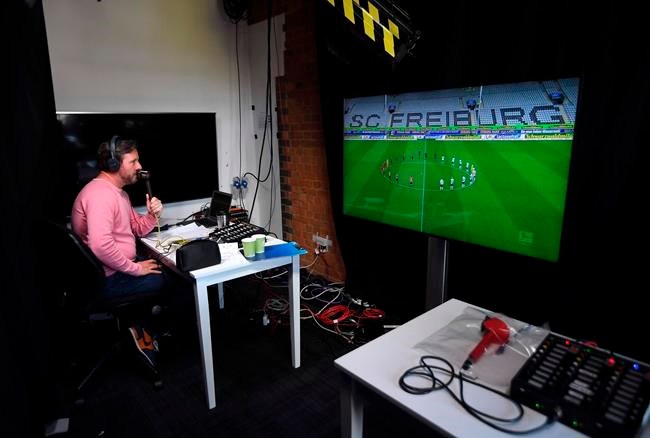
“Normally we’d be in Cologne doing these games, in Germany,” O’Hagan said from the studio in the same building that houses The Associated Press. “Obviously that now is not possible, but doing games from studios for most commentators now, it’s almost second nature. So that doesn’t really present a new challenge.”
The big challenge actually came last week, when Germany became the first country to restart a major soccer league amid the pandemic, albeit in empty stadiums and with social distancing protocols in place.
It wasn’t just the players that were out of practice.
“I think (it was) eight weeks without working,” O’Hagan said, “so I was a bit worried that I might be a bit rusty.”
One of the most important elements for O’Hagan during the resumption has been keeping the right balance between soccer and the deadly effects of the virus around the world.
Germany seems to have handled the pandemic better than many other big countries, but it still has reported more than 8,000 deaths.
“We want to hit the right tone because it’s a very serious global situation, so we want to make sure that our coverage reflects respectfully both the tone and also the measures in place from the German football league to ensure the games are played safely,” O’Hagan said.
“The German game has done all it can to get the games on so we feel a responsibility to portray the league in a light that shows these efforts.”

The remote commentators don’t have any control over the pictures that they have to talk over, but that is normal when calling games from a studio, O’Hagan said.
The weird aspect of these particular games, though, is the empty stadiums.
“OK, there’s no fans there, but the pictures are still the pictures we’d get anyway in terms of angles, in terms of number of cameras, and closeups,” O’Hagan said. “So there’s no great difference in calling the game here or in Cologne or in the stadium.”
___
More AP soccer: https://apnews.com/Soccer and https://twitter.com/AP_Sports
Related Articles
Lyon boss asks PM to reconsider early end of French season






Advertisement Advertise With Us
Advertisement Advertise With Us