

Pandemic stops small German clubs from hosting cup games
Advertisement
Read this article for free:
or
Already have an account? Log in here »
To continue reading, please subscribe:

Digital Subscription
One year of digital access for only $205*
- Enjoy unlimited reading on winnipegfreepress.com
- Read the E-Edition, our digital replica newspaper
- Access News Break, our award-winning app
- Play interactive puzzles
*First annual payment billed as $205.00 + GST for one year. This annual subscription will automatically renew at $233.00 + GST every 52 weeks (10% off the regular annual price of $259.35). Offer available to new and qualified returning subscribers only. Cancel any time.
To continue reading, please subscribe:
Add Free Press access to your Brandon Sun subscription for only an additional
$1 for the first 4 weeks*
- Enjoy unlimited reading on winnipegfreepress.com
- Read the E-Edition, our digital replica newspaper
- Access News Break, our award-winning app
- Play interactive puzzles
*Your next Brandon Sun subscription payment will increase by $1.00 and you will be charged $17.95 plus GST for four weeks. After four weeks, your payment will increase to $24.95 plus GST every four weeks.
Read unlimited articles for free today:
or
Already have an account? Log in here »
Hey there, time traveller!
This article was published 10/09/2020 (2189 days ago), so information in it may no longer be current.
DÜSSELDORF, Germany – It could have been the game of a lifetime for fans of German soccer club Union Fürstenwalde, taking on Bundesliga team Wolfsburg in its 2,000-capacity home stadium. The coronavirus made it impossible.
Fürstenwalde, from the north-east regional league, is one of 11 German clubs in the fourth and fifth divisions who gave up their cherished home advantage against much bigger opponents as the German Cup begins this weekend.
Instead of playing before a passionate crowd of locals trying to intimidate the Bundesliga visitors, Fürstenwalde will travel to Wolfsburg’s empty reserve stadium.
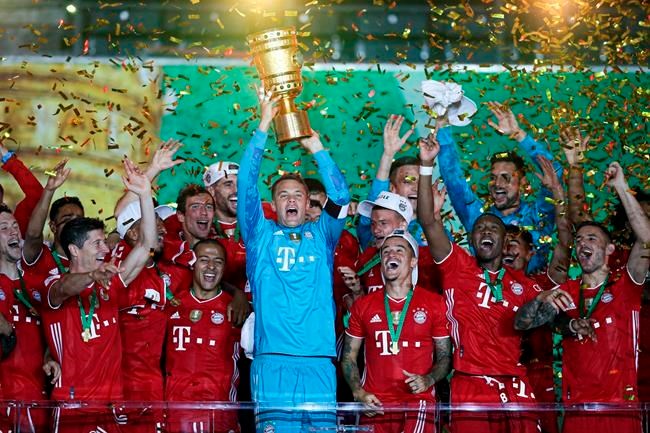
In normal conditions, Fürstenwalde could hope to earn 350,000 euros ($410,000) from its first German Cup game and invest it in the club’s future, club spokesman Fred Wilczek told The Associated Press.
This season it faced spending much of its prize money from a regional qualifying competition on adapting the stadium for TV, with spectator numbers greatly reduced even if the club had approval from local authorities. The situation during the pandemic is “extremely problematic,” Wilczek said.
The first round of the German Cup is a traditional showcase for amateur and semi-professional teams, who automatically get home advantage against clubs from higher divisions. It usually brings a windfall in ticket sales and TV exposure, so competition to qualify via regional cups is fierce.
The home crowd can lift obscure teams to a surprise victory — or several — on the national stage. Last season, fourth-division club Saarbrücken knocked out two Bundesliga clubs at home on its way to the semifinals before being beaten by Bayer Leverkusen in an empty stadium amid the pandemic.
This season, strict rules around the coronavirus left small clubs facing big costs to play at home, or simply a flat refusal from the German soccer authorities.
Besides testing players for COVID-19, clubs have to divide the stadium into three working zones to enforce social distancing between people working in different roles before and during the game. Even for a Bundesliga club it’s an organizational headache. In a cramped or ramshackle amateur stadium, it may be impossible.
Fifth-division club Rielasingen-Arlen complained the German soccer federation, known as the DFB, forced it to give up home advantage despite attempts to show it could host safely at its own stadium or other local grounds.
Rielasingen-Arlen said the DFB would only accept the club using top-division Freiburg’s arena, which wasn’t available. Rielasingen-Arlen has now allowed second-division opponent Holstein Kiel to hold the game.

“With a heavy heart we had to give away hosting rights for the DFB Cup game against Holstein Kiel. We had to give in to the great pressure which was piled onto us by the DFB,” the club said in a statement.
The DFB allowed defending champion Bayern Munich to move its first-round game against fifth-division club Düren back a month to Oct. 15. That allows Bayern more time to recover after winning the Champions League final. That game also will be played at Bayern’s home stadium.
German rules on fans at games during the pandemic are a patchwork of regulations from different local authorities. Bundesliga club Mainz is hoping to have 1,000 fans when it hosts fourth-division club Havelse. Schalke wants to invite 300 workers from hospitals and senior care homes to watch it play Schweinfurt. Both Havelse and Schweinfurt gave up home advantage citing the burden of hosting under coronavirus-related restrictions.
___
More AP soccer: https://apnews.com/Soccer and https://twitter.com/AP_Sports
Related Articles
Plenty of class in 2020-21 for Europe's top football leagues






Advertisement Advertise With Us
Advertisement Advertise With Us