

FIFA provides breakdown of expanded 32-team Women’s World Cup field
Advertisement
Read this article for free:
or
Already have an account? Log in here »
To continue reading, please subscribe:
Digital Subscription
One year of digital access for only $1.44 a week*
- Enjoy unlimited reading on winnipegfreepress.com
- Read the E-Edition, our digital replica newspaper
- Access News Break, our award-winning app
- Play interactive puzzles
*Billed as $5.77 plus GST every four weeks. After 52 weeks, price increases to the regular rate of $19.95 plus GST every four weeks. Offer available to new and qualified returning subscribers only. Cancel any time.
To continue reading, please subscribe:
Add Free Press access to your Brandon Sun subscription for only an additional
$1 for the first 4 weeks*
- Enjoy unlimited reading on winnipegfreepress.com
- Read the E-Edition, our digital replica newspaper
- Access News Break, our award-winning app
- Play interactive puzzles
*Your next Brandon Sun subscription payment will increase by $1.00 and you will be charged $17.95 plus GST for four weeks. After four weeks, your payment will increase to $24.95 plus GST every four weeks.
Read unlimited articles for free today:
or
Already have an account? Log in here »
Hey there, time traveller!
This article was published 24/12/2020 (2126 days ago), so information in it may no longer be current.
CONCACAF will have four direct berths for the expanded Women’s World Cup in 2023 with two more teams from the region having a chance to join them via a 10-team playoff tournament.
Canada, the U.S. and Jamaica represented the confederation covering North and Central America and the Caribbean at the 24-team World Cup in France last year. A fourth CONCACAF country, Panama, had a chance to qualify but lost 5-1 on aggregate to Argentina in a home-and-away CONCACAF-CONMEBOL playoff.
On Thursday, FIFA released the breakdown for the enlarged 32-team women’s showcase,
Europe (UEFA) will get 11 direct slots while Asia (AFC) gets six and Africa (CAF), like CONCACAF, gets four. South America (CONMEBOL) gets three and Oceania (OFC) one.
Host Australia and New Zealand automatically qualify with their slots taken directly from the quotas allocated to their confederations (AFC and OFC, respectively).
Host Australia and New Zealand automatically qualify with their slots taken directly from the quotas allocated to their confederations (AFC and OFC, respectively). ,one each from Oceania and Europe.
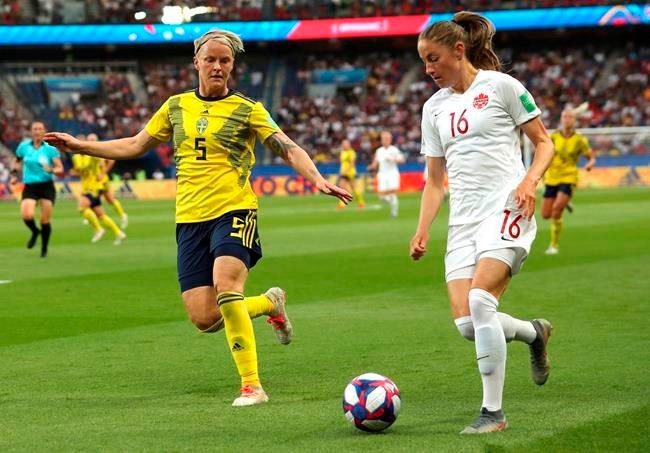
The 2019 World Cup field featured nine teams from Europe, including host France, five from Asia, three from Africa and CONCACAF, two from South America, one from Oceania and the winner of the CONCACAF-CONMEBOL playoff.
The first Women’s World Cup, held in 1991 in China, had 12 participants. Canada failed to qualify for the first edition, with the U.S. the lone representative from CONCACAF.
But Canada has played in the seven tournaments since. Its best showing was in 2003 when it finished fourth in the U.S. The Canadian women reached the quarterfinals in 2015 on home soil and exited in the round-of-16 last year in France.
Four teams will be seeded in the 2023 playoff tournament, based on the latest FIFA world rankings prior to the draw, with a maximum of one seeded team per confederation. The teams will be divided into three pools — two of three countries and one of four — with sides from the same confederation kept apart.
The three-team groups will see the seeded country against the winner of a knockout game involving the two unseeded teams in the group with a World Cup berth on the line. The four-team group will see seeds No. 3 and 4 playing against the two unseeded teams in the group, with the two winners then playing for a place in the World Cup.

The playoff tournament will serve as a test event in Australia and New Zealand with both hosts taking part in friendly matches against the teams in Group 1 and Group 2, ensuring all teams play two matches during the competition.
In other tournament news, FIFA has cancelled the 2021 editions of the men’s FIFA U-20 World Cup and FIFA U-17 World Cup due to the pandemic. Indonesia and Peru, which were to host the tournaments in 2021, will serve as hosts in 2023.
“It became clear that the global situation has failed to normalize to a sufficient level to address the challenges associated with hosting both tournaments, including the feasibility of the relevant qualification pathways,” FIFA said in a statement.
Follow @NeilMDavidson on Twitter
This report by The Canadian Press was first published Dec. 24, 2020
Related Articles
Leicester rallies twice to draw 2-2 with Manchester United





Advertisement Advertise With Us
Advertisement Advertise With Us