

Löw limps closer to exit after Germany’s latest painful loss
Advertisement
Read this article for free:
or
Already have an account? Log in here »
To continue reading, please subscribe:

Digital Subscription
One year of digital access for only $205*
- Enjoy unlimited reading on winnipegfreepress.com
- Read the E-Edition, our digital replica newspaper
- Access News Break, our award-winning app
- Play interactive puzzles
*First annual payment billed as $205.00 + GST for one year. This annual subscription will automatically renew at $233.00 + GST every 52 weeks (10% off the regular annual price of $259.35). Offer available to new and qualified returning subscribers only. Cancel any time.
To continue reading, please subscribe:
Add Free Press access to your Brandon Sun subscription for only an additional
$1 for the first 4 weeks*
- Enjoy unlimited reading on winnipegfreepress.com
- Read the E-Edition, our digital replica newspaper
- Access News Break, our award-winning app
- Play interactive puzzles
*Your next Brandon Sun subscription payment will increase by $1.00 and you will be charged $17.95 plus GST for four weeks. After four weeks, your payment will increase to $24.95 plus GST every four weeks.
Read unlimited articles for free today:
or
Already have an account? Log in here »
Hey there, time traveller!
This article was published 01/04/2021 (2001 days ago), so information in it may no longer be current.
DÜSSELDORF, Germany – Joachim Löw’s explanations of what went wrong in the German national team’s latest humiliating loss have become a familiar ritual.
When South Korea eliminated Germany from the 2018 World Cup, he said the team went to Russia “perhaps with a certain arrogance.” When Spain routed his new-look team 6-0 last year, it was a “very dark day” when “nothing worked.”
Löw did it again Wednesday after North Macedonia beat Germany 2-1 in the last qualifying game of his 15-year-tenure.
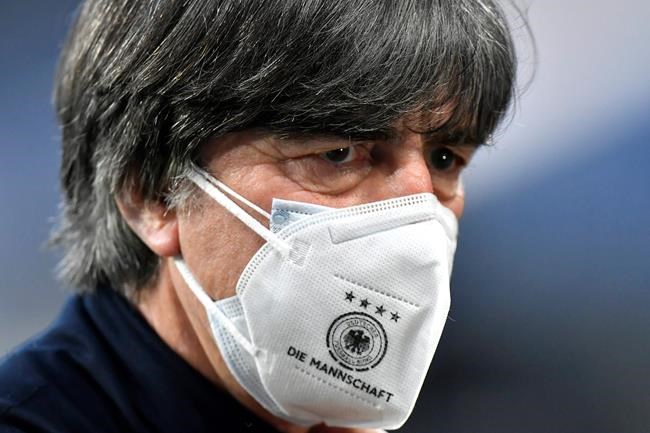
“We just lost many, many balls when playing forward,” he told broadcaster RTL.
Facing counterattacks, he said “the defence was not stable.”
There won’t be many more of these moments. Not necessarily because Germany will improve before playing World Cup champion France, European champion Portugal and Hungary at this year’s European Championship, but because Löw is leaving after that tournament. The 6-0 loss in Spain was the catalyst for him to bring forward his departure date, rather than cling on until the 2022 World Cup.
When Germany signed Löw to a four-year contract extension in May 2018, it showed faith in the coach who had led the team to the 2014 World Cup title. Even then, eyebrows were raised at the timing. Germany’s collapse at the World Cup in Russia the following month meant the final act of Löw’s long tenure would be a rebuild.
Germany’s showing in Russia was its worst World Cup campaign since 1938, and there’s been more unwanted history since. The loss to Spain was Germany’s biggest in 89 years. Losing to North Macedonia ended a 20-year, 35-game unbeaten run for the national team in World Cup qualifying.
Löw finds it hard to explain why his plans aren’t working. The team is built around Bayern Munich, the team that won the Champions League last season. Individual players are doing well for their clubs, like Manchester City midfielder Ilkay Gündogan, who captained Germany on Wednesday, and Chelsea defender Antonio Rüdiger. They just don’t seem to gel in Germany shirts.
Injuries have played their part, too, leading Löw to use defensive midfielder Emre Can at left back and right back in successive World Cup qualifiers. The pandemic-affected schedule means heavy legs and arduous travel, but that’s also true for North Macedonia, which started 37-year-old striker Goran Pandev in three games in six days. He still scored against Germany.
Löw has resisted reversing the central decision of his rebuild — dropping stalwarts Thomas Müller, Jerome Boateng and Mats Hummels in 2019. Since then, Müller has excelled for Bayern. Hummels and Boateng remain regulars at their clubs, too, while Löw has experimented with various uneasy centre back combinations of Rüdiger, Niklas Süle, Jonathan Tah, Robin Koch and Matthias Ginter.
One big difference between Bayern and Germany is the national team’s lack of an imposing centre forward. Bayern has Poland striker Robert Lewandowski, while Germany has Timo Werner. The Chelsea forward squatted with his head in his hands after missing a point-blank chance against North Macedonia, mirroring his problems adapting to the Premier League this season.

And at left back, Robin Gosens, Philipp Max and Marcel Halstenberg have all played but none have staked a convincing claim to be first choice.
The build-up to Löw’s last tournament will be dominated by speculation about who will replace him. Löw has done some useful groundwork for his successor, like persuading 18-year-old Bayern forward Jamal Musiala to choose Germany over England.
Recent results mean the new coach will have another advantage — low expectations.
___
More AP soccer: https://apnews.com/hub/soccer and https://twitter.com/AP_Sports
Related Articles
Man from Malta joins FC Manitoba


Advertisement Advertise With Us
Advertisement Advertise With Us