

A new year brings new challenges for Bev Priestman and Canada’s women
Advertisement
Read this article for free:
or
Already have an account? Log in here »
To continue reading, please subscribe:

Digital Subscription
One year of digital access for only $205*
- Enjoy unlimited reading on winnipegfreepress.com
- Read the E-Edition, our digital replica newspaper
- Access News Break, our award-winning app
- Play interactive puzzles
*First annual payment billed as $205.00 + GST for one year. This annual subscription will automatically renew at $233.00 + GST every 52 weeks (10% off the regular annual price of $259.35). Offer available to new and qualified returning subscribers only. Cancel any time.
To continue reading, please subscribe:
Add Free Press access to your Brandon Sun subscription for only an additional
$1 for the first 4 weeks*
- Enjoy unlimited reading on winnipegfreepress.com
- Read the E-Edition, our digital replica newspaper
- Access News Break, our award-winning app
- Play interactive puzzles
*Your next Brandon Sun subscription payment will increase by $1.00 and you will be charged $17.95 plus GST for four weeks. After four weeks, your payment will increase to $24.95 plus GST every four weeks.
Read unlimited articles for free today:
or
Already have an account? Log in here »
Hey there, time traveller!
This article was published 07/02/2022 (1699 days ago), so information in it may no longer be current.
There is nothing like winning Olympic gold, but Bev Priestman is putting the medal Canada’s national team won in women’s soccer at Tokyo 2020 in the rearview mirror as she kicks off a new year with the squad.
Priestman’s first full year in charge of the team in 2021, after she was hired as head coach in October 2020, was a busy one. She comes into 2022 feeling fresh, and ready to take the squad in a new direction.
“We have to set that new vision and tweak some things that will help us longer term as a team,” Priestman said last week.
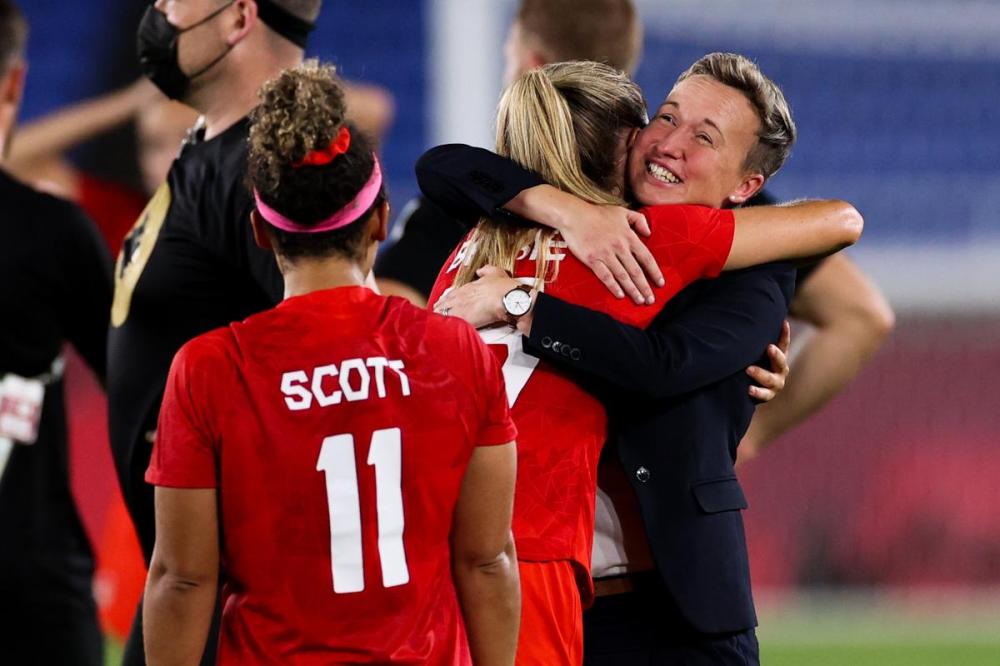
That process began not long after Canada climbed to the top of the podium last August. The team took part in two celebration tour games in Ottawa and Montreal in October, as well as in a pair of friendlies in Mexico in November. Priestman has been continually scouting and assessing a number of Canadian players at club level in Europe and around the world.
But the start of a new journey begins in earnest this week, as Priestman gathers 25 players in England for the inaugural Arnold Clark Cup, a four-team tournament beginning on Thursday that will see the sixth-ranked Canadians take on world No. 3 Germany, No. 8 England and No. 10 Spain through next Wednesday.
It’s a tough jumping off point as Priestman prepares the team for this summer’s CONCACAF W Championship, a new eight-team competition to be held in Mexico in July that will serves as qualification for both the World Cup in Australia and New Zealand in 2023 and the Paris 2024 Olympics. The final four teams in that tournament earn World Cup qualification, with another two advancing to inter-continental playoffs. Only the W Championship’s winner automatically qualifies for the next Summer Games, with the second- and third-place teams advancing to a CONCACAF Olympic playoff.
Priestman isn’t expecting Canada to blow its competition in England out of the water, with nearly half the squad essentially out of season as the National Women’s Soccer League in the United States is only ramping up. The German, English and Spanish teams are all midway through the group phase of Europe’s World Cup qualification process.
But the message from the coach is clear: Canada has climbed one mountain. Becoming World Cup champions is another.
“If you really want to put yourself out there, you enter this tournament,” Priestman said. “We want to be competing with the best continuously. The safe thing to do would be to go and play some weaker opposition but we want to keep moving forward.”
Captain Christine Sinclair is not in camp, after her mother, Sandi, died following a 40-year battle with multiple sclerosis.
“As a team we’re right behind Christine and collectively we made the decision for her to be around loved ones at this really, really difficult time,” Priestman said.
Forward Adriana Leon is also out, as she recovers from her foot surgery last fall.
The squad includes 18 players who won gold in Tokyo; goalkeeper Sabrina D’Angelo, fullback Sura Yekka, midfielder Victoria Pickett and forward Cloe Lacasse, who joined the team in Mexico last year; and newcomers Marie-Yasmine Alidou, a midfielder, forward Tanya Boychuk and goalkeeper Devon Kerr.
A shorter turnaround between major competitions because of the delay to Tokyo 2020 means Priestman will have to assess players on the fly, as she narrows in on her qualification and, eventually, World Cup squads.

“The team that’s needed in 2023 might be different to the team that was needed in 2021,” Priestman said.
Priestman will also be assessing how Canada fares against European competition. The upcoming World Cup, which will be expanded from 24 to 32 teams, will include at least 11 European nations, three more than was at the Women’s World Cup in 2019.
Seven of the final eight teams in France three years ago came out of Europe. Canada has historically struggled against European teams, with just one win in its past seven World Cup matches against European opposition, dating back to 2010. Priestman knows Canada will need to improve those statistics to win the World Cup, which is why she is starting to challenging her team by competing at the Arnold Clark Cup now.
“When you play these level of opposition, every minute counts on the sideline, every touch matters,” Priestman said. “I think this is the place that you learn, you grow, you develop.”
Laura Armstrong is a Star sports reporter based in Toronto. Follow her on Twitter: @lauraarmy
Related Articles
Players react to abuse allegations with letter to US Soccer Cavalry FC sign experienced winger Fraser Aird






Advertisement Advertise With Us
Advertisement Advertise With Us