

Inside the Qatar control room watching over the World Cup
Advertisement
Read this article for free:
or
Already have an account? Log in here »
To continue reading, please subscribe:
Digital Subscription
One year of digital access for only $1.44 a week*
- Enjoy unlimited reading on winnipegfreepress.com
- Read the E-Edition, our digital replica newspaper
- Access News Break, our award-winning app
- Play interactive puzzles
*Billed as $5.77 plus GST every four weeks. After 52 weeks, price increases to the regular rate of $19.95 plus GST every four weeks. Offer available to new and qualified returning subscribers only. Cancel any time.
To continue reading, please subscribe:
Add Free Press access to your Brandon Sun subscription for only an additional
$1 for the first 4 weeks*
- Enjoy unlimited reading on winnipegfreepress.com
- Read the E-Edition, our digital replica newspaper
- Access News Break, our award-winning app
- Play interactive puzzles
*Your next Brandon Sun subscription payment will increase by $1.00 and you will be charged $17.95 plus GST for four weeks. After four weeks, your payment will increase to $24.95 plus GST every four weeks.
Read unlimited articles for free today:
or
Already have an account? Log in here »
Hey there, time traveller!
This article was published 28/03/2022 (1672 days ago), so information in it may no longer be current.
DOHA, Qatar (AP) — A map of the world flashes cyber threat warnings. Into view across the big-screen-covered wall comes live video from World Cup stadiums. Then there’s the incident alarm panels for all eight venues in Qatar.
This command center for the World Cup is all quiet and calm. By November, however, it will be at the heart of operations for the most high-profile sporting event to be staged in the Middle East.
This is a first look inside one of the key locations overseeing security and logistics.
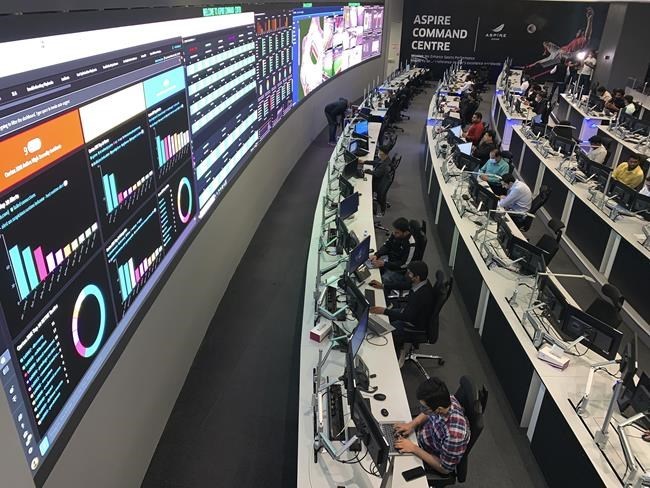
As a screen with the map of Qatar shows starkly, the World Cup is being staged in the most compact setting ever. All eight stadiums being monitored from this room, which is on the Aspire sports campus on the outskirts of Doha, are within a 30-mile (50-kilometer) radius of the capital of this energy-rich Gulf nation.
Most of the 32 nations will have discovered where they will be playing after the tournament draw takes place in the center of Doha on Friday — the first major gathering of world football in the city since Qatar so unexpectedly won the FIFA hosting vote in 2010. The decision required a major upgrade of infrastructure and for this tiny nation to prepare for an unprecedented influx of supporters.
“We have the capabilities to remotely monitor every system we can, control every system, and thereby change the behavior in the stadiums,” Niyas Abdulrahiman, an executive director with the local organizers, told The Associated Press.
Abdulrahiman was speaking while surrounded by staff peering into banks of monitors.
“We can also receive alarms and notifications as part of our proactive monitoring in the command center. Before something goes wrong.”
Qatar claims it is the most sophisticated system ever seen at a sporting event. In linking the stadiums to one hub, each stadium also has a digital version of itself that allows officials to trace an issue on site.
The deadly crush in January involving fans at the African Cup of Nations in Cameroon could be avoided at the World Cup thanks to the command center’s ability to offer key decisions about crowd control and whether to open gates.
“One of the most powerful features of this command center is coordinating the different actions on the ground in the event of any unfortunate incident, such as … a crowd-based situation,” Abdulrahiman said.
“Here the power of the platform is that you have total control over those systems and, if such an incident happens, there’s a predefined standard operating procedure that … starts executing one, two, three steps. So one of them would be that, if there is an emergency, open all the gates. So that can happen all at once.”
Public announcements can be triggered from the command center to be broadcast at stadiums, including urging an evacuation. Messages can be flashed on the stadium screens from the keyboards surrounding Abdulrahiman.

“If there’s an incident in one stadium,” he said, “we can not only manage that incident in that stadium, but also how it will influence the other stadiums.”
But such connectivity poses risks made clear by the map of the globe showing live threats from hackers and countries being attacked digitally to penetrate systems. Cyber surveillance will be happening around the clock to try and ensure modern online warfare does not pose a risk to the Nov. 21-Dec. 18 FIFA showpiece.
“Cyber terrorism has become more and more prominent and has become a favorite tool for people with bad intentions,” Abdulrahiman said. “We have made sure that we have the tools and capabilities and people to be prepared for such unfortunate scenarios.”
___
More AP soccer: https://apnews.com/hub/soccer and https://twitter.com/AP_Sports
Related Articles
Record attendance: 91,553 watch women's game in Barcelona






Advertisement Advertise With Us
Advertisement Advertise With Us