

South American women’s soccer improving but some way to go
Advertisement
Read this article for free:
or
Already have an account? Log in here »
To continue reading, please subscribe:

Digital Subscription
One year of digital access for only $205*
- Enjoy unlimited reading on winnipegfreepress.com
- Read the E-Edition, our digital replica newspaper
- Access News Break, our award-winning app
- Play interactive puzzles
*First annual payment billed as $205.00 + GST for one year. This annual subscription will automatically renew at $233.00 + GST every 52 weeks (10% off the regular annual price of $259.35). Offer available to new and qualified returning subscribers only. Cancel any time.
To continue reading, please subscribe:
Add Free Press access to your Brandon Sun subscription for only an additional
$1 for the first 4 weeks*
- Enjoy unlimited reading on winnipegfreepress.com
- Read the E-Edition, our digital replica newspaper
- Access News Break, our award-winning app
- Play interactive puzzles
*Your next Brandon Sun subscription payment will increase by $1.00 and you will be charged $17.95 plus GST for four weeks. After four weeks, your payment will increase to $24.95 plus GST every four weeks.
Read unlimited articles for free today:
or
Already have an account? Log in here »
Hey there, time traveller!
This article was published 06/07/2022 (1550 days ago), so information in it may no longer be current.
BUENOS AIRES (AP) — The Women’s Copa America soccer tournament starts Friday in Colombia at a time when the sport is clearly evolving in South America but at significantly different speeds and opportunities for players.
Ten teams are split into two groups with two countries advancing from each group to the knockout stage. The final is on July 30 at Stadium Alfonso Lopez in the Colombian city of Bucaramanga.
Defending champion Brazil has developed its women’s soccer organization on its own. Elsewhere, most players in the region have struggled to get professional contracts and, even when they do, there remains a huge gap compared to the money paid to men’s teams and their players.
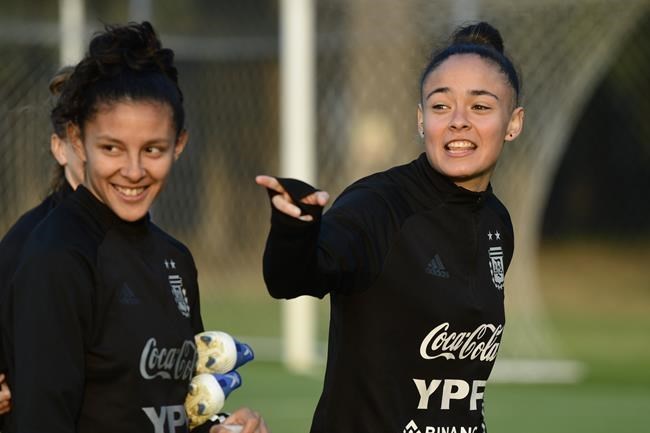
Four years ago at the Women’s Copa America in Chile, veteran goalkeeper Vanina Correa organized a protest with other players on the Argentina national team. As they gathered for a pre-match photo, they struck a pose with their hands cupped behind their right ears, a sign of protest and showing they wanted to be heard by Argentina’s soccer federation.
“Many things have changed, they have listened to us,” Correa said after training with Argentina at the Ezeiza complex, outside Buenos Aires, where soccer superstar Lionel Messi has also trained when on national duty.
At the tournament in Colombia, Argentina hopes to secure one of the three direct spots available for the Women’s World Cup in New Zealand and Australia in 2023.
A lot has changed in the game. Younger women footballers in Argentina have secured a minimum level of pay. Players like the 38-year-old Correa faced a much more hostile and sexist environment most of their careers, with women often criticized simply for wanting to play soccer. Clubs had no locker rooms or kits for the teams. Signing a contract was only a dream.
“We always believe we can add many other things, but we get our objectives and then ask for something extra,” Correa said.
The South American soccer confederation (CONMEBOL) said the winner of the tournament, which was played for the first time in 1991, will earn a record $1.5 million. From this edition onward, the tournament will be played once every two years.
“Women’s soccer has a short trajectory in South America, only 31 years, we are working to speed our processes up,” said Fabimar Franchi, who manages the development division for women’s soccer at CONMEBOL. “It will be a historic Copa America, a different one, and you will see on and off the pitch. Preparations, the show, the organization. Women’s soccer continues to grow.”
This year, Argentina started a system of licenses for women’s soccer clubs which requires them to have two women on their coaching staff, pay for players’ health insurance, provide training grounds and social media profiles, along with a protocol for dealing with situations of violence and discrimination.
The 2018 runner-up Chile, whose captain Christiane Endler recently won the Women’s Champions League with Lyon, started its professional league this year.
“There is very good work at the national team level, but we still need more in the local tournaments, not enough has been done,” Endler said. “The professionalization of women’s soccer is a great step, no doubt, but it is important that clubs work more.”
Chile’s rules require clubs to give contracts to half of their players in the first year, then 75% in the second, and 100% in the third.
In Colombia, women’s soccer is also professional but the season is short and players have no income for months. But fans are clearly interested, with around 40,000 watching the latest Colombian championship between Deportivo Cali and América Cali.
CONMEBOL has organized youth division tournaments for women since 2018. Men’s clubs wanting to take part in the prestigious Copa Libertadores must have two categories of women’s teams — senior and youth.
“Some of these players at age 17 and 18 are already professional. These girls who have had new opportunities will be at the Women’s Copa America,” Franchi said.
Brazil has led the region in women’s soccer developments, even more so since its own soccer body required in 2019 that every club in the men’s Brazilian championship must also have a women’s team.
Corinthians and Ferroviaria’s teams have won continental and national championships in recent years — with occasional crowds of more than 40,000 fans. Other big clubs like Palmeiras and Flamengo have also invested in women’s soccer.
Brazil’s soccer confederation paid Corinthians women’s team $54,000 for winning its third consecutive Brazilian title in 2021 — less than 1% of the amount received by Atlético Mineiro, the men’s champion. Brazilian media reports earlier this year said the monthly payroll of Corinthians’ women’s team is around $73,000, while the men’s team tops $2.7 million.

Brazilian soccer bodies have said most of the country’s professional women footballers are paid about $920 a month, similar to five years ago, though some benefits have improved and there is growing interest from fans.
All this is still far from women’s soccer powerhouses like United States and Spain, but many South American women footballers say progress is possible.
“Sponsors, the media, people have to get interested in going to the stadium to watch women’s soccer,” said Argentina defender Aldana Cometti. “When this happens, everyone will grow.”
___
More AP soccer: https://apnews.com/hub/soccer and https://twitter.com/AP_Sports
Related Articles
DC United goalkeeper Hamid out 2-3 months after hand surgery Whitecaps forward Caicedo out for season







Advertisement Advertise With Us
Advertisement Advertise With Us