

EXPLAINER: Why are Argentines such ardent World Cup fans?
Advertisement
Read this article for free:
or
Already have an account? Log in here »
To continue reading, please subscribe:

Digital Subscription
One year of digital access for only $205*
- Enjoy unlimited reading on winnipegfreepress.com
- Read the E-Edition, our digital replica newspaper
- Access News Break, our award-winning app
- Play interactive puzzles
*First annual payment billed as $205.00 + GST for one year. This annual subscription will automatically renew at $233.00 + GST every 52 weeks (10% off the regular annual price of $259.35). Offer available to new and qualified returning subscribers only. Cancel any time.
To continue reading, please subscribe:
Add Free Press access to your Brandon Sun subscription for only an additional
$1 for the first 4 weeks*
- Enjoy unlimited reading on winnipegfreepress.com
- Read the E-Edition, our digital replica newspaper
- Access News Break, our award-winning app
- Play interactive puzzles
*Your next Brandon Sun subscription payment will increase by $1.00 and you will be charged $17.95 plus GST for four weeks. After four weeks, your payment will increase to $24.95 plus GST every four weeks.
Read unlimited articles for free today:
or
Already have an account? Log in here »
Hey there, time traveller!
This article was published 17/12/2022 (1384 days ago), so information in it may no longer be current.
Argentina arguably has the World Cup’s most fervent fans, known for their rhythmical singing, incessant drumming and trance-like ferocity.
The country’s history of success at the World Cup — champions in 1978 and 1986, and runners-up three times — is rivaled by few. This fervor will only grow as Lionel Messi leads Argentina against defending champion France in Sunday’s final in Qatar.
The World Cup is followed almost everywhere — Brazil to Belgium, Morocco to Mexico, and Saudi Arabia to Spain. But few fans are as intense Argentina’s, or as large in numbers in Qatar.
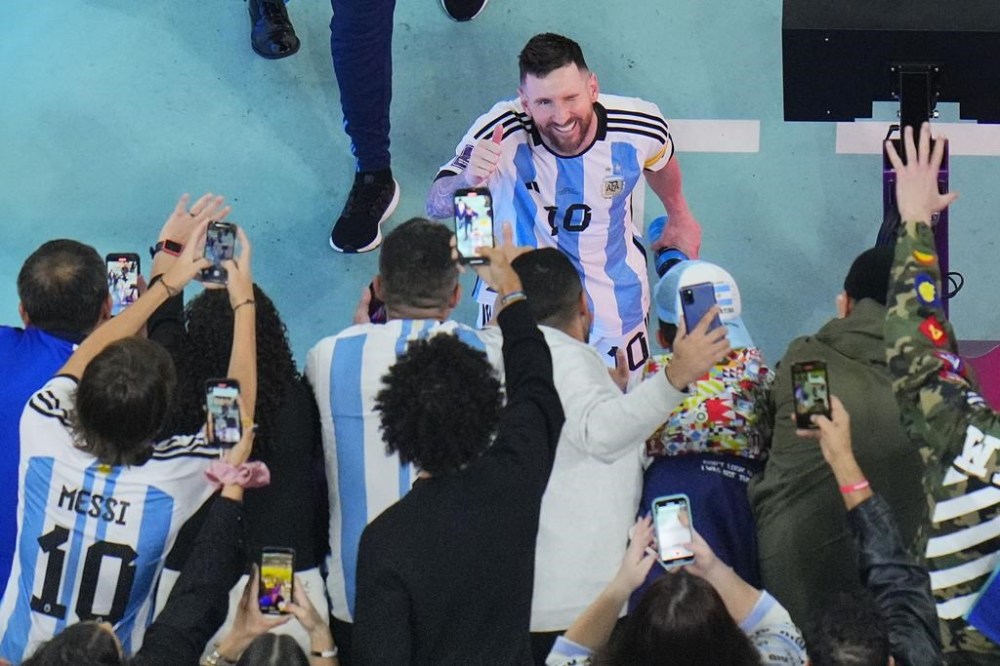
“Above that, people are quite proud of that intensity,” said Santiago Alles, who teaches political science at the University of San Andres in Argentina. “This is something that we are good at, and we care the most about it.”
NATIONAL PRIDE
Inflation in Argentina is running at 100%, unemployment is high and economic growth is slow, and politics are rancorous. But none of that matters during the World Cup. Even opposition political parties call a truce, knowing there is only space for upbeat talk about soccer.
“For a country in the global South, opportunities to defeat the global North are not that frequent,” Alles said. “The World Cup is an opportunity to do that. The national pride is not something you can take away.”
Alles noted that social media in Argentina has shown Japanese fans in Qatar imitating Argentina’s style of cheering, copying the melodies, the pounding drums, and adding improvised lyrics in Japanese.
“We are exporting our way of watching games to other places — faraway places with entirely different cultures,” Alles said. “There is some pride there.”
Alles acknowledged he cannot explain entirely why soccer “holds a pervasive presence in social life,” but it’s omnipresent.
“And it has been that way for at least a century,” Alles added. “I saw a picture of a large crowd listening to the 1930 World Cup on the radio.”
Neighboring Uruguay defeated Argentina 4-2 in the first World Cup final, that one at Estadio Centenario in Montevideo.
IN THE DNA
From sunrise to sunset, in office talk or chatting with friends, the first and last topic in Argentina is often soccer.
“This is a culture where soccer is related with almost every activity in our life,” said Pablo Ava, who teaches sociology at the University of Buenos Aires. “It’s not only passion, but identification. The passion you see in Qatar reflects the passion you see for clubs at a local level.”
Buenos Aires is home to one of the greatest club rivalries: Boca Juniors versus River Plate. Racing Club, among the so-called “Big Five” clubs in Argentina, was strongly supported by former President Juan Domingo Peron. And the stadium was named for him.
“Soccer is important,” Ava said. “It’s part of our conversation. It’s part of our life. Part of our family tradition. Part of our DNA. There is a very strong identification between soccer and your personal life.”
THE POLITICS
Mauricio Macri was the president of Boca Juniors, which helped propel him to the election as mayor of the capital Buenos Aires, and then the presidency of Argentina (2015-19).
Other politicians are directly — or indirectly — connected to many clubs. Sergio Massa, the country’s economy minister, has been a leader at Tigre club and gets some credit for helping get it promoted to the first division.
“Marci showed up in politics, not as an entrepreneur. He showed up as Boca Juniors president who won 17 cups (tournaments),” Ava said. “So many people start seeing soccer teams as a trampoline to a career in politics.
“Soccer and politics have started to have a strong marriage because you get good exposure on TV and if you are a success in soccer you can take that success to the public,” Ava added.
The opposite is also true. Macri attended Argentina’s loss to Saudi Arabia a few weeks ago in the opening match of group play at the World Cup. At home, Macri was seen as bringing bad luck. Consequently, current President Alberto Fernandez has said he will not attend the final.
“He is not going to risk his presidency and show up at the last game in Qatar,” Ava said.
UNIFYING FACTOR
Argentines can disagree on everything, but the national soccer team is a unifying force like nothing else.
“In a country that’s highly factious, it the factor that unites everyone,” Mark Jones, who studies Latin American politics at Rice University in Houston, told The Associated Press. “The team usually does well and it’s something to be associated with.”

The only other unifier that’s as strong is Argentina’s claim over the Falkland Islands (Las Malvinas in Spanish), located off the country’s Atlantic coast but under British control. Argentina fought a brief war over the islands in 1982 and lost.
“Argentines see the country has having gone downhill over the last 75 years, and they see their standard of living is significantly worse than it was three or four year ago,” Jones said. “So they are looking for something to be optimistic about — to be happy about — something to hold on to. The national team, the World Cup, provides that.”
Ava, the sociologist, said Argentines are not “caring now to talk about the inflation, the unemployment, because we are going through something that looks more important — and least for a few more days. Politics has to take a little break to let soccer carry on.”
___
AP World Cup coverage: https://apnews.com/hub/world-cup and https://twitter.com/AP_Sports
Related Articles
With Mbappé and Deschamps, France's future looks just fine








Advertisement Advertise With Us
Advertisement Advertise With Us