

Morocco, Benzina set to make Women’s World Cup history in a game against Germany
Advertisement
Read this article for free:
or
Already have an account? Log in here »
To continue reading, please subscribe:

Digital Subscription
One year of digital access for only $205*
- Enjoy unlimited reading on winnipegfreepress.com
- Read the E-Edition, our digital replica newspaper
- Access News Break, our award-winning app
- Play interactive puzzles
*First annual payment billed as $205.00 + GST for one year. This annual subscription will automatically renew at $233.00 + GST every 52 weeks (10% off the regular annual price of $259.35). Offer available to new and qualified returning subscribers only. Cancel any time.
To continue reading, please subscribe:
Add Free Press access to your Brandon Sun subscription for only an additional
$1 for the first 4 weeks*
- Enjoy unlimited reading on winnipegfreepress.com
- Read the E-Edition, our digital replica newspaper
- Access News Break, our award-winning app
- Play interactive puzzles
*Your next Brandon Sun subscription payment will increase by $1.00 and you will be charged $17.95 plus GST for four weeks. After four weeks, your payment will increase to $24.95 plus GST every four weeks.
Read unlimited articles for free today:
or
Already have an account? Log in here »
Hey there, time traveller!
This article was published 23/07/2023 (1168 days ago), so information in it may no longer be current.
MELBOURNE, Australia (AP) — When Nouhaila Benzina steps onto the field for Morocco’s first match of the Women’s World Cup against Germany, she will make history — and not just as a player for the first Arab or North African nation ever in the tournament.
The 25-year-old defender will be the first player to wear the Islamic headscarf at the senior-level Women’s World Cup. She and the Atlas Lionesses face two-time World Cup champions Germany in Melbourne, Australia, on Monday.
“Girls will look at Benzina (and think) ‘That could be me,’” said Assmaah Helal, a co-founder of the Muslim Women in Sports Network said of the hijab. “Also the policymakers, the decision-makers, the administrators will say, ‘We need to do more in our country to create these accepting and open and inclusive spaces for women and girls to participate in the game.’”
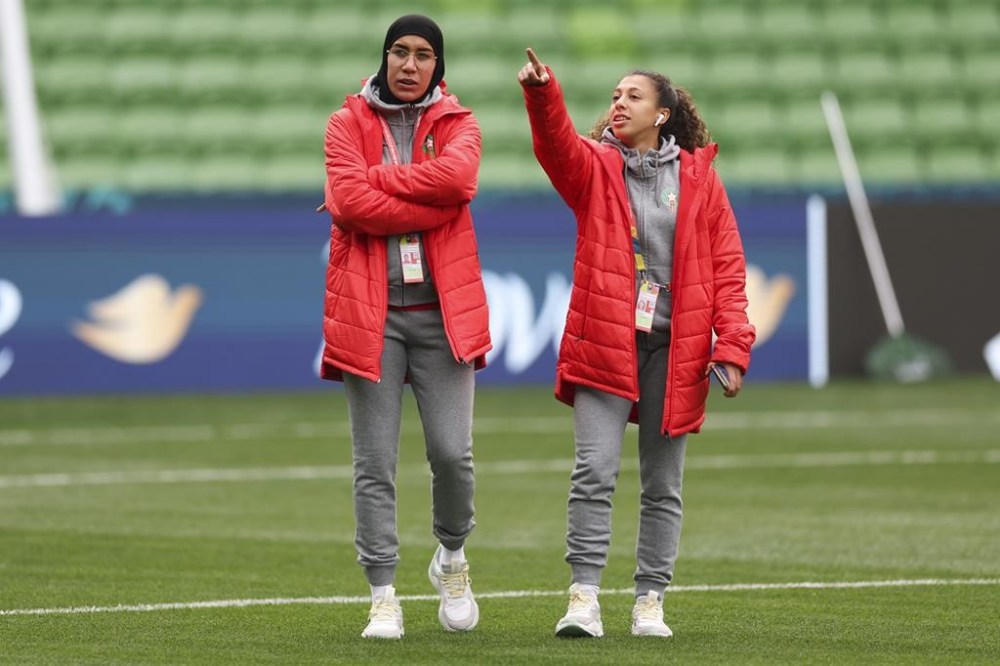
Benzina, who plays professional club soccer for the Association’s Sports of Forces Armed Royal – the eight-time defending champions in Morocco’s top women’s league – hasn’t yet been made available to speak to reporters here at the Women’s World Cup. In recent weeks, she has shared social media posts from others about the history-making nature of her World Cup appearance.
“We are honored to be the first Arab country to take part in the Women’s World Cup,” Morocco captain Ghizlane Chebbak said on Sunday, “and we feel that we have to shoulder a big responsibility to give a good image, to show the achievements the Moroccan team has made.”
Had Morocco qualified for the Women’s World Cup a decade ago, a player who wanted to wear the hijab during a game might have been forced to choose between that and representing her country.
In 2007, a referee barred an 11-year-old Canadian girl from wearing a hijab during a club match. When the issue reached FIFA, the sport’s global governing body banned head coverings in competitions it sanctioned, except for coverings that exposed the neck.
FIFA cited “health and safety” concerns, some related to possible choking, with regulations forbidding “equipment that is dangerous to himself or another player.”
“That really sent a strong message to Muslim women, particularly those who wear hijabs, (that) we don’t belong,” said Helal, an Australia-based operations manager of Creating Chances and Football United.
Helal was among the social activists, Muslim athletes, and government and soccer officials who worked to overturn the ban.
In 2012, FIFA granted the Asian Football Confederation a two-year trial period during which players would be allowed to wear head coverings at international competitions. No senior-level World Cups, men’s or women’s, were scheduled during the trial period.
In 2014, FIFA lifted its ban on head coverings. Two years later, the under-17 Women’s World Cup in Jordan marked the first time Muslim players wore headscarves during an international FIFA event.
Maryan Hagi-Hashi, a Melbourne resident who attended Morocco’s public practice session last week, said she is supporting the Atlas Lionesses alongside tournament co-host Australia. She appreciates the representation that the Moroccan team and Benzina provide, she said.
“There’s a mixture of (Muslim) women that wear hijab and don’t wear a hijab,” Hagi-Hashi said. “I think the world has realized there is diversity.”
Helal said that since the ban was lifted, she has seen an increase in Muslim girls and women playing soccer, pursuing coaching pathways and leading their own football clubs.

“I think it’s key to understand that the hijab is an essential part of a Muslim woman, should she choose to wear it,” Helal said. “It’s actually part of our identities.”
—
Cassidy Hettesheimer is a student at the University of Georgia’s Carmical Sports Media Institute.
—-
More AP coverage of the Women’s World Cup: https://apnews.com/hub/fifa-womens-world-cup and https://twitter.com/AP_Sports
Related Articles
Spanish soccer club Osasuna announces deal with UEFA to overturn expulsion from competition Canada looks to finds its top gear against Ireland







Advertisement Advertise With Us
Advertisement Advertise With Us