

Blind fans were given touch tech to follow Africa Cup games, but not for the final
Advertisement
Read this article for free:
or
Already have an account? Log in here »
To continue reading, please subscribe:

Digital Subscription
One year of digital access for only $205*
- Enjoy unlimited reading on winnipegfreepress.com
- Read the E-Edition, our digital replica newspaper
- Access News Break, our award-winning app
- Play interactive puzzles
*First annual payment billed as $205.00 + GST for one year. This annual subscription will automatically renew at $233.00 + GST every 52 weeks (10% off the regular annual price of $259.35). Offer available to new and qualified returning subscribers only. Cancel any time.
To continue reading, please subscribe:
Add Free Press access to your Brandon Sun subscription for only an additional
$1 for the first 4 weeks*
- Enjoy unlimited reading on winnipegfreepress.com
- Read the E-Edition, our digital replica newspaper
- Access News Break, our award-winning app
- Play interactive puzzles
*Your next Brandon Sun subscription payment will increase by $1.00 and you will be charged $17.95 plus GST for four weeks. After four weeks, your payment will increase to $24.95 plus GST every four weeks.
Read unlimited articles for free today:
or
Already have an account? Log in here »
Hey there, time traveller!
This article was published 18/01/2026 (254 days ago), so information in it may no longer be current.
CASABLANCA, Morocco (AP) — Despite the availability of haptic, or touch, devices for visually impaired supporters at the Africa Cup of Nations, none were available when Senegal defeated Morocco 1-0 in front of 66,526 supporters in Sunday’s final.
Visually impaired fans were accommodated at only three of the 52 games in the 35th edition of the tournament, raising questions about claims of inclusivity and the priority of facilities for supporters with disabilities at the tournament.
“We have an ongoing duty that facilities and infrastructure that we’ve provided – because it’s an obligation we have, it’s also a commitment we have. And we will continue increasing the infrastructure facilities for all disabled supporters. It’s very, very important,” Patrice Motsepe, the president of the Confederation of African Football, said at his closing press conference on Saturday.
He did not give any examples. CAF did not respond to several requests for further information.
Some have suggested the minimal number of fans who got to use the devices – up to 15 at each of the three games – hides a different reality.
“A lot of measures are presented as inclusive, but when we look into their details, it’s generally token measures made for imagery and communication,” Idir Ouguindi, who has been a disability-rights advocate for 30 years and uses crutches to walk, told The Associated Press.
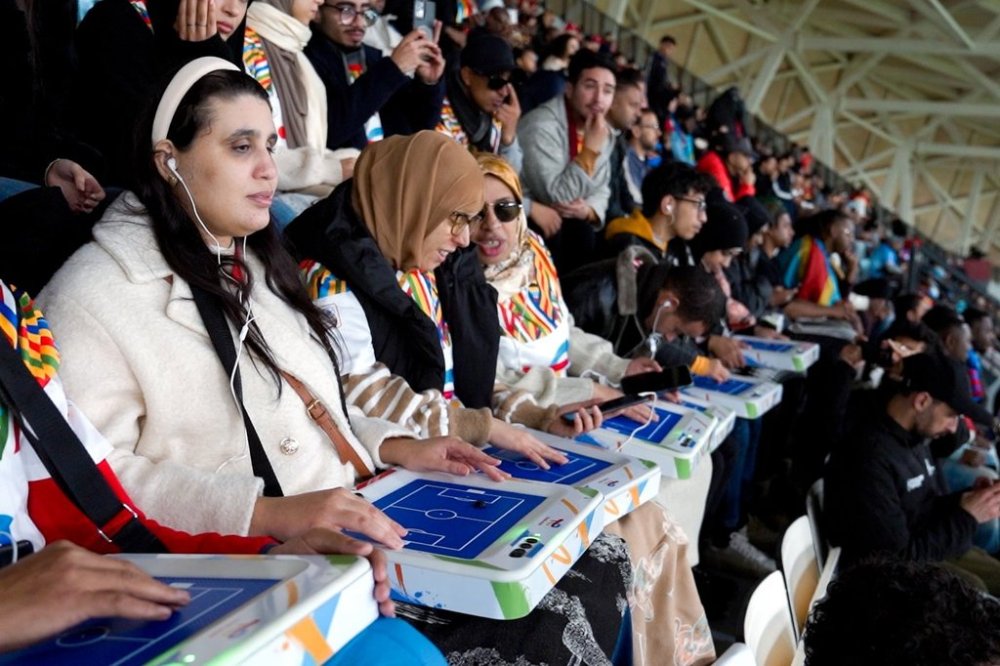
Images of blind and visually impaired supporters using the devices at Africa Cup games were widely shared on social media. Moroccan media hailed the initiative as a historic measure and a major step toward inclusivity in the North African nation.
“As an initiative to show that blind and visually impaired people can watch soccer games, it’s a positive step. But to call it an inclusive decision that truly includes all the affected people, I don’t think that’s accurate,” Ouguindi said.
Ouguindi pointed out that blind citizens are still treated as incapacitated in Morocco, often requiring a witness just to open a bank account.
Mohammed El Hachimi, a blind computer science teacher, used one of the devices at one of the group stage games between Congo and Botswana in Rabat, describing it as an “extraordinary” experience.
Using a soccer-field-shaped tablet made by French company Touch2See, El Hachimi was able to follow the game using a magnetic cursor that tracked the ball’s movement in real time.
“I felt like I could see the ball,” El Hachimi told the AP. “Other users told me they will never forget that day.”
El Hachimi said every blind fan following a game needed a companion, “so if ten blind fans attend, ten companions need to come as well,” and he said there were also “serious resource and logistical challenges” getting to games.
The 54-year-old from the northwestern city of Ksar el-Kebir would have liked to attend the final, but the technology is not available for the tournament’s most important game.
“This final, with the national team playing, should have included better representation of blind fans,” El Hachimi said. “It would have meant a lot for us to be part of such an important moment.”
Morocco is under the global spotlight as it prepares to co-host the 2030 World Cup. The country is using the tournament to showcase its modern stadiums and infrastructure. Off the field, the kingdom is eager to brand itself as a model for accessibility and social inclusion.
Arthur Chazelle, chief executive of Touch2See, told the AP he was not approached to implement the technology for Morocco’s domestic league or the 2030 World Cup.

Morocco’s family ministry did not respond to requests for comment.
___
AP Sports Writer Ciarán Fahey contributed.
___
AP at the Africa Cup: https://apnews.com/hub/africa-cup-of-nations
Related Articles
Surprise Scottish league leader Hearts loses injured top scorer Shankland for 6 weeks









Advertisement Advertise With Us
Advertisement Advertise With Us