

Senegal and Morocco’s dispute over Africa Cup title has extended beyond sports
Advertisement
Read this article for free:
or
Already have an account? Log in here »
To continue reading, please subscribe:

Digital Subscription
One year of digital access for only $205*
- Enjoy unlimited reading on winnipegfreepress.com
- Read the E-Edition, our digital replica newspaper
- Access News Break, our award-winning app
- Play interactive puzzles
*First annual payment billed as $205.00 + GST for one year. This annual subscription will automatically renew at $233.00 + GST every 52 weeks (10% off the regular annual price of $259.35). Offer available to new and qualified returning subscribers only. Cancel any time.
To continue reading, please subscribe:
Add Free Press access to your Brandon Sun subscription for only an additional
$1 for the first 4 weeks*
- Enjoy unlimited reading on winnipegfreepress.com
- Read the E-Edition, our digital replica newspaper
- Access News Break, our award-winning app
- Play interactive puzzles
*Your next Brandon Sun subscription payment will increase by $1.00 and you will be charged $17.95 plus GST for four weeks. After four weeks, your payment will increase to $24.95 plus GST every four weeks.
Read unlimited articles for free today:
or
Already have an account? Log in here »
Hey there, time traveller!
This article was published 19/03/2026 (202 days ago), so information in it may no longer be current.
DAKAR, Senegal (AP) — Morocco being awarded the Africa Cup of Nations title after governing body judges overturned Senegal’s victory two months after the chaotic final stunned soccer fans worldwide.
While Moroccans took to the streets to celebrate their team’s belated success, the decision by the Confederation of African Football was met with disbelief in Senegal, with fans and authorities calling the decision “unjust.”
Senegal’s government on Wednesday said it will pursue “all appropriate legal avenues” to overturn the decision and called for an international investigation into “suspected corruption” within African soccer’s governing body.
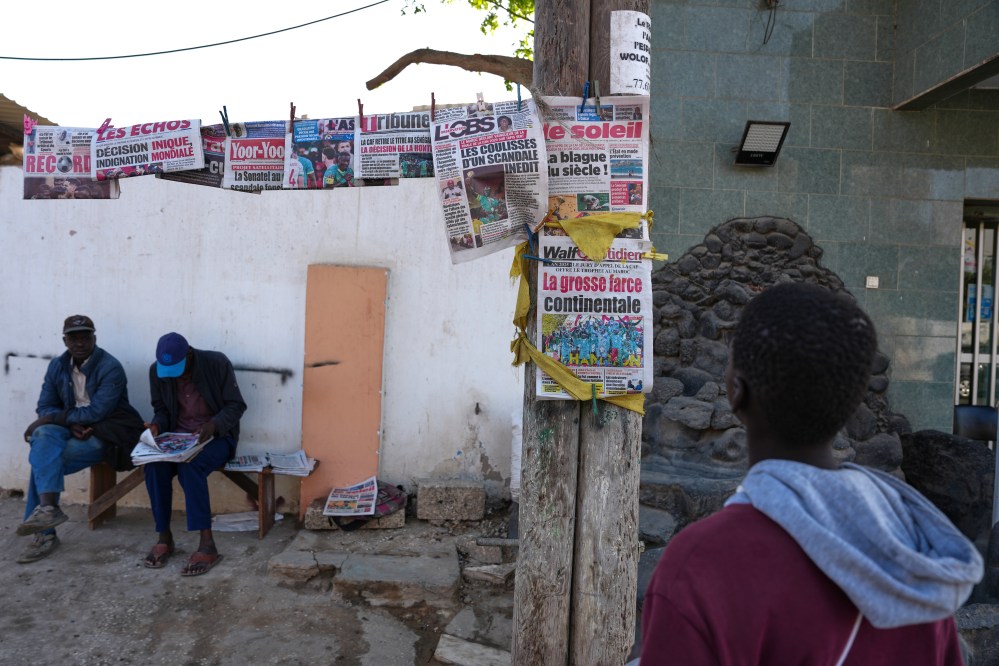
CAF’s appeals board on Tuesday ruled that Senegal forfeited the final by leaving the field of play without the referee’s authorization, and it awarded Morocco a default 3-0 win.
Most of the Senegal team left for almost 10 minutes while Senegal fans battled stewards behind one of the goals in protest against a controversial penalty call for Morocco after Senegal had a goal ruled out. The players returned, Morocco missed the penalty, and Senegal won the match by scoring in extra time.
Here is what to know about the controversies surrounding the decision to overturn Senegal’s victory:
Dispute has gone beyond soccer
Morocco and Senegal have long shared close ties built on religion, trade and culture. Tijaniyyah, a Sufi Muslim order, is widely followed in both countries. Moroccan banks and companies heavily invest in Senegal’s finance and agriculture sectors. Cultural exchanges include student programs, migration and joint festivals.
But the tensions surrounding the final and CAF’s appeals court decision to overturn Senegal’s victory have put a strain on the relationship between the two countries.
Last month, 19 Senegal fans who were arrested on charges of hooliganism at the final were given prison terms of up to a year by a Moroccan court. The Senegalese government has expressed solidarity with the Senegalese supporters.
Seydina Issa Laye Diop, president of the Senegalese national team’s fan group called “12th Gaindé” told The Associated Press on Thursday that the incidents should not damage the relationship between Senegal and Morocco.
“However, there are limits: if this continues, it could somewhat affect the pride of the Senegalese people,” Diop said. “If the goal is to preserve friendship, then it must be nurtured. Small gestures can have a big impact. These are things we can move past, especially since, during the trial, no solid argument has justified the continued detention of these supporters.”
Mariama Ndeye, a student in Senegal’s capital Dakar, said the decision has negatively impacted her view of Moroccans.
“When everything goes well, they call us their brothers. But when things don’t go their way, they start being nasty,” Ndeye said.
On Wednesday, Morocco’s embassy in Dakar called on Moroccans in Senegal to “demonstrate restraint, vigilance, and a sense of responsibility.”
“It is important to recall that, in all circumstances, it is only a match, the outcome of which should never justify any form of escalation or excessive remarks between brotherly peoples,” the embassy said.
In Casablanca, home appliances business owner Ismail Fnani said he felt like other African countries were rooting against Morocco during the final.
“Honestly, my views toward Senegalese and sub-Saharan Africans changed after this,” he said. “We used to feel sympathy and help them because they were migrants who had struggled to get here. Where there was once sympathy and compassion, now I will treat them as they have treated us.”
Mohamed El Arabi, who works in a grocery shop in Casablanca, said he didn’t celebrate the decision awarding Morocco the title.
“We would have preferred it to stay with Senegal because it doesn’t feel right otherwise,” El Arabi said.
“People here have started hating Senegalese. They no longer provide them with help. We used to be like brothers, especially since they are Muslims like us, but that is no longer the case,” he added.
Accusations of favoritism within CAF

The Senegalese government’s allegation of “suspected corruption” at CAF followed anger at perceived favoritism toward Morocco, which is a 2030 World Cup co-host and has invested heavily to become a soccer superpower.
On Wednesday, CAF President Patrice Motsepe defended the body against perceptions of favoritism toward Morocco.
“Not a single country in Africa will be treated in a manner that is more preferential, or more advantageous, or more favorable than any other country on the African continent,” Motsepe said in a video published on the CAF website.
___
AP soccer: https://apnews.com/hub/soccer
Related Articles
Elche ends winless streak in 2026 with victory over Mallorca in La Liga Toronto FC keeps points streak alive with 2-1 comeback victory over Columbus








Advertisement Advertise With Us
Advertisement Advertise With Us