

Discover the ‘other’ Brenner Pass
Alpine delights are off the beaten track
Advertisement
Read this article for free:
or
Already have an account? Log in here »
To continue reading, please subscribe:
Digital Subscription
One year of digital access for only $1.44 a week*
- Enjoy unlimited reading on winnipegfreepress.com
- Read the E-Edition, our digital replica newspaper
- Access News Break, our award-winning app
- Play interactive puzzles
*Billed as $5.77 plus GST every four weeks. After 52 weeks, price increases to the regular rate of $19.95 plus GST every four weeks. Offer available to new and qualified returning subscribers only. Cancel any time.
To continue reading, please subscribe:
Add Free Press access to your Brandon Sun subscription for only an additional
$1 for the first 4 weeks*
- Enjoy unlimited reading on winnipegfreepress.com
- Read the E-Edition, our digital replica newspaper
- Access News Break, our award-winning app
- Play interactive puzzles
*Your next Brandon Sun subscription payment will increase by $1.00 and you will be charged $17.95 plus GST for four weeks. After four weeks, your payment will increase to $24.95 plus GST every four weeks.
Read unlimited articles for free today:
or
Already have an account? Log in here »
Hey there, time traveller!
This article was published 19/09/2009 (6100 days ago), so information in it may no longer be current.
Crossing the Alps is easy.
Just pick one of the major passes that traverses the majestic European mountain range, set the cruise control, and go. If you don’t look out the window too much you might not even be distracted by the incredibly gorgeous scenery — jagged snow-capped peaks, thick belts of green forests and mountain meadows dotted by picturesque wooden homes with peaked roofs and Swiss Chalet-style trim.
Even if you do marvel at the scenery, you’re still only getting half the picture. Most of the passes have been used for centuries, even millennia, for trade, war and expansion. Originally blazed during the Iron Age, the passes have been hotly contested by tribes, warlords and governments ever since.
Nowadays, they carry thousands of cars and trucks a day, criss-crossing the Continent at highway speeds, most drivers stopping only to refuel. There are rewards, however, for travellers who get off the main road and take a side trip or two.
On a recent trip from Innsbruck, Austria to Verona, Italy, I drove the E45 motorway, a path that extends to the northern tip of Scandinavia to the southern coast of Sicily and uses the Brenner Pass to cross the Alps. Jet-lagged, I drank so many Red Bulls that I not only had wings, but a beak and bird’s feet, too. I was eager to get to Verona and my hotel bed (near Juliet’s famous balcony, as it turns out).
However, I began to notice castles of various sizes, complexity and opulence near the road and became intrigued. According to a guidebook, there are some 350 castles in the region bisected by the E45.
Located in the northernmost point of Italy, the area is called the Alto Adige, but is also known as South Tyrol in Austria and Germany. In fact, many of the place names in Alto Adige are Germanic sounding and the architecture has a definite Teutonic feel. Not only that, but the majority of residents speak German, not Italian. A small percentage speak Ladin, a Rhaeto-Romance language with origins in Roman Empire Latin during the reign of Emperor Augustus (63 BC to 14 AD).
The region has also been a centre of international intrigue for centuries. Historians believe the Romans named the Brenner Pass after a local tribe and used the pass for trade and the relentless expansion of the Empire. Over time, the region became part of the Austrian Empire and then the Austro-Hungarian Empire.
After the First World War it was ceded to Italy, but a large population of mostly Germans remained. When the Fascists seized power in the 1920s, they forced assimilation of their foreign-speaking subjects, often with brute force and murder.
Fascist Italy’s pact with Nazi Germany guaranteed the region would remain Italian. In fact, Mussolini and Hitler celebrated their Pact of Steel at the Brenner Pass.
As a result, the area has more baggage than a soap opera diva. To the casual, English-speaking traveller, the bilingual and sometimes trilingual signs and place names are confusing.
We became even more perplexed when we stopped for a coffee and some of the locals were dressed in Germanic/Austrian style garb with green felt Tyrolean hats and boiled wool sweaters.
"Where the hell are we?" I asked. Having crossed the Italian border, we expected at least some Italian influence. I couldn’t tell you exactly what — a Tuscan cypress, red tiled roofs, Armani — but something.
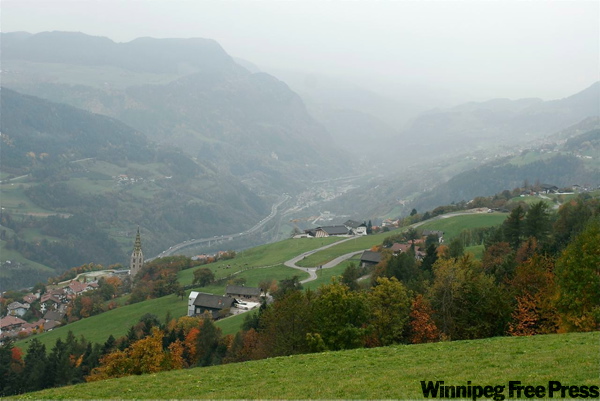
We had exited the E45 around Villandro (also called Villanders). Though it was a misty day, every so often we got a glimpse of the whole valley with the motorway winding along its floor.
The road became increasingly narrow as we ascended. At the top we got out of the car. We were so far above the motorway we couldn’t even hear it. Only the whispering of wind and the chirps of mountain birds reached our ears. A stream of cars and trucks moved along the distant motorway like bubbles in a hose. We stood and watched awhile, glad for taking the scenic route. Then we got in the car and began the drive downhill.
— Canwest News Service