

GRENADA: An enchanted island
Advertisement
Read this article for free:
or
Already have an account? Log in here »
To continue reading, please subscribe:
Monthly Digital Subscription
$1 per week for 24 weeks*
- Enjoy unlimited reading on winnipegfreepress.com
- Read the E-Edition, our digital replica newspaper
- Access News Break, our award-winning app
- Play interactive puzzles
*Billed as $4.00 plus GST every four weeks. After 24 weeks, price increases to the regular rate of $19.95 plus GST every four weeks. Offer available to new and qualified returning subscribers only. Cancel any time.
Monthly Digital Subscription
$4.99/week*
- Enjoy unlimited reading on winnipegfreepress.com
- Read the E-Edition, our digital replica newspaper
- Access News Break, our award-winning app
- Play interactive puzzles
*Billed as $19.95 plus GST every four weeks. Cancel any time.
To continue reading, please subscribe:
Add Free Press access to your Brandon Sun subscription for only an additional
$1 for the first 4 weeks*
*Your next subscription payment will increase by $1.00 and you will be charged $16.99 plus GST for four weeks. After four weeks, your payment will increase to $23.99 plus GST every four weeks.
Read unlimited articles for free today:
or
Already have an account? Log in here »
Hey there, time traveller!
This article was published 31/10/2009 (6005 days ago), so information in it may no longer be current.
Occupied for centuries by the Spanish, French and English, the spice island of Grenada, is now home-ground to the progeny of West African slaves transported here to work on sugar cane plantations. Today, after revolutions, political strife and invasion by American forces, Grenada is a peaceful land.
At the end of the work week, as the sun drops below the horizon, the people of this laid-back, sociable nation can be found lounging on deckchairs along the roadside, at huge family gatherings in overgrown gardens or enjoying a tipple of rum outside local drinking dens. ‘Limeing’ is what it’s called in Grenada. In other words, passing the time of day.
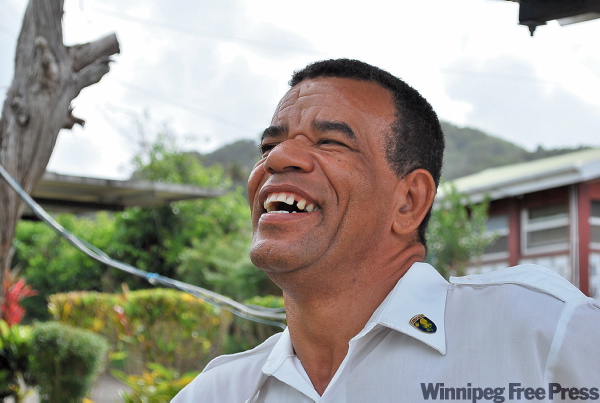
Our group of four Canadians came to know and appreciate the gregarious nature of Grenadians in the company of our guide Mandoo. With an encyclopaedic knowledge of the island, Mandoo (meaning "Sweet Man", a name given by his doting grandmother when he was a child) is of Scots and African ancestry. He appeared to have a passing acquaintance with every individual on the island. "I know at least 15,000 people" he boasted, "and the other 15,000 know me." Mandoo had an answer for everything. "That’s a nine hole golf course" he pointed out. "And if you play it twice it’s an 18 hole golf course." Ladies in particular were drawn to our friendly guide. "Hi Sweetheart, lovely lady", was his greeting to one and all. As a sideline to guiding he is also a regular feature at local schools, teaching young Grenadians the importance of caring for the environment.
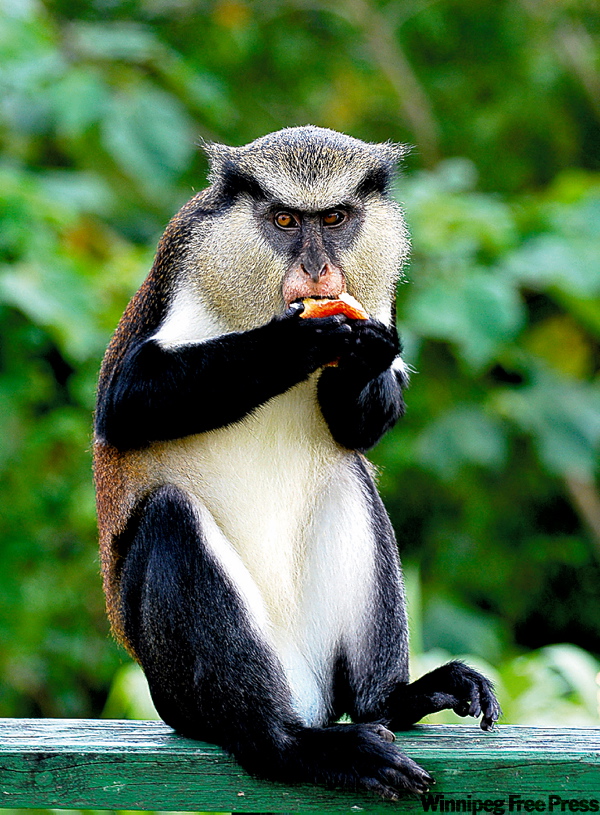
Mandoo’s rapport with the local Mona monkeys whose forbears were brought to the island on slave ships 300 years ago, is legendary. Those savvy rainforest dwellers know at the sound of Mandoo’s bark – his unique imitation of ‘monkey talk’ – that bananas are not far behind.
This land of multiple attractions also has a thriving spice industry. In medieval times, spice along with diamonds and gold were treasures indeed. Today Grenada ranks second after Indonesia as producer of what used to be one of the world’s most valuable commodities. Nutmeg and its associate mace together with other spices grow wild in the countryside, on well-ordered plantations and on small farms.
Each week farmers arrive at the Gouyave Nutmeg Processing Station with their harvest of nutmegs. Once the delivery is weighed, the farmers are paid and the nutmegs are dried on huge shallow trays prior to sorting. They work on a co-op system here, and if the year’s harvest is good, farmers can expect a bonus.
With a multitude of outlandish claims – the Hindus believed nutmeg to have sensual qualities, sorcerers used them in a magical perfume and they have even been used (I don’t know how successfully…) as an aid in gambling, – the truth is that nutmeg, since AD540, appears to have been utilized successfully as a medicine. The certainties are that this spice, if incorrectly used, is a powerful hallucinogen. Michael X can vouch for that. Ingesting crushed nutmeg in water when he was incarcerated in prison in 1946 produced "the same kick as three or four reefers".
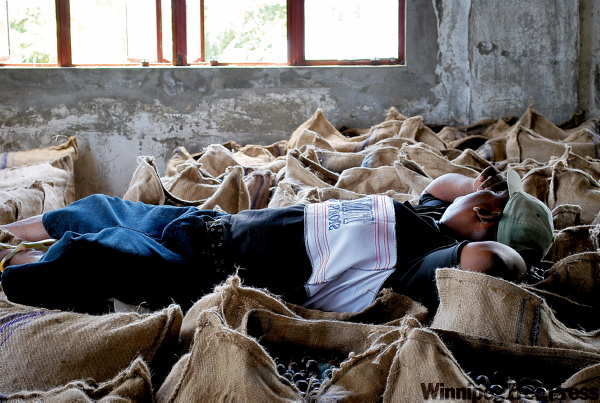
In the Gouyave Nutmeg Processing Station life moves at a leisurely pace. Sitting at rickety tables or on the floor much as they have done for centuries, women, like exotic bright birds, laugh and chatter as they sort the island’s treasure. On the upper floor, away from nosy tourists, a man snoring quietly, snatches forty winks on bulky sacks of nutmegs awaiting export to foreign lands.
Cocoa beans and bananas were at one time lucrative money-spinners for Grenada. In the plantation office on the Dougaldston Spice Estate there is a poignant reminder of those more affluent times. Spiked stacks of paper on office shelves – edges curling and brown from age – lie alongside ledgers once used to keep track of crop yields and sales. Today the ancient volumes are coated with dust and laced together with spider webs. Sheds where sorting, drying and shelling once took place are now silent. Cocoa beans processed in a small scale operation are still used in the finest Swiss and Belgian chocolate.
An essential stop-off for seafood lovers is Gouyave’s Fish Friday. Every week starting at 6 pm, thousands gather in Gouyave fishing village for a party. Vendors set up stalls on a huge grassy arena. Cooks in tall white hats and ladies in knotted doeks sweat over bubbling pans and barbeques.
Their combined efforts produce a scrumptious feast of fish cakes, delicious snapper and breadfruit chips, shrimp kebabs, lobster swathed in garlic sauce, and that king of the catch, jerked marlin. "Pappy Products nearby sells a potent selection of liquors", Roger our escort for the evening tells us. "Watch the boys," he says. "They’ll all go for Bois Bande. It’s made from the bark of a tree and reputed to be an aphrodisiac." And sure enough they did.
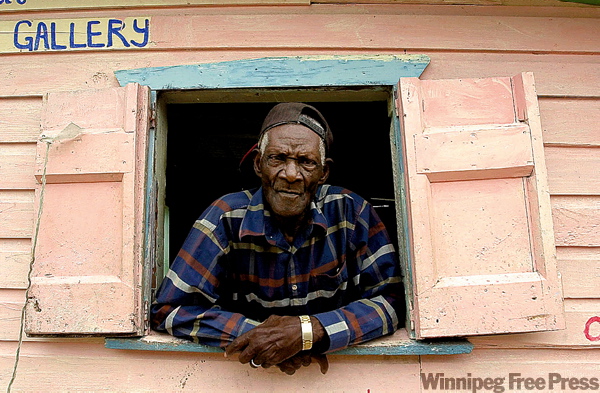
Saturday in Grenada is market day. Crammed beneath coloured umbrellas, vendors sell everything from massive bunches of bananas, papayas and bread fruit to CDs, clothes ….and of course spices. Miss Ronda, a large lady with a bright toothy smile, occupies the first stall at the market entrance. Her counter top is stacked with ginger, cloves, saffron, cinnamon, bay leaves and nutmegs. When I stop at Miss Rosie’s stall to buy cocoa beans, she raises her arms and dances with an infectious rhythm. Miss Bernadette decked out in hair rollers and black hairnet tells me the origins of cinnamon, "it comes from under the tree bark". Wandering down a narrow alleyway Miss Sabirah dangles a fragrant spice necklace close to my nose. "When the fragrance starts to die just soak it in warm water. It’ll be as good as new" she coaxes. Dodging a cart laden with sour sop (great for ice cream and juices), I bump into Keith Augustine Laborie, a tall grey-bearded Grenadian. Immediately negotiation begins. Used to the attention of photographers, he drives a hard bargain when I ask to photograph him.
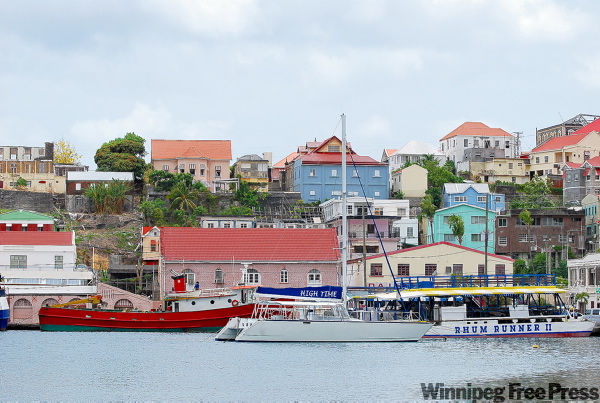
Closeby in the Carenage, a statue of "Christ of the Deep" presented to the people of St. George’s by the Costa Steamship Line, looks out over the harbour. When the Italian cruise liner, Bianca C caught fire and sank in the island’s Outer Harbour in 1961, the entire community was involved in the dangerous rescue. Ignoring the prospect of an explosion, Grenadians took to the sea in a flotilla of fishing boats, ocean going yachts, rowing boats and dinghies to rescue 700 passengers and crew. ‘Castaways’ were then given hospitality in the homes of local people, in guest houses and hotels until they could leave the island.
Between March and July beside coastal waters in the north west of the island, one of nature’s spectacular happenings unfolds. In the dead of night Levera Beach becomes a giant nursery. Over a period of six months hundreds of expectant Leatherback turtles – some weighing up to 800 kilograms – emerge from the ocean intent upon reproduction. With ungainly gait they move across the sands in search of prime locations for making nests and laying their eggs. Burrowing into the sand, the female deposits around 70 large fertile eggs.
On those vast and lonely sands, with a blustery wind blowing and our only light a sky splashed with stars, we were denied a view of a mature turtle, but were equally delighted with the hatching of a three-inch long baby turtle. We followed like ghosts in the night, as intent upon his destiny, the infant turtle used his tiny flippers to propel himself towards the sea. Preceding him, two well-intentioned but I think ill-advised Ocean Spirit workers cleared the way – smoothing out sand hills and pulling away tendrils of beach creeper that might impede his progress. Eventually reaching the waterline, a shallow wave rippled ashore, lifted him and carried him seaward to an uncertain future where only one in a thousand hatchlings survive.
Come July, ‘Carnival’, a celebration said to have origins in the harvest festivals of ancient Egypt, turns the island into a 24/7 fun-fest. Since the emancipation of slaves 175 years ago, ‘Carnival’, officially called ‘Spice Mas’, continues through to mid-August with masquerades, beauty pageants, steel band competitions, parades and the shenanigans of a molasses-covered Jab Jab, a mischievous devil who roams the streets of Grenada at night. Arley Gill, Minister of State in the Ministry of Culture has assured all Carnival-goers, "We guarantee to every Grenadian and every visitor to Spice Mas 2009 that it will be an exhilarating and exciting showcase that they are not likely to forget."
IF YOU GO
ACCOMMODATION
Maca Bana Villas, Point Salines, Grenada, telephone: 439-5355, website:www.macabana.com, e-mail: macabana@spiceisle.com. The tariff starts at about US$300 plus taxes.
Delightful self-contained villas on a cliff-top surrounded by a tropical garden with frangipani, orchids, lobster claw, palms and brilliantly coloured bougainvillea. An infinity pool overlooks the beach and the sea; a fabulous view.
The Gem Beach Resort, Morne Rouge Bay, Grenada, telephone: 439-3421 website: www.gembeachresort.com, e-mail: gem@spiceisle.com. The tariff for a double room with garden view starts at about US$110 plus taxes.
A mini resort fronted by one kilometer of white sand beach just 15 minutes from St. George’s.
WHERE TO EAT
The Aquarium Restaurant and Bar, Magazine Beach, Point Salines, Grenada.
Dine beneath palm trees overlooking the ocean. The food is excellent, the ambience great.
MORE PLACES TO SEE
– The 300 year old Belmont Estate Plantation for delicious Creole buffets.
– Explore the Carenage, St. George’s Inner Harbour.
– Dougaldston Spice Estate where spices are grown and processed in the old way.
– Grand Etang National Park. Situated in a rainforest Grand Etang Lake is surrounded by hiking trails.
– Lake Antoine is in the crater of an extinct volcano.
– Leapers Hill, a 30 metre high cliff face where the Carib Indians are said to have leapt into the sea rather than surrender to the French in 1650.
BEACH PRECAUTIONS
– Don’t sit under coconut palms that have ripe nuts. They can do severe damage if you’re underneath when they fall.
– A tree called the Manchineel produces fruits that look like green apples. To avoid blistering don’t touch fruit or sap. Centipedes are known to shelter in these trees and their bite is painful.
– Sea urchin spines are painful. Protect feet by wearing flops in the sea water.
RECOMMENDED GUIDE
Mandoo Tours, P.O. Box 826, St. George’s, Grenada, W.I., Telephone: (473) 440-1428
FOR MORE INFORMATION
Contact Grenada Board of Tourism, telephone (416) 595-1339, e-mail: tourism@grenadaconsulate.com, website: www.grenadagrenadines.com