

ASK JOURNEYS: Traveller’s cheques not OK everywhere
Advertisement
Read this article for free:
or
Already have an account? Log in here »
To continue reading, please subscribe:
Digital Subscription
One year of digital access for only $1.44 a week*
- Enjoy unlimited reading on winnipegfreepress.com
- Read the E-Edition, our digital replica newspaper
- Access News Break, our award-winning app
- Play interactive puzzles
*Billed as $5.77 plus GST every four weeks. After 52 weeks, price increases to the regular rate of $19.95 plus GST every four weeks. Offer available to new and qualified returning subscribers only. Cancel any time.
To continue reading, please subscribe:
Add Free Press access to your Brandon Sun subscription for only an additional
$1 for the first 4 weeks*
- Enjoy unlimited reading on winnipegfreepress.com
- Read the E-Edition, our digital replica newspaper
- Access News Break, our award-winning app
- Play interactive puzzles
*Your next Brandon Sun subscription payment will increase by $1.00 and you will be charged $17.95 plus GST for four weeks. After four weeks, your payment will increase to $24.95 plus GST every four weeks.
Read unlimited articles for free today:
or
Already have an account? Log in here »
Hey there, time traveller!
This article was published 07/11/2009 (6056 days ago), so information in it may no longer be current.
It is the never-ending question. What currency or traveller’s cheques are best to take with you when you travel? Should I use my debit card in foreign countries? Am I better off paying by credit card? Over the months I have addressed these questions in some form or other but recent personal and reader experiences suggest it is time to do an update.
QUESTION: We were in Europe recently and found cashing American Express traveller’s cheques very difficult to do. Stores did not want to take them, either. Is this common?
ANSWER: Not only have I found American Express traveller’s cheques to be unpopular, many restaurants and stores will not take American Express cards, either.
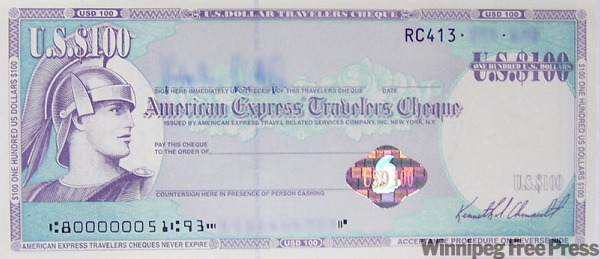
On our most recent trip to Turkey and Greece I found many establishments that would not accept the card and in one case, at a jewellery store, they were reluctant to accept the card even though signage clearly indicated they did.
Travellers cheques of any kind have become less desirable, but you are better off with euros drawn on a Visa traveller’s cheque than any others.
Readers planning on travelling to Cuba this winter should take note that even Visa traveller’s cheques cleared through American banks will not be accepted.
I don’t know of a financial institution selling traveller’s cheques that are not cleared through the United States.
Going overseas, one is quickly faced with a new reality. The euro has gotten very strong and there is some belief that in a few years it may replace the American dollar as the base for comparison and acquisition. This will depend upon how the dollar performs over the next few years, but the financial world is clearly changing.
I use credit cards a lot when I travel. Notwithstanding my fears that one may be compromised sooner or later, I find carrying cash from destination to destination not all that comforting.
I accept the premium I have to pay by using the card, but I still find it the most convenient, and in the end, the safest.
QUESTION: I have not taken a plane trip anywhere in several years, but I seem to recall my luggage would start out locked and end up with the locks broken off. Does security inspect all luggage? Is there any point to trying to lock my checked bags?
ANSWER: The degree to which luggage is opened is in some way dependent on where you are travelling to or from.
The Americans and British, for very good reason, are the most diligent in checking luggage. It is important to know that there should always be a note left in the luggage if it has been opened for inspection by the authorities in these, or any other, countries.
If you feel your luggage has been tampered with and there is no note, you should let the airline know immediately.
The Transportation Security Administration in the U.S. has worked with the luggage industry to develop a special series of locks, branded as Travel Sentry certified locks.
Each lock has a special identifying logo on the lock and a code written on the bottom of the lock. The code informs the TSA officers which key they need to use to open the lock to search the bags in question.
These locks were introduced a number of years ago and are now commonplace. The system seems to be working very well. After it was tested in the United States, the locks were accepted by HMRC – Her Majesty’s Revenue and Customs — in the UK.
Unfortunately, the not all countries have adopted the Travel Sentry program. As a result, a search will require that your lock be cut, and therefore of no further use.
Nevertheless, most people still prefer to lock their luggage, particularly the main compartment where most of the valuables are likely packed.
If the lock is not present when you receive your bags at your destination, you should look inside for the above-mentioned note. If it is not there, once again, you should report that fact to the airline immediately.
The two reasons people still choose to lock luggage are, firstly, the obvious theft-deterrence. The second is to prevent anyone from putting illegal substances in your baggage in transit, thus making you an unwitting ‘mule,’ as people who bring in drugs on behalf of someone else are known.
I always recommend travellers use the Travel Sentry locks since they are about the same price as the non-branded ones anyway, thus giving you the added dynamic of comfort should you travel through the United States. These locks are widely available in most luggage departments.
QUESTION: I am planning a trip to Cuba in a few months, I have a 120-volt hair straightener (pricey). What do I need for a converter?
ANSWER: Cuba has properties and locations that will use either 110-V or 220-V. Obviously, if you are at a place that uses 110-V you have no problem as the outlets are also the same as ours.
On the other hand, if you are staying at a hotel that is 220-V you may have a real problem. There are ceramic materials in most of these appliances. To quote directly from the brochure of Austin House, one of the largest travel accessory companies in North America, "Ceramic appliances are NOT compatible with converters or transformers. Ceramic appliances can ONLY be used overseas if they are dual-voltage."
We know of a number of instances where people have tried to use them in other countries and have essentially fried their expensive appliance.
Forward your travel questions to askjourneys@journeystravel.com. Ron Pradinuk is president of Journeys Travel & Leisure SuperCentre and can be heard Sundays at noon on CJOB. Previous columns and tips can be found on www.journeystravel.com or read Ron’s travel blog at www.thattravelguy.ca