

Walk on the Grimm side
The darker side of Germany's fairy-tale culture
Advertisement
Read this article for free:
or
Already have an account? Log in here »
To continue reading, please subscribe:
Digital Subscription
One year of digital access for only $75*
- Enjoy unlimited reading on winnipegfreepress.com
- Read the E-Edition, our digital replica newspaper
- Access News Break, our award-winning app
- Play interactive puzzles
*Billed as $5.77 plus GST every four weeks. After 52 weeks, price increases to the regular rate of $19.95 plus GST every four weeks. Offer available to new and qualified returning subscribers only. Cancel any time.
Monthly Digital Subscription
$4.99/week*
- Enjoy unlimited reading on winnipegfreepress.com
- Read the E-Edition, our digital replica newspaper
- Access News Break, our award-winning app
- Play interactive puzzles
*Billed as $19.95 plus GST every four weeks. Cancel any time.
To continue reading, please subscribe:
Add Free Press access to your Brandon Sun subscription for only an additional
$1 for the first 4 weeks*
- Enjoy unlimited reading on winnipegfreepress.com
- Read the E-Edition, our digital replica newspaper
- Access News Break, our award-winning app
- Play interactive puzzles
*Your next Brandon Sun subscription payment will increase by $1.00 and you will be charged $17.95 plus GST for four weeks. After four weeks, your payment will increase to $24.95 plus GST every four weeks.
Read unlimited articles for free today:
or
Already have an account? Log in here »
Hey there, time traveller!
This article was published 28/05/2011 (5477 days ago), so information in it may no longer be current.
In the age of Disney, it’s easy to forget just how sinister fairy tales can be.
Long before The Frog Prince was relocated to New Orleans and even before the dwarves belted out Heigh Ho, the Brothers Grimm delivered the same tales with oodles of goosebumps.
As a child, when I read those stories — Hansel and Gretel, Little Red Riding Hood, Snow White and the like — I wasn’t in it for the sappy endings. It was the macabre bits that thrilled: themes such as darkness, abandonment and death.
None of my modern bedtime stories described parents sending their children into the woods to be devoured by wild beasts, an evil queen dancing herself to death in red-hot shoes or corpses (formerly daring princes) caught in thorns surrounding an enchanted castle.
Those tales must have come from a terribly scary place, I surmised.
Due to the mass popularity of the fables, Germany started promoting its Fairy Tale Route in 1975. Stretching from Bremen in the north to Hanau in the south, the trail spans 600 kilometres, including turnoffs. You can connect the dots at some 50 points of interest, including Sleeping Beauty’s castle, Rapunzel’s tower and a Cinderella pageant.
Filled with puppet shows, festivals and museums, it’s a living story time sure to delight any family. But — no offence to costumed actors with flaxen locks and impeccably whitened teeth — when I visited, my urge to flip to the dark pages remained.
Chapter One: Bremen
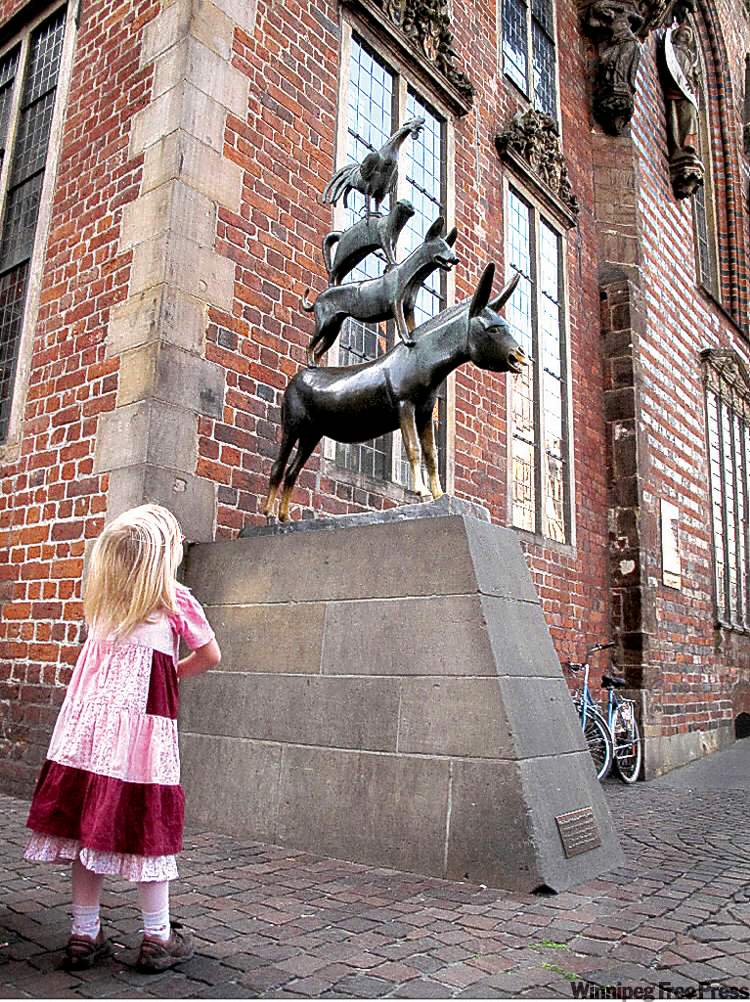
BREMEN, my starting point, is famous for a B-list Grimm tale: The Bremen Town Musicians. It’s the story of an elderly group of animals (a donkey, rooster, cat and dog) who, rather than end up on their owner’s fork, decide to flee the farm for Bremen, where they intend to strike it rich as musicians — sort of a Babe-meets-Grumpy Old Men plot.
Near the market square, a statue of the quartet is a magnet for superstitious visitors. Legend says if you grasp the donkey’s legs and shut your eyes, your wish will be granted.
Cute? Yes. Bone-chilling? Hardly.
‘Twas a little tame for my liking, so I ducked into the nearby Ratskeller, mostly because it sounded like the offspring of two hideous words: “rat” and “skeleton.”
Founded in the vaults of the Bremen town hall in 1405, the subterranean Ratskeller boasts the world’s largest collection of fine German wine. It is also a restaurant where I sampled Bremer Knipp, a dense local dish consisting of crispy fried oat groats, pork sausage, potatoes, dill pickle and apple compote.
Strolling through Bremen’s stately central square and the pretty Schnoor neighbourhood, I almost gave up on finding anything sombre. Then I spotted a gem buried deep in my Lonely Planet guide that hadn’t made the cut in the tourist brochures.
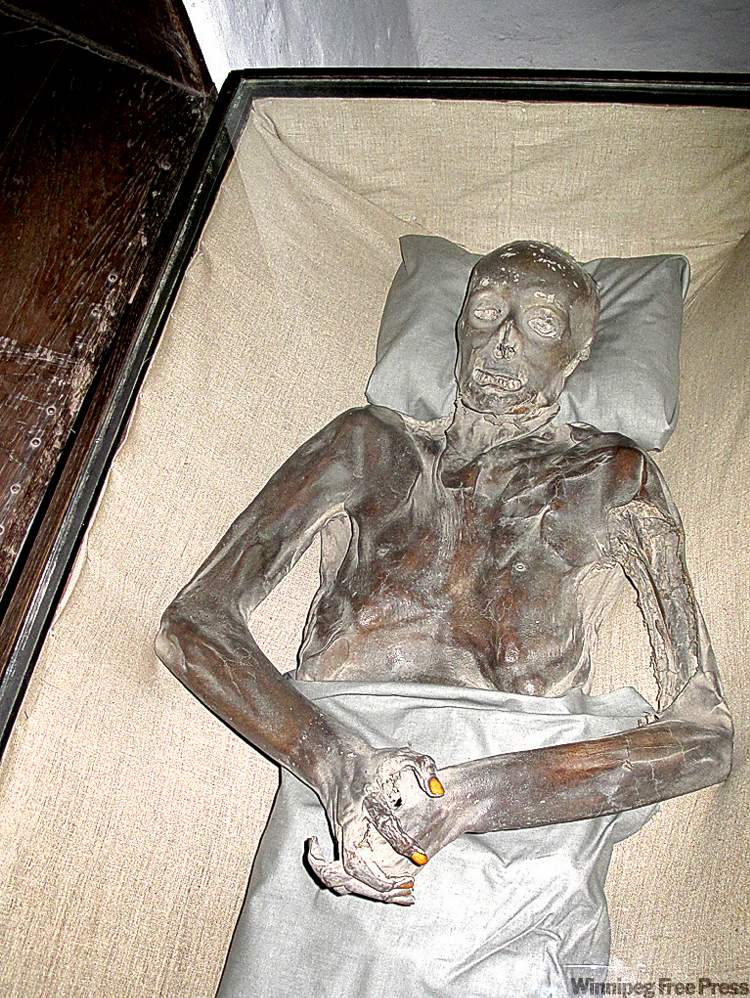
I’d hit pay dirt: There were 300-year-old mummies stored away in the cellar of Dom St. Petri cathedral. Better yet: I could meet ’em for under two bucks.
About 500 years ago, some enterprising church employee discovered the air beneath the cathedral was so arid, it could desiccate a human body within a few months. They dehydrated eight folks who remain there to this day, including a countess who allegedly died of syphilis and a student killed in a 1765 duel.
All lie in caskets, propped up on pillows with their hands clasped and their crotches tastefully covered.
With bits of flesh clinging to their faces, long orange fingernails and caved-in, leathery flesh, they’re positively gruesome. Until recently, the corpses didn’t even have glass cases. But when visitors started swiping fingernails and teeth as souvenirs, the mummies were fitted with personal skylights.
Chapter Two: Hamelin
My next stop should ring a bell… or a play a pipe.
A native of Pennsylvania, Michael Boyer came to Germany on holiday, but “stayed for the women and the beer.” For 15 years, he has wandered the streets of Hamelin portraying the infamous Pied Piper.
When he appeared in multicoloured garb and tights, I thought I was in for a performance somewhere along the lines of a rent-a-clown at a children’s party.
How wrong I was: Boyer’s piper is even weirder than a clown. He’s a creep. In fact, he’s a downright menace.
You may recall the Grimm story goes like this: In 1284, a stranger lures all of the rats out of Hamelin by coaxing an enchanting tune from his pipe. The vermin drown en masse in the nearby Weser River, but when it comes time for the townsfolk to pay up, they balk. The vengeful piper then casts his musical spell on the children of Hamelin, leading them onto a mountain, where they vanish forever.
Boyer explained that, to understand the story, you must contextualize the piper’s fashion statement.
“The people of Hamelin were scared to death of the Pied Piper. They were all in grey, brown and black and here comes this colourful fellow. You get the same effect today with goths,” he said.
Hamelin is a remarkable old storybook city if ever there was one, densely populated by black-and-white half-timbered houses. Striding down the narrow streets in his custom-made curly-toed shoes, the breeze rustling the genuine pheasant feathers in his hat, Boyer discussed the culture behind the fairy tales.
“The world was darker in the Middle Ages. You could get your hand cut off just for stealing. You were risking your life every day in one way or another — whether it was eating bad food or walking into a battle.”
On the outer wall of the Pied Piper Restaurant, an eyewitness account of the children’s departure is recorded, but there is nary a mention of rats.
“The children who got lost were teenagers of a marrying age, your typical party people,” said Boyer.
“One theory is that the young people followed the Piper up the mountain to have a big party, then something terrible happened. Whether he killed them, captured them or sold them into slavery… we don’t know.”
Boyer’s earlier statement about “beer and women” flashed through my head. Rainbow garb notwithstanding, he started to look awfully shady to me.
Chapter Three: Kassel
As chilling as they were, the stories released by Jacob and Wilhelm Grimm in their 1812 magnum opus were already watered down.
Did you know that in the 17th-century version of Little Red Riding Hood, the heroine was gobbled up for good?
The Grimms thought this was a bit overboard, so they injected the part where the huntsman frees her from the wolf’s stomach.
“They have made it a bit child-friendly,” said Lars Thias, who works for the Brothers Grimm Museum in Kassel.
“Stories were told to children and adults alike. So, yes, the stories were very cruel, but there’s always a moral to the story, like ‘don’t go in the forest’ or ‘don’t follow any stranger.’ “
The brothers spent 30 years working in Kassel, which is also the headquarters of the Fairy Tale Route. There, I received a final confirmation that the German fascination with death was alive and well (if one can make such a contradictory statement): the Museum of Sepulchral Culture.

The museum reads like the Grim Reaper’s personal art collection: funeral monuments from the Middle Ages to the present — hearses, mourning costumes, mourning jewelry, and so on.
There’s a stack of 17th-century coffins taken from a crypt, and a fascinating photo essay depicting a man’s last day: He wakes up, shaves, eats and, by nightfall, he’s lifeless on a bed.
Docent Benjamin Stutz filled me in on some of the gorier details of medieval burial.
“Sometimes they’d exhume a body and find it was in a different position than when it had been buried,” he said.
This led to the invention of a pulley system that could ring a bell above ground — just in case.
Stutz interpreted the art pieces people had lying around their houses, such as a picture of a skull or little models of coffins with rotting bodies inside.
“This would be a constant reminder to be prepared for the final judgment,” he said.
At 28, Stutz struck me as rather young to be spending his days in a death museum. Did it ever depress him? His response was surprising.
I think you have to look at it like, ‘Let’s use that energy to seize the day.’ “
In other words, accept the darkness, but always end on the “happily ever after” note. Sounds familiar.
— Postmedia News