

Searching for the elusive Spirit Bear
Breathtakingly beautiful B.C. rainforest home to intriguing animal
Advertisement
Read this article for free:
or
Already have an account? Log in here »
To continue reading, please subscribe:
Digital Subscription
One year of digital access for only $75*
- Enjoy unlimited reading on winnipegfreepress.com
- Read the E-Edition, our digital replica newspaper
- Access News Break, our award-winning app
- Play interactive puzzles
*Billed as $5.77 plus GST every four weeks. After 52 weeks, price increases to the regular rate of $19.95 plus GST every four weeks. Offer available to new and qualified returning subscribers only. Cancel any time.
Monthly Digital Subscription
$4.99/week*
- Enjoy unlimited reading on winnipegfreepress.com
- Read the E-Edition, our digital replica newspaper
- Access News Break, our award-winning app
- Play interactive puzzles
*Billed as $19.95 plus GST every four weeks. Cancel any time.
To continue reading, please subscribe:
Add Free Press access to your Brandon Sun subscription for only an additional
$1 for the first 4 weeks*
- Enjoy unlimited reading on winnipegfreepress.com
- Read the E-Edition, our digital replica newspaper
- Access News Break, our award-winning app
- Play interactive puzzles
*Your next Brandon Sun subscription payment will increase by $1.00 and you will be charged $17.95 plus GST for four weeks. After four weeks, your payment will increase to $24.95 plus GST every four weeks.
Read unlimited articles for free today:
or
Already have an account? Log in here »
Hey there, time traveller!
This article was published 08/10/2011 (5340 days ago), so information in it may no longer be current.
‘There’s a Spirit Bear over there by the other observation platform!’
With those hushed words from our Gitga’at guide, Marvin Robinson, who hails from Hartley Bay, we tourists, cautiously climb down the narrow wooden ladder from our 2.5-metre high cedar deck, which rests on the edge of the salmon-laden Ryorden River on Gribbell Island.
We were deep within the two-million hectare heartland of the Great Bear Rainforest on the west coast of the British Columbia mainland, stretching from just north of Knight Inlet (east of north-central Vancouver Island) to Princess Royal Island and all the way north to the Alaskan border.
A steady drizzle pelts our thick rubber rain gear as we make our way single-file through the lush temperate rainforest, surrounded by a cathedral of towering ancient Sitka spruce, red cedar, western hemlock, amabilis and Douglas fir, to the second structure about 75 metres farther upstream.
On our last full day in this sublime place, we are finally going to have the privilege of seeing this rare and rather docile creature the locals call moskgmól (white bear).
I was part of a group of five, including a couple, Bernie and Maureen, from New Hampshire and a semi-retired microbiologist, Daphne, from Stockton, Calif., who had travelled to the region for a week in September on a trip: White Bears of the Great Bear Rainforest: the elusive Spirit bear of British Columbia’s rain coast.
It was organized by bear specialist/adventurer extraordinaire Rupert Pilkington, head of Ursus International, an eco-tourism and conservation company.
“You must visit the Great Bear Rainforest one day, Martin,” Rupert had said to me one day last fall when we were both participating (he was the instructor) in a five-day adventure study tour to view polar bears at the Churchill Northern Studies Centre.
After I read about this sublime place, I was compelled to go.
We were staying at the modern and spacious Spirit Bear Lodge in the remote Kitasoo/Xai’xais fishing village of Klemtu on Swindle Island – a brief boat ride away from Princess Royal Island, some 150 nautical miles by float-plane north of Port Hardy on the northern tip of Vancouver Island.
Arrangements had to be made the day before by Spirit Bear Lodge manager, Tim McGrady, and Kitasoo Chief/tour guide, Doug Neasloss, for us to visit Gitga’at territory. It required a two-hour boat trip north up Princess Royal Channel.
Our odyssey began several days earlier with a fog-delayed (further up the coast) flight, onboard a Pacific Coastal Airlines twin-engine turboprop from Vancouver Airport to the coastal community of Bella Bella on Campbell Island, home to the Heiltsuk First Nation.
We stayed overnight at the comfortable Shearwater Resort and Marina on Denny Island, gateway to the GBR.
After breakfast the following morning, we took a two-hour covered boat ride on fairly smooth waters (but that wasn’t always the case) to Klemtu.
Besides bears, we also encountered Humpback whales, Stellar sea lions, river otters, countless bald eagles, porpoises, harbour seals, plus gulls, ravens, ducks, American dippers and other bird species; as well as numerous varieties of maritime and terrestrial plant life in that breathtaking mountainous region of islands, channels, rivers, streams, fjords and forests.
I was hoping to catch a glimpse of the salmon-eating coastal grey wolves and orcas but, neither of those species showed themselves to us during the week.
It was mostly bears, and especially the fabled Spirit Bear, that we had come to see.
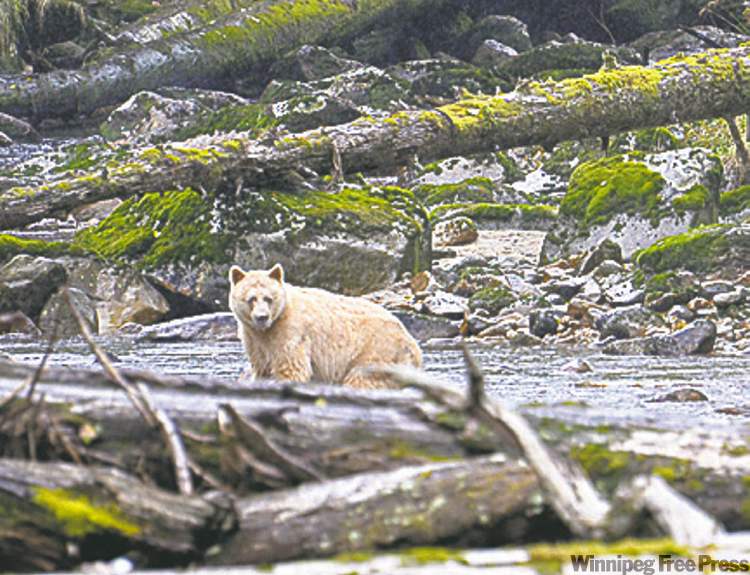
Spirit Bears, or white Kermode bears, as they are more formally known, are not albinos, but the result of a recessive gene that dominates in 10 per cent of the black bear population on Princess Royal Island, resulting in the white coat.
The coastal First Nations people offer another account for the existence of this rare cream-coloured creature that, in some respects, looks like a slightly smaller version of the polar bear.
One of our Kitasoo boat drivers, the avuncular Charlie, had earlier captivated our imaginations with the intriguing legend about the origin of moskgmol: “Goo-wee (Raven) made one in every 10 black bears white to remind the people of a time when glaciers covered this land and how people should be thankful of the lush and bountiful land of today.”
Many of the Kitasoo/Xai’xais maintain that moskgmol possess supernatural powers, thus the term Spirit Bear .
Afterwards, a friend in Winnipeg reminded me of the sacred status of a white bison, especially a calf, among many Native Americans on the Great Plains.
“What a striking similarity between the legends of coastal First Nations and their Prairie brethren,” I mused.
“There are about 30 Spirit Bears on this island,” another Gitga’at guide, Terran Fisher said while showing me a recent video on his BlackBerry of a black bear and her cubs as well as a Spirit Bear, which he had taken a few feet from where we were now positioned.
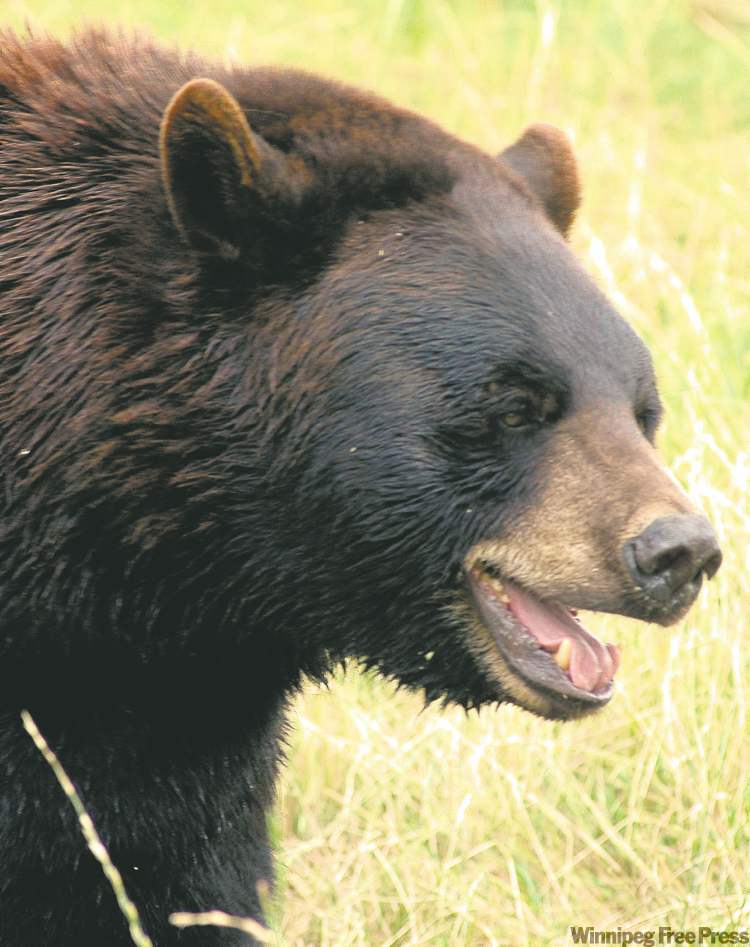
For the past 31/2 hours we had watched and taken endless photographs of several big black bears, including a mother and two cubs, who scrambled up a nearby cedar when a burly male bear wandered onto the opposite bank.
They had all lumbered out of the forest and into the river to catch salmon, which have returned to the rivers in the GBR, after some years out in the Pacific Ocean, to spawn and then die.
This is truly the salmon forest — a place where salmon not only feed the bears but also, through the process of decomposition, fertilize the environment, explained Rupert Pilkington.
At one point earlier in the trip, we watched massive grizzly bears a mere 65 metres from us catching chum and pink salmon from the estuary of another river in the awesome forest. The bear buffet was open for business.
Both black bears and grizzlies, while fully aware of our presence, seemed unconcerned we were there.
Some people observing on Gribbell Island had even set up their cameras underneath the deck only two or three metres away from a couple of those hungry bruins.
One beady-eyed bear shifted his large head toward us momentarily, sniffed the air, and then continued farther upstream in that typical, pigeon-toed shuffle.
Bears, especially in the weeks leading up to hibernation higher up in the mountains, are single-minded: They just wanted to pack on the calories by dining on their succulent sushi, regardless of whether it was freshly caught or, more often than not, fish that were already dead or dying on the boulders or in the shallows.
About 200 metres from the second platform, past a tumble of giant weathered logs, a Spirit Bear stood patiently on a slippery rock as he scanned the shallows. He was waiting for the right moment to lunge into the water and snag an unlucky salmon.
“Every so often the bear lifts its head and peers upstream and then back down stream,” I scribble in my handy all-weather notebook while watching this drama unfold.
“Suddenly, he bolts from his semi-stationary position and plunges midstream at a salmon. His misses but, then, immediately, the bear does a belly-flop and comes up with a large wriggling fish clamped firmly in his powerful jaws.”
He’s a very patient fisherman.
“So, at the end of our quest, we finally located Mr. Spirit Bear,” Rupert remarks quietly, as the white bear shuffles back into the ancient forest to consume his meal in private.
Meanwhile, wildlife photographer Ted Krug, who was with another group of tourists from the adventure-cruise sailing ship Ocean Light ll (which was moored offshore), called this an exceptional experience.
“I came specifically to photograph the Spirit Bear,” said the bearded native of Parry Sound, Ont., whose high-powered camera rested on a sturdy tripod.
He added that he had also taken shots the day before of white bears, including two who briefly tussled over a fishing spot, right in front of the viewing platform.
“It’s great to have the freedom to be so close to the bears without disturbing them,” observed naturalist Jamie Scarrow, an employee of the Spirit Bear Lodge, as our boat sped back to the lodge under an ethereal, misty sky.
I nodded in agreement and gave quiet thanks to the Great Spirit for this extraordinary experience.
A few facts about the Great Bear Rainforest and Spirit Bears
The Great Bear Rainforest is located on the west coast of the British Columbia mainland, stretching from just north of Knight Inlet (across from north-central Vancouver Island) to Princess Royal Island and all the way north to the Alaskan border.
This ancient place is one of the largest tracts of temperate rainforest left in the world (two-million hectares), and is home to thousands of species of plants, birds and animals. Bears drag the carcasses of spawned-out salmon into the forest, facilitating a major upslope nitrogen transfer into the forest soil.
Princess Royal Island is best known as being home to the legendary white Kermode Bear, Spirit Bear of the North Coast of British Columbia. These magnificent bears, known as Moksgm’ol in the Tsimshian language, are a sub-species of the black bear and are not found anywhere else in the world.
The oil and gas industry is proposing to build pipelines to transport crude oil from the Alberta oilsands to the GBR. Oil tankers, for the first time ever, would travel through the heart of the Great Bear Rainforest loaded with crude oil bound for Asia. “An Exon Valdez-type disaster would have unimaginable consequences for our coastal environment and economy,” says award-winning writer/environmentalist Ian McAllister, conservation director of Pacific Wild, who is based on Denny Island.
Sources:
Pacific Wild.org
Raincoast Conservation Society in Victoria, B.C.
Greenpeace