

Pain de sucre a sweet sight
At Quebec's Montmorency Falls, its winter 'sugarloaf' has long been an attraction
Advertisement
Read this article for free:
or
Already have an account? Log in here »
To continue reading, please subscribe:
Monthly Digital Subscription
$1 per week for 24 weeks*
- Enjoy unlimited reading on winnipegfreepress.com
- Read the E-Edition, our digital replica newspaper
- Access News Break, our award-winning app
- Play interactive puzzles
*Billed as $4.00 plus GST every four weeks. After 24 weeks, price increases to the regular rate of $19.95 plus GST every four weeks. Offer available to new and qualified returning subscribers only. Cancel any time.
Monthly Digital Subscription
$4.99/week*
- Enjoy unlimited reading on winnipegfreepress.com
- Read the E-Edition, our digital replica newspaper
- Access News Break, our award-winning app
- Play interactive puzzles
*Billed as $19.95 plus GST every four weeks. Cancel any time.
To continue reading, please subscribe:
Add Free Press access to your Brandon Sun subscription for only an additional
$1 for the first 4 weeks*
*Your next subscription payment will increase by $1.00 and you will be charged $16.99 plus GST for four weeks. After four weeks, your payment will increase to $23.99 plus GST every four weeks.
Read unlimited articles for free today:
or
Already have an account? Log in here »
Hey there, time traveller!
This article was published 16/03/2013 (4765 days ago), so information in it may no longer be current.
The oldest tourist destinations in the world are natural attractions — mountains, hot springs, waterfalls. One of the oldest in Quebec is Montmorency Falls east of Quebec City, which attracted sightseers from among Canada’s aboriginal nations long before the first European explorer, Jacques Cartier, arrived in 1534.
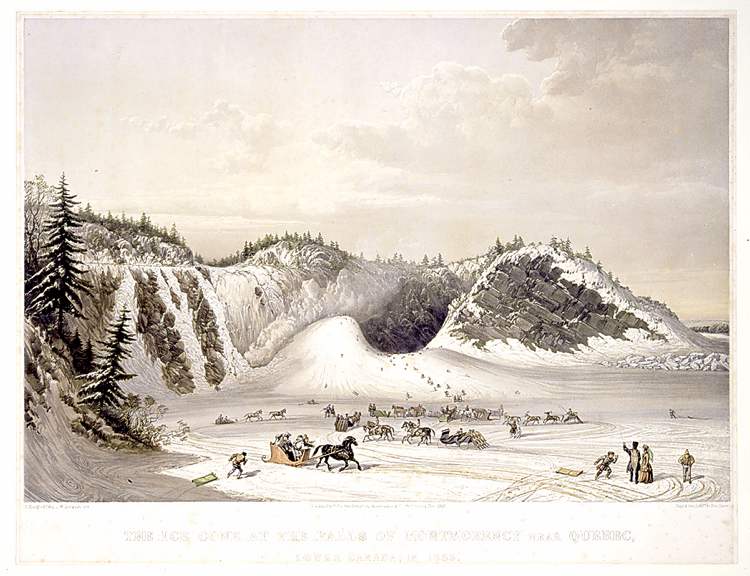
At 82 metres high, the falls are 30 metres taller than Niagara Falls, although they are much narrower and therefore don’t have the same panoramic quality. The remarkable thing about them is they give birth every winter to an offspring that is a natural attraction — a little mountain of snow and ice at the base of the falls known as the Pain de sucre, or Sugarloaf. Prominent painters of the 19th century paid homage to it, mostly notably Cornelius Krieghoff in 1853 with his oil painting, The Ice Cone at the Falls of Montmorency near Quebec.
The little mountain takes shape every winter as mist from the crashing waterfall rises into the air, crystallizes, then falls again as ice or snow on the frozen bay at the base of the falls. Provided temperatures remain consistently below zero (as is normally the case in winter in Quebec City, unlike the more balmy Niagara Falls, Ont.), the little mountain rises steadily in height throughout January and February, especially after a fresh snowfall.
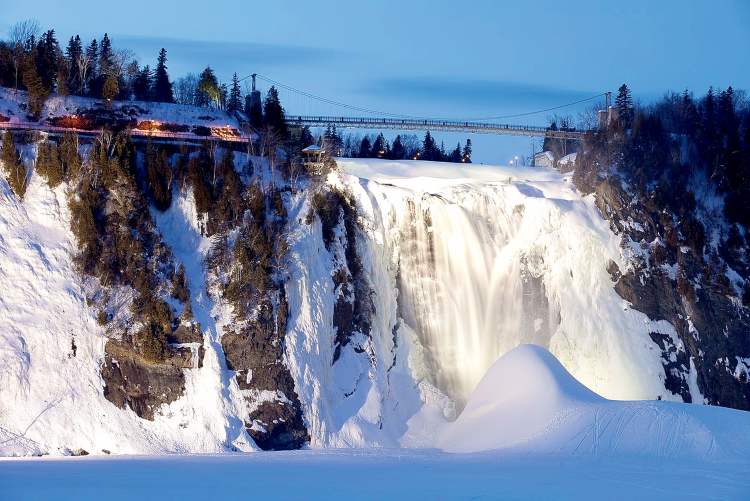
Eventually, it comes to resemble a giant sugarloaf, the name derived from the conical shape of the loaf form in which sugar was sold until the late 19th century before it was sold in granular form or small cubes.
Krieghoff’s tribute to the Pain de sucre shows happy habitants playing on it in winter and riding around the frozen bay in horse-drawn carriages. With global warming, though, dangers have set in. Six years ago, a woman fell into a small crevice near the top of the cone and broke her leg.
Access was closed after that, opening again only three years ago on a more restricted basis. Now, people are only allowed to walk around the base of the ice cone except during Montmorency Falls’ annual Féerie hivernale in February.
When I visited with my family Feb. 1, there was no access allowed to the base of the sugarloaf. An exceptional warm spell in January meant there had been no significant growth in the little mountain. Also, the bay itself had not frozen over, which was unusual. But weather conditions changed and full access to the Pain de sucre and tobogganing resumed.
On other winter weekends, access to the base of the sugarloaf is permitted only when ice thickness, which is carefully tested for safety, exceeds a certain threshold. But even when ice thickness is insufficient, Montmorency is still worth a visit in winter. The pedestrian suspension bridge above the falls, linking the west bank of the Montmorency River to the east bank, is open year-round. By comparison, there is no bridge above Niagara Falls.
Standing in the middle of the suspension bridge, looking directly down at the cascading waters of the Montmorency River, visitors can sense the enormous power of these falls. Canada’s first electricity-generating station was built at the falls in 1886. Once opened, it powered the first area to receive electrical lighting in this country — Dufferin Terrace behind the Chateau Frontenac.
Although the generating station closed in 1964, there’s another historic building on the cliff beside the falls. Kent House, originally known as Haldimand House, was built in 1780 for Frederick Haldimand, governor of Quebec during the American Revolution. The Sunday brunch at Kent House, which I savoured a couple of years ago, is highly recommended, like the rest of Montmorency Falls.
— Postmedia News