

Che and the chocolate factory
Visitors can nibble on the sweet edible legacy of Cuban hero
Advertisement
Read this article for free:
or
Already have an account? Log in here »
To continue reading, please subscribe:
Digital Subscription
One year of digital access for only $75*
- Enjoy unlimited reading on winnipegfreepress.com
- Read the E-Edition, our digital replica newspaper
- Access News Break, our award-winning app
- Play interactive puzzles
*Billed as $5.77 plus GST every four weeks. After 52 weeks, price increases to the regular rate of $19.95 plus GST every four weeks. Offer available to new and qualified returning subscribers only. Cancel any time.
Monthly Digital Subscription
$4.99/week*
- Enjoy unlimited reading on winnipegfreepress.com
- Read the E-Edition, our digital replica newspaper
- Access News Break, our award-winning app
- Play interactive puzzles
*Billed as $19.95 plus GST every four weeks. Cancel any time.
To continue reading, please subscribe:
Add Free Press access to your Brandon Sun subscription for only an additional
$1 for the first 4 weeks*
- Enjoy unlimited reading on winnipegfreepress.com
- Read the E-Edition, our digital replica newspaper
- Access News Break, our award-winning app
- Play interactive puzzles
*Your next Brandon Sun subscription payment will increase by $1.00 and you will be charged $17.95 plus GST for four weeks. After four weeks, your payment will increase to $24.95 plus GST every four weeks.
Read unlimited articles for free today:
or
Already have an account? Log in here »
Hey there, time traveller!
This article was published 11/01/2014 (4512 days ago), so information in it may no longer be current.
Ernesto (Che) Guevara’s legacy as a freedom fighter is woven firmly into Cuba’s cultural fabric, much as his fearless gaze is firmly rooted on T-shirts and college dorm walls around the globe. But in Baracoa, Cuba’s oldest and most remote city, Che Guevara’s legacy is based on something sweeter. In the early days of Fidel Castro’s revolutionary government, El Che, then Cuba’s minister of industry, came to Baracoa to deliver stimulus to the local economy in the form of a shiny new chocolate factory.
Coastal Baracoa is unique among Cuban cities due to its hemmed-in location at the island’s eastern extremity. For a brief period it was Cuba’s capital, but as the country was settled, other regions flourished and Baracoa languished in isolation for more than 400 years. Its fortunes changed dramatically after Castro and his revolutionaries overthrew the government in 1959. One of their first nation-building accomplishments, still regarded as one of Cuba’s great engineering feats, was the construction of a concrete highway known as La Farola — The Lighthouse — over the jungle-covered mountains that isolated Baracoa for centuries.
I arrived in Baracoa after cycling La Farola, appreciative of the hard work that went into the concrete road weaving up the Sierra del Puril mountains and peaking in pine-scented cloud forest before dropping down to the tropical Atlantic coast. Normally the first place I go to get my bearings in a Cuban city is the central plaza, but as I coasted into town I was beckoned by waves breaking along an arching bay. I came to a stop next to an 18th-century Spanish fort built to protect the city from pirates.
The fort’s walls are thicker than they are tall, so I was able to pull myself atop the outer wall and survey the ocean crashing onto the black rocks below the malecon, or seaside boulevard. Waves and sea spray are the only things Baracoa’s malecon shares with its big brother in Havana. Instead of four lanes of traffic, here children play in the middle of the road and cars seem like an afterthought.
When I did make it to Baracoa’s modest central plaza, I discovered Guevara was not the only hero to leave his footprint there. Occupying the south side of the Plaza Independencia is a crumbling white cathedral built in 1833. Behind its tall wooden doors is a glass cabinet housing the Cruz de la Parra, a wooden cross with gold trimming many believe was delivered by Christopher Columbus when he landed in 1492.
Exiting the cathedral after paying homage to this symbol of the conquistador’s faith, I encountered the fearless gaze of a Taino chief named Hatuey. A copper bust of the pierced and ponytailed warrior is set above a white pedestal with the words, “The first rebel of America. Slain in Baracoa.” Hatuey lived on the neighbouring island of Hispaniola when Columbus and the Spaniards arrived and decimated the indigenous population. He fled in a canoe to Cuba and led a group of local Taino in resistance to Spanish rule. Hiding in the jungle hills, just as Castro and Guevara did four and a half centuries later, Hatuey waged a guerrilla campaign against the oppressors. He was eventually captured and, displaying their Christian charity, his captors offered to baptize him before burning him at the stake.
The next morning I explored Baracoa on foot, walking down sleepy streets lined with one-storey pastel-coloured homes that featured neglected colonial facades topped by dishevelled clay tiles. Moving to higher ground, I climbed the steps to the Hotel El Castillo overlooking the city. The region’s swankiest hotel was built in the late ’70s on the site of another 18th-century Spanish fort. Along the perimeter of the pool deck, the original turrets are still in place, offering panoramic views of what Columbus allegedly described as the most beautiful land he had ever set eyes on. The two features competing for top billing on this vista are the calm blue waters of Baracoa’s sickle-shaped bay and the tabletop mountain, El Yunque.
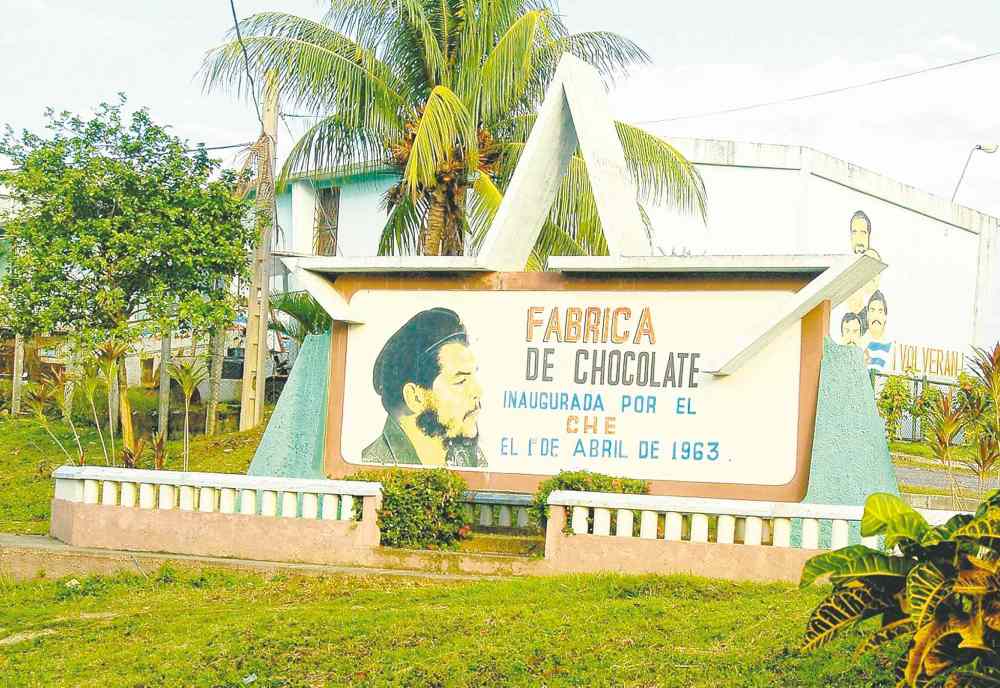
Next I got on my bike and rode north toward Duaba beach. Before I reached the outskirts of the city, I passed a monument featuring Guevara’s beret-clad profile next to the words Fabrica de Chocolate. The monument marks the entrance to Baracoa’s chocolate factory, which still churns out Cuba’s best chocolate. I asked at the gate if any was for sale, but the attendant shook his head. It is not available in any of the common shops in town either, as it is considered a luxury item, sold only in high-end stores, priced well out of reach of average Cubans.
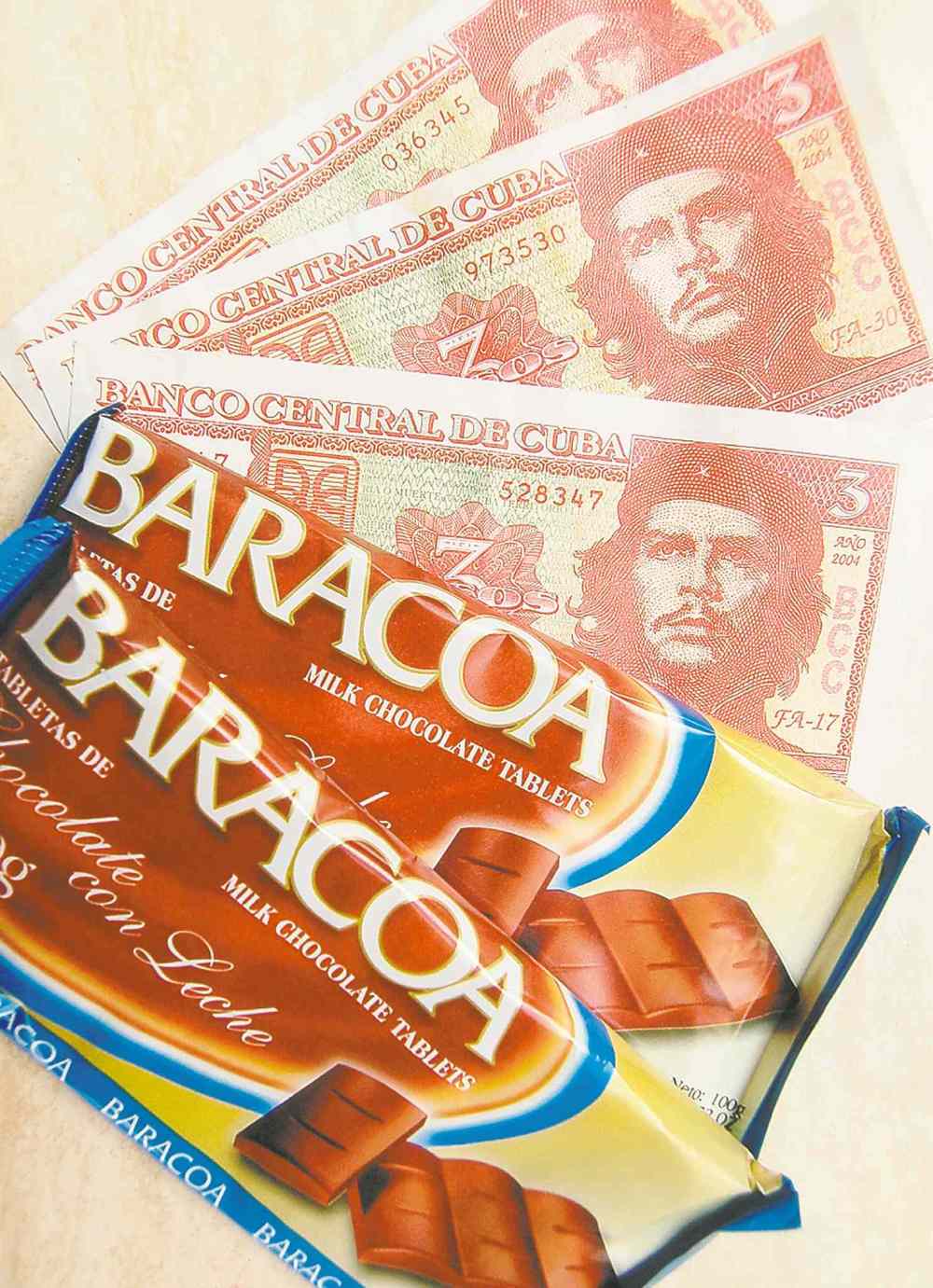
Eleven kilometres farther, I reached Duaba beach. Because Baracoa gets few visitors compared with Cuba’s resort destinations, the two-kilometre white-sand beach hosted only a few dozen tourists. There were an equal number of Cubans on hand selling snacks and meals. As a vegetarian, I passed on the $10 barbecued lobster I was offered first. When I was approached next, I encountered my first bars of elusive Baracoa chocolate. I was told employees at the factory occasionally get free boxes of chocolate, and by selling to tourists for $2 a bar they can double their regular salary. I pulled out a three-peso bill, featuring Guevara’s image, that I had been saving for a special occasion and exchanged it for a chocolate bar.
Even before my teeth had pierced the bar, I could tell it was far superior to the coarse chocolate I had previously encountered in Cuba. Its rich flavour and smooth texture were comparable in quality to American milk chocolate, but perhaps not quite as good as European varieties. However, locally grown cocoa beans are coveted in Europe and most are exported to Switzerland.
Due to the perma-hunger that stalks all cycle-tourists, my eyes constantly prowled the beach for other snacks. I spied some peculiar cone-shaped bundles hanging over the shoulders of hawkers walking the beach. These are the region’s original sweet treat, cucurucho, a sugary blend of mashed coconut and other fruits with honey and spices wrapped tightly in a palm frond.
Unlike Baracoa chocolate, cucuruchos are enjoyed by locals in every income bracket. I purchased three for less than one peso, and when I got on my bike to move on from Baracoa, the high-density carbs hand-packed into each cucurucho provided enough fuel to overcome the region’s isolation and make my return to Cuba proper.
Although Baracoa is not large, the legacies of some of Cuba’s biggest heroes reverberate off its remote coastline and jungle-clad mountains, reinforcing its heritage as Cuba’s, and one of the world’s, most unique cities.
Guevara famously once said, “Be realistic, demand the impossible!” In Baracoa you can realistically demand to do a number of impossible things: sack a fort that repelled pirates for centuries, visit a companion that sailed the seas with Columbus, stare into the eyes of the New World’s first martyr, or eat a chocolate bar made by Che Guevara.
If you go:
Getting there and around: The easiest way to reach Baracoa is by plane from Havana. Check online for flight options. Once there, Viazul operates tourist-class buses daily to and from Santiago and Baracoa. These buses are often full, so it is a good idea to make a reservation at the Viazul office as soon as you arrive. Tickets for the bus cost $20 plus a $5 reservation fee. The best way to reach Baracoa is navigating the 50 kilometres of the Farola highway yourself, either by bike or by rental car. The cycling trip can be made from Guantanamo, but at 150 km it makes for a long day. Hiring a taxi to drive part of the way is a good solution. Rental cars are available at resorts or major cities and cost at least $50 per day.
Accommodations: There are no all-inclusive resorts near Baracoa and few hotels. Undoubtedly the best hotel in the region is Hotel El Castillo, with its turret-lined pool deck overlooking the bay and inland mountains. Rooms go for $70 and it is often fully booked. An even better option is to stay in a Casa Particulaire — the Cuban equivalent of a bed and breakfast. There are dozens in Baracoa, and each one offers the unique opportunity to glimpse Cuban life from behind the colonial facades lining the streets. The Casas are identifiable by a white sign with a blue “T” on its door. Any local will happily take you to a nearby Casa. The Casas are regulated by the government, so they all meet stringent requirements for cleanliness and service. Rooms typically cost between $20 and $30 with home-cooked meals costing an additional $5 to $10.
— Postmedia Network Inc. 2013