

Easy to see why it’s called ‘Stampede City’
Annual Calgary rodeo a rite of summer
Advertisement
Read this article for free:
or
Already have an account? Log in here »
To continue reading, please subscribe:
Monthly Digital Subscription
$1 per week for 24 weeks*
- Enjoy unlimited reading on winnipegfreepress.com
- Read the E-Edition, our digital replica newspaper
- Access News Break, our award-winning app
- Play interactive puzzles
*Billed as $4.00 plus GST every four weeks. After 24 weeks, price increases to the regular rate of $19.95 plus GST every four weeks. Offer available to new and qualified returning subscribers only. Cancel any time.
Monthly Digital Subscription
$4.99/week*
- Enjoy unlimited reading on winnipegfreepress.com
- Read the E-Edition, our digital replica newspaper
- Access News Break, our award-winning app
- Play interactive puzzles
*Billed as $19.95 plus GST every four weeks. Cancel any time.
To continue reading, please subscribe:
Add Free Press access to your Brandon Sun subscription for only an additional
$1 for the first 4 weeks*
*Your next subscription payment will increase by $1.00 and you will be charged $16.99 plus GST for four weeks. After four weeks, your payment will increase to $23.99 plus GST every four weeks.
Read unlimited articles for free today:
or
Already have an account? Log in here »
Hey there, time traveller!
This article was published 04/08/2018 (2813 days ago), so information in it may no longer be current.
Going to the Calgary Stampede seems to be a rite of passage for many Canadians — a milestone I had missed out on for years, but not anymore.
After attending the 2018 Stampede, I finally feel I’m in the know about this 10-day event in July, which helps define Calgary — a city appropriately nicknamed “Stampede City.”
What I quickly came to learn is the heart of the Stampede is the rodeo.

Cowboys from the North American West first came to Calgary in 1912 to compete in roping and bronc events — bringing the practical skills they had acquired on the open range to the city’s agricultural fair.
Today’s cowboys continue to show off their skills, but to a much larger group of spectators.
This year’s Stampede attracted 1.27 million people.
Being a first-timer to the Calgary Stampede, I turned to former saddle bronc champion and 2017 rodeo judge Jim Dunn, who knows a thing or two about cowboy competitions.
As we sat in the elevated grandstand watching the saddle bronc competition, Dunn shared his own history with the Calgary Stampede with me. He grew up on a cattle and grain farm in Airdrie, 15 minutes north of Calgary, where his parents still farm.
He smiles as he said he caught his 82-year-old dad under the truck recently putting in a new muffler. Dunn definitely comes from hardy stock, so it was natural he was drawn to the life of a cowboy. He started competing professionally while still in high school, and made his living from rodeos for 25 years.
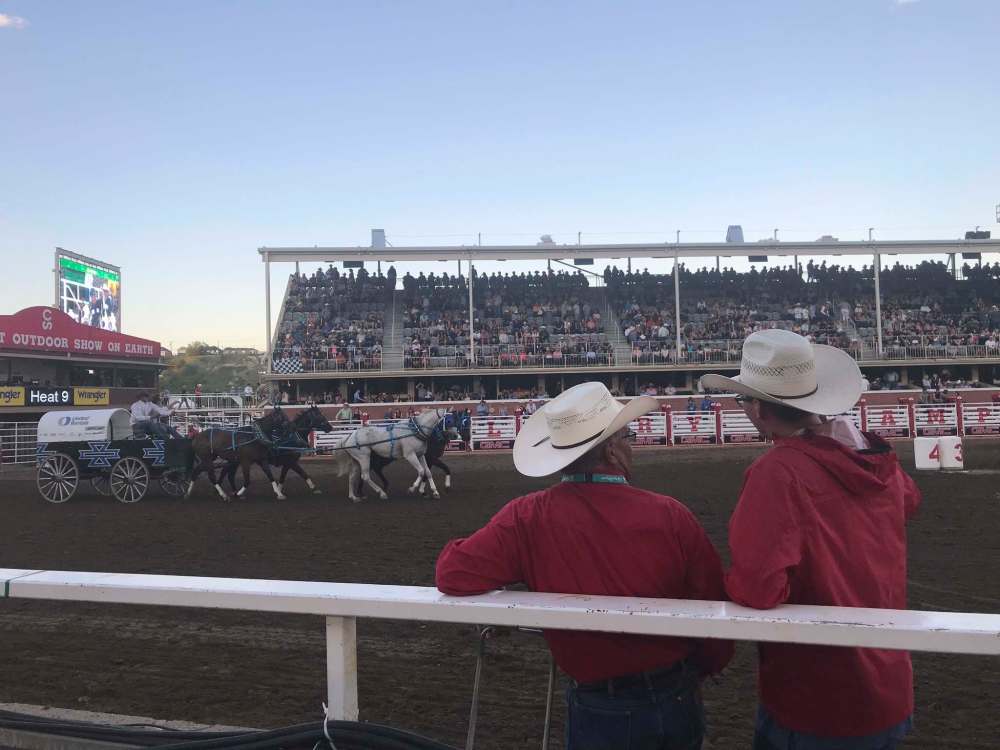
“I’ve had a broken ankle, broken jaw, sore back, sore arms. You name it,” Dunn said. “An older bareback rider once told me when he was driving to the rodeo and just thinking about competing, he’d start to feel sore. I felt the same way.”
Dunn officially retired from the rodeo circuit when he was 39, but he has continued to be involved, including working as a judge for many years.
He pointed out cowboys can be on the road, attending anywhere from 65 to 120 rodeos across North America throughout the year. The Calgary Stampede is where they all want to go, he added, but only 15 of the world’s top cowboys are invited to participate in each of the rodeo events.
The afternoon rodeo is made up of six major events — saddle bronc, bull riding, steer wrestling, tie-down roping, bareback and barrel racing. The latter event is for women riders only.
The competitor’s goal is to get scores high enough to make Sunday’s finale, when the top prize money is handed out. With a prize of $100,000 to the winner in each major discipline, and more than $2 million handed out overall, the Calgary Stampede offers one of the richest rodeo payouts.
Saddle bronc riding, which Dunn used to compete in, is clearly one of the most exciting events, as riders hang onto one braided rein connected to the horse’s halter for eight seconds to qualify.
“It looks simple, but it’s pretty complicated,” said Dunn, who explained judging is also based on how much the horses are bucking.
The Calgary Stampede started a ranch in 1961 to guarantee a high quality of bucking horses and bulls, and has about 200 bucking horses trained not to accept a saddle or a rider. All of the livestock for the Stampede comes from this 22,000-acre ranch, near the town of Hanna.
The cowboys are assigned their horses based on a lottery system, so when it comes to these points it’s a matter of luck. How well the cowboy does in the saddle is all up to him, Dunn said.
As we watched the saddle bronc favourite, 20-year-old Ryder Wright, Dunn explained why this young cowboy scored highest in one of the nightly competitions we were watching that would lead to him securing a spot in the finals. The Milford, Utah, native would eventually go on to win the $100,000 grand prize for this event.
Dunn said it’s all a matter of how well Wright was able to maintain his balance while holding onto the rein with one hand, and his feet placement. Riders must have one hand free at all times and not touch either the horse or the equipment. To score well, he said, the rider must be able to move his feet from the horse’s neck towards the back of the saddle in time with the bronc’s actions.
“Rhythm between the rider and his horse is key. It’s a lot of stuff to look for, two judges are watching the horse and two are watching the rider. Once you train your eye, it’s not that hard,” he said of judging riders.
In the event we were watching, Wright scored 93 — coming close to the all-time highest score in the history of saddle bronc riding of 96 at the Calgary Stampede.
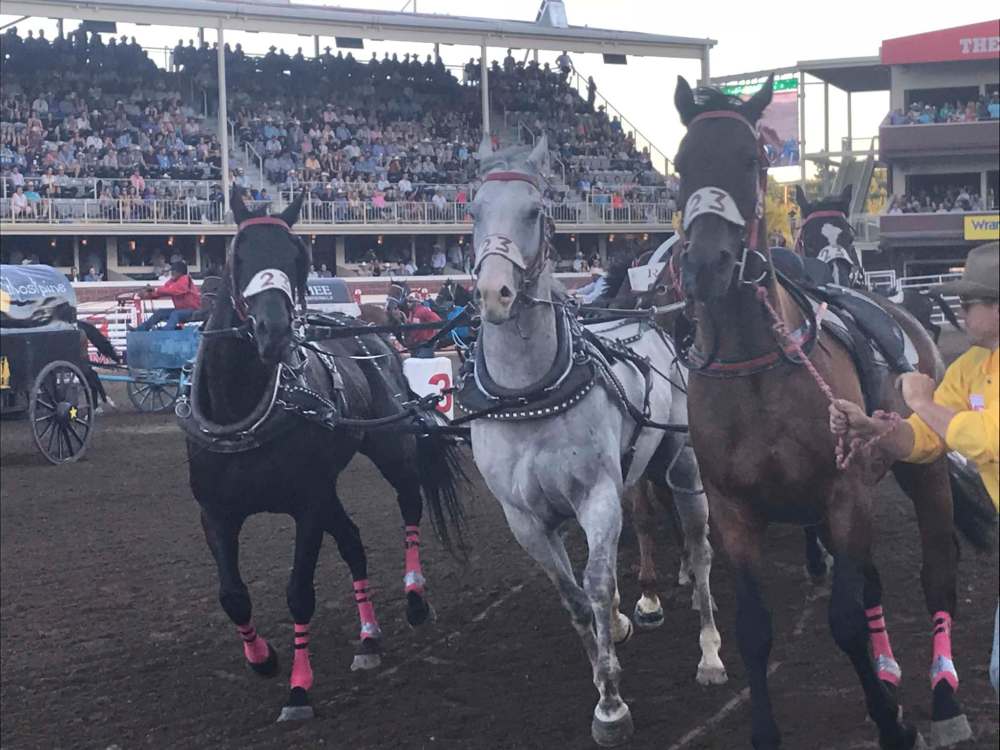
The evening portion of the rodeo is dedicated to the chuckwagon races, as 36 teams vie for a spot in the finals.
A team is made up of four cowboys. Two riders on the wagon while the other two are riding horses behind — they must follow a certain distance behind and will be penalized if they are either too close or too far behind.
The chuckwagon races not only bring a huge cash payout at the finale, but also the opportunity to auction off their wagon canvas to an advertiser at next year’s Stampede. At the 2018 races, it wasn’t uncommon for drivers to earn as much as $130,000 in sponsorship money for the canvas.
A few years back, the highest price a chuckwagon team earned for a canvas was $300,000, said chuckwagon committee member Kirk Moore, one of 2,300 Stampede volunteers.
He pointed out the canvas auctions have come to represent how well the economy is doing.
But that money can come at a high cost. Critics of the rodeo say each year it’s not uncommon for the chuckwagon races to end in the death of a horse. Indeed, a press release issued during the 2018 Stampede noted the death of an outriding horse after it sustained a leg injury during a race earlier in the week.
“The veterinarian determined the need to euthanize the horse due to a fractured lower front leg. This type of injury is known in racing horses, and is not unique to chuckwagon racing. The loss is felt deeply within our organization as well as by the owner,” the release stated.
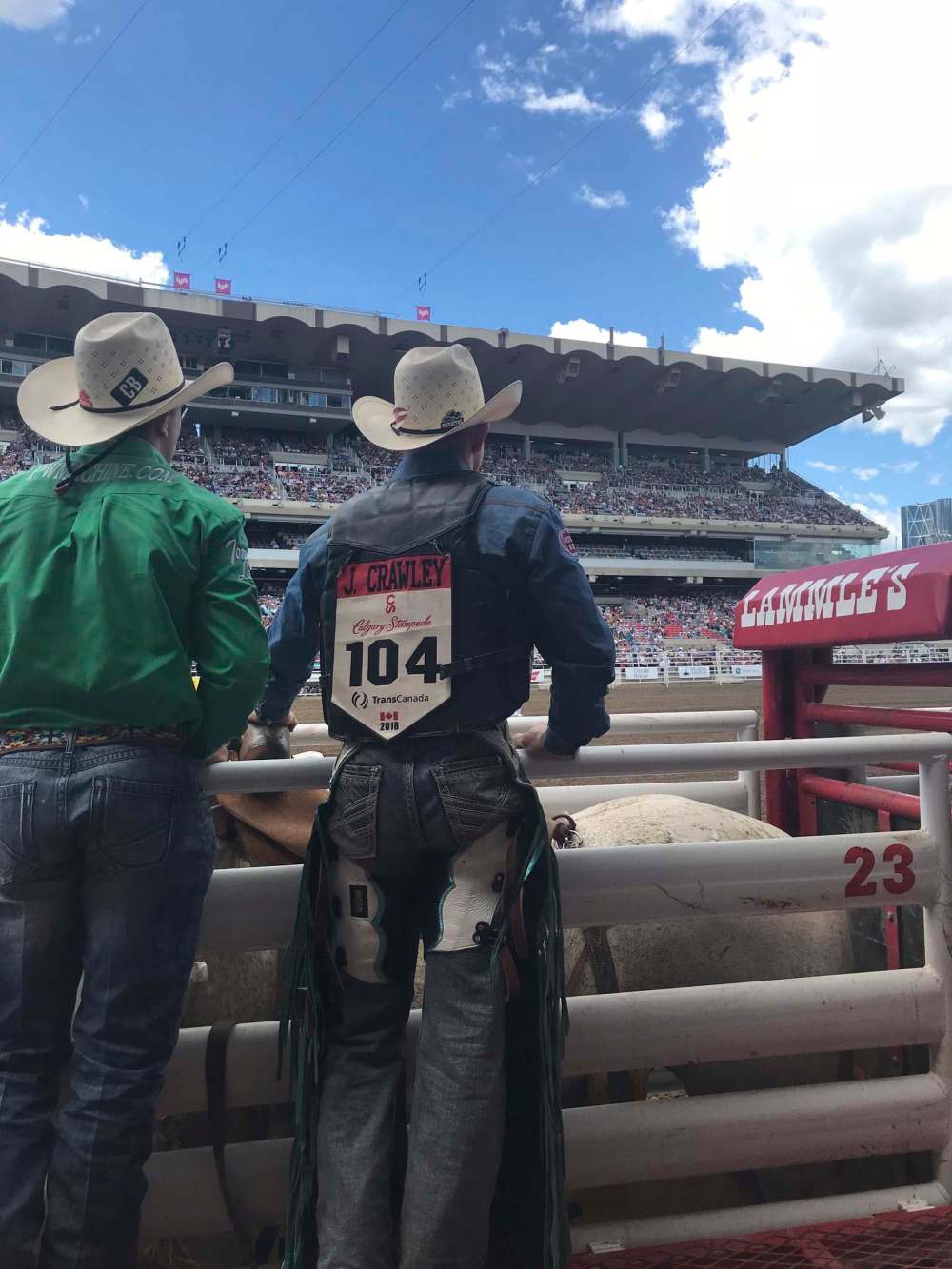
Although animal-rights organizations publicly denounce the Stampede, and again called for the end of the rodeo, Kevin Burke-Gaffney from the rodeo committee said the Stampede is “an integral part of what Calgary is.”
“Calgary is a family-oriented rodeo, and our history is more than 100 years old now,” he said.
Cowboy Danny Ringuette, one of the chuckwagon drivers, summed it up best when he explained why the rodeo life is for him.
“I love the horses. I love the adrenaline, the racing, the competitiveness. This is my life from April to August. I’m with these horses 12 hours a day. They’re like my family,” he said.
And there’s nowhere better to be than the Calgary Stampede, he added.
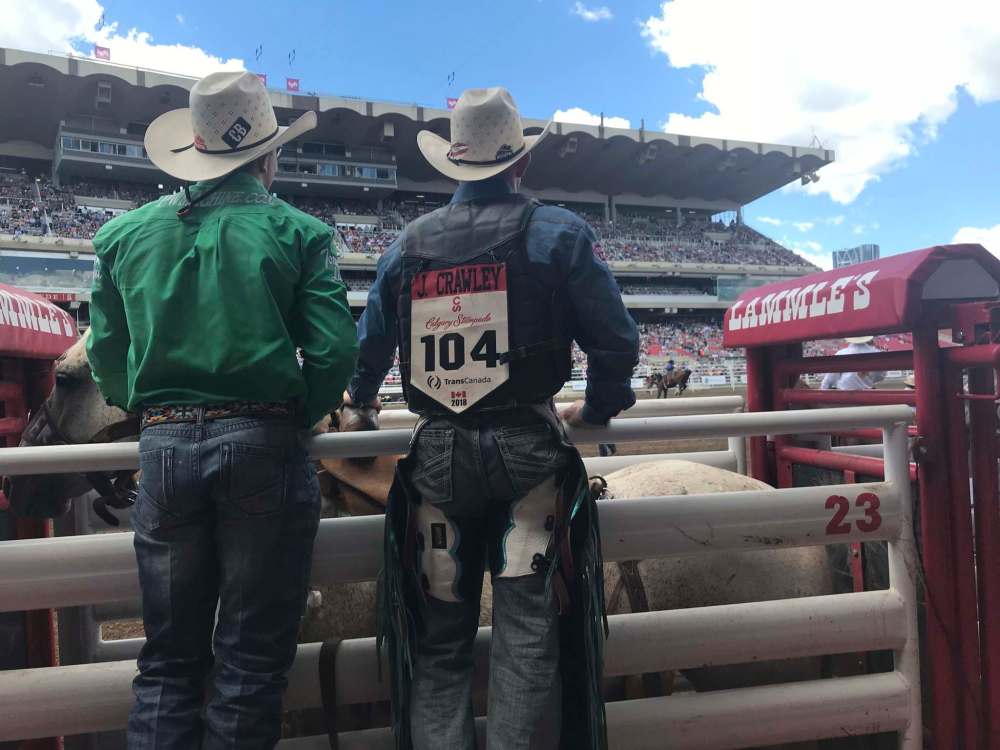
“Everyone strives to make the Calgary Stampede. This is the Stanley Cup of rodeos. It’s a great show and we all want to be here.”
kpemberton@shaw.ca