

Black crappie increasing in popularity
The sport fish is native to some Manitoba watersheds, stocked by the province in others
Advertisement
Read this article for free:
or
Already have an account? Log in here »
To continue reading, please subscribe:
Monthly Digital Subscription
$1 per week for 24 weeks*
- Enjoy unlimited reading on winnipegfreepress.com
- Read the E-Edition, our digital replica newspaper
- Access News Break, our award-winning app
- Play interactive puzzles
*Billed as $4.00 plus GST every four weeks. After 24 weeks, price increases to the regular rate of $19.95 plus GST every four weeks. Offer available to new and qualified returning subscribers only. Cancel any time.
Monthly Digital Subscription
$4.99/week*
- Enjoy unlimited reading on winnipegfreepress.com
- Read the E-Edition, our digital replica newspaper
- Access News Break, our award-winning app
- Play interactive puzzles
*Billed as $19.95 plus GST every four weeks. Cancel any time.
To continue reading, please subscribe:
Add Free Press access to your Brandon Sun subscription for only an additional
$1 for the first 4 weeks*
*Your next subscription payment will increase by $1.00 and you will be charged $16.99 plus GST for four weeks. After four weeks, your payment will increase to $23.99 plus GST every four weeks.
Read unlimited articles for free today:
or
Already have an account? Log in here »
Hey there, time traveller!
This article was published 29/12/2018 (2651 days ago), so information in it may no longer be current.
I get more questions about black crappie than any other species I write about. The history of this sport fish in Manitoba goes back to the Second World War. It arguably has risen in stature to become the second most popular sport fish in the province.
Star Lake, in Whiteshell Provincial Park, was originally stocked with black crappie in 1942 or 1943 (as well as Minnewasta Lake and, possibly, Barren Lake) largely by mistake, along with a load of largemouth bass. According to fisheries biologist Ken Kansas, these Star Lake black crappie slowly made their way downstream to West Hawk Lake and subsequently into Caddy Lake, through to South and North Cross Lakes, then Sailing Lake and onward.
My first encounter with black crappie was indeed on Star Lake while staying at a friend’s cabin. Since that first encounter some 30 years ago, I have spent a lot of time searching them out in all parts of this province.
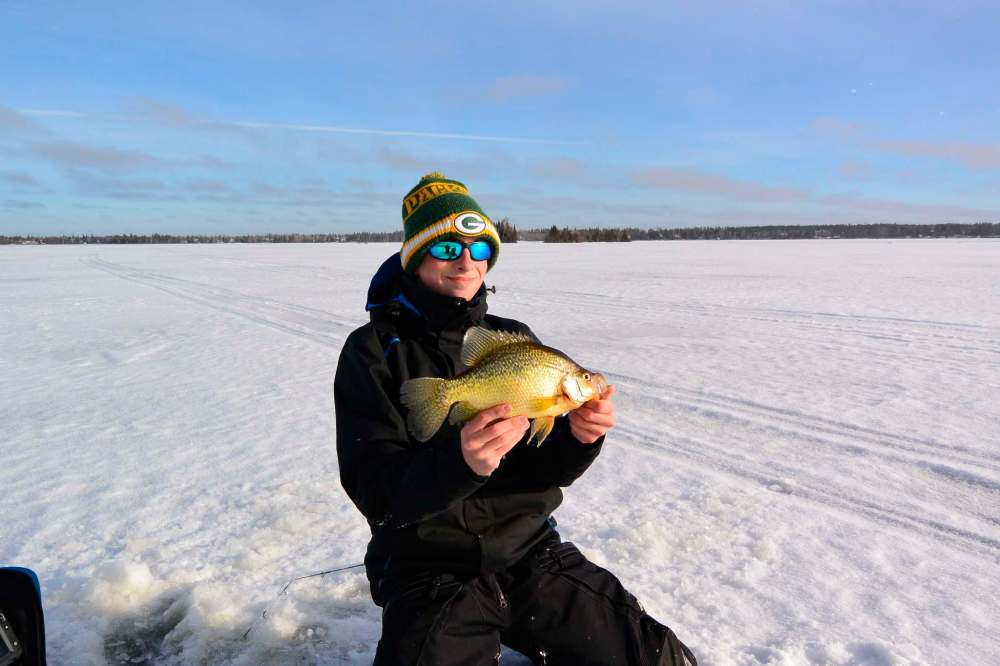
I can remember catching my first trophy on the Wanipigow River on the east side of Lake Winnipeg in 1993. Later that day, we boated out to the lake itself and caught a few more crappies in the main lake, something that just blew me away.
Back in the day, when I had The Complete Angler television show, one of my most popular shows was filmed on Lake Minnewasta with friend Dino Branfield.
He and I had a great day in late fall, catching fish in both numbers and size. That fishery is still in good shape, and nearby, Mary Jane Reservoir has seen a resurgence in the population of crappies in the last couple of years.
This past week, with excellent ice conditions, I headed out to Brereton Lake for a day on the ice. I met up with regional fisheries manager Derek Kroeker, who is trying to get a handle on crappie populations in his region.
He and his son, Justin, were already on the ice when I arrived. We started out off near a shoreline point, concentrating on a somewhat deeper area close by.
Derek had drilled a series of holes over a large area in order to try and find a concentration of fish. Justin would follow behind with a depth finder to see if he could mark fish. Once a decent number were located, it was time to fish.
Justin hooked up the first crappie, a 31-centimetre fish about perfect eating size. As it turns out, Brereton is not a deep lake, with a maximum depth of about six metres. This means it provides good habitat for crappies and winterkill is not an issue. It also means you don’t have to worry about causing these fish any stress upon release. We fished about five metres for most of the day, landing about 10 fish, the largest close to 33 centimetres. Master Angler length for these fish is 30.5 centimetres.
We didn’t mark a lot of big fish, so I am not sure what that means. Are there not many adult crappies? Were the fish scattered?
Derek says there should be a lot more data on Manitoba crappie populations coming out in the next two years. His department received a grant from the Manitoba Fish and Wildlife Enhancement Fund to do aging work as well as DNR testing. The first black crappie creel studies were done this past summer and the information from that should be available in the next few months.
Derek says the research being done will help decide what management tools are needed to look after the ever-increasing popularity of Manitoba crappies.
Black crappie are native to certain watersheds in Manitoba, namely the Red River/Lake Winnipeg connection and the Winnipeg River, which drains from Lake of the Woods. Further distribution across southern Manitoba is mainly from legal provincial stocking programs, natural downstream migrations and/or illegal “bait bucket biologist” introductions.
Angler’s Notes: Ice conditions in the province are excellent in most cases. Recent snowfall has not hampered travel by vehicle in a significant way. It has allowed travel by snow machine.
The annual KidFish Ice Fishing Derby will be held Jan. 6 on the Red River near the Selkirk Float Plane Base. The first 500 young anglers with receive an ice fishing rod and reel combination. The gates open at 8 a.m and the event starts at 10 a.m.
All proceeds in support of CancerCare Manitoba and the Children’s Hospital Foundation of Manitoba.
dlamont46@gmail.com