

‘Flying’ in Thailand’s deep blue seas
Exploring one of Earth's most famous diving destinations and its abundant marine life
Advertisement
Read this article for free:
or
Already have an account? Log in here »
To continue reading, please subscribe:
Monthly Digital Subscription
$0 for the first 4 weeks*
- Enjoy unlimited reading on winnipegfreepress.com
- Read the E-Edition, our digital replica newspaper
- Access News Break, our award-winning app
- Play interactive puzzles
*No charge for 4 weeks then price increases to the regular rate of $19.95 plus GST every four weeks. Offer available to new and qualified returning subscribers only. Cancel any time.
Monthly Digital Subscription
$4.99/week*
- Enjoy unlimited reading on winnipegfreepress.com
- Read the E-Edition, our digital replica newspaper
- Access News Break, our award-winning app
- Play interactive puzzles
*Billed as $19.95 plus GST every four weeks. Cancel any time.
To continue reading, please subscribe:
Add Free Press access to your Brandon Sun subscription for only an additional
$1 for the first 4 weeks*
*Your next subscription payment will increase by $1.00 and you will be charged $16.99 plus GST for four weeks. After four weeks, your payment will increase to $23.99 plus GST every four weeks.
Read unlimited articles for free today:
or
Already have an account? Log in here »
Hey there, time traveller!
This article was published 30/03/2019 (2471 days ago), so information in it may no longer be current.
Bobbing in the inky Andaman Sea, kilometres from the Thai shoreline, I watched a crescent moon emerge as twilight deepened. I turned on my flashlight, peered at my husband, Andrew, and made the most appropriate statement for such circumstances:
“Big white rabbits are fluffy.”
No bunnies were floating with us; this ridiculous phrase is a crucial mnemonic for the five steps of a dive buddy safety check.
Satisfied with each other’s buoyancy, weight, releases and air, we gave each other the final OK and descended into the void beneath our fins. The moon disappeared, then the lights from the boat faded as we dropped into a world where darkness swallows the coral, fish and sea outside flashlight beams.
The Similan Islands are one of the world’s most famous diving destinations. The protected waters, in the Andaman Sea about 65 kilometres from Thailand’s west coast, contain abundant marine life, including vibrant reefs and larger pelagic animals that live in the open sea, and we had two days to explore it all.
The overnighter was part of an independent trip to the Andaman, where we used our advanced scuba certification to dive 11 times in three national parks: Mu Ko Lanta, Hat Chao Mai and Mu Ko Similan, the last lying west of resort villages ravaged by the 2004 Indian Ocean tsunami.
On a drizzly November morning, Andrew and I departed on a speedboat from a dive shop on Ko Lanta, an Andaman island about 70 km southeast of Phuket.
Four dive staffers and nine other divers joined us on the hour-long ride to Ko Rok Nok, one of Thailand’s top dive sites. The island and its sister isle, Ko Rok Nai, reside within Mu Ko Lanta National Park. Except for the rangers who stay on Ko Rok Nai, the two islands are uninhabited.
From the back of the boat, I watched Ko Lanta’s jungle-clad hills disappear. Flying fish leaped from our wake and crashed back into the water.
“Don’t forget to look into the deep blue,” our guide Non said as we pulled on our wetsuits, reminding us to watch for the occasional manta ray and whale shark. “And if you look into a barrel sponge, you might see a surprise,” he added cryptically.
I had last scuba dived more than a year before, so plunging underwater felt a bit unfamiliar. But on our first dive, I lasted about an hour; because of the warm water and gentle current, I didn’t consume much air. I lazily drifted past colourful sea slugs clinging to rocks, clownfish nestled in anemones and lionfish patrolling their territories with spikes sticking out like porcupines.
“The water was so clear, I felt like I was flying,” Andrew said as we floated on the surface.
For lunch, we disembarked on a powdery white beach at the narrow channel that runs between Ko Rok Nok and Ko Rok Nai. We ate green curry where hermit crabs left criss-crossed tracks in the sand.
Back under on our second dive, I scanned the open water abutting the reef. A faint shape emerged, growing more distinct as it approached. A sea turtle — one that swam so close that I saw each of the scales on its face. From a coral similar to a barrel sponge, with a three-foot opening, my surprise glared at me indignantly: a huge moray curled up like a snake.
Our next Mu Ko Lanta National Park excursion was land-based. Andrew and I rented a motorized scooter to reach park headquarters at the southern tip of Ko Lanta. Leaving behind the controlled street chaos of beachy tourist areas, we puttered along the increasingly jungled roads near the park. Dipping down a precipitous hill, we swerved around monkeys that refused to move from the centre of the road.
Thailand has nearly 150 national parks. In 1990, Mu Ko Lanta National Park became its 62nd. In the park’s main headquarters building, I browsed educational displays, including a disconcerting collection of plastic garbage that had washed up on beaches. We lounged on a lighthouse-crowned beach, walked a small section of coastal trails that wind through the rainforest and watched monkeys enjoying the view where the jungle met the sea.
Three days later, Andrew and I boarded a speedboat to Ko Kradan, a serene, jungled island that houses a half-dozen small, off-the-grid resorts.
A long-tail boat carrying our guide Note, the captain and three divers from Italy and Germany picked us up from the beach in front of our resort. The group made room for us in the traditional Southeast Asian vessel that resembles a wide gondola with a long, propeller-tipped shaft.
I counted three dozen islands dotting the horizon on our way to Ko Waen, a nearby islet that is part of Hat Chao Mai National Park, in Thailand’s southwestern corner.
Our long-tail boat plowed through the water like a heavy wooden toboggan. During our pre-dive briefing, Note pointed out a first-aid kit — “in case you get bitten by a shark,” he joked — before warning everyone that touching any marine life is dangerous for both divers and the fragile ecosystem.
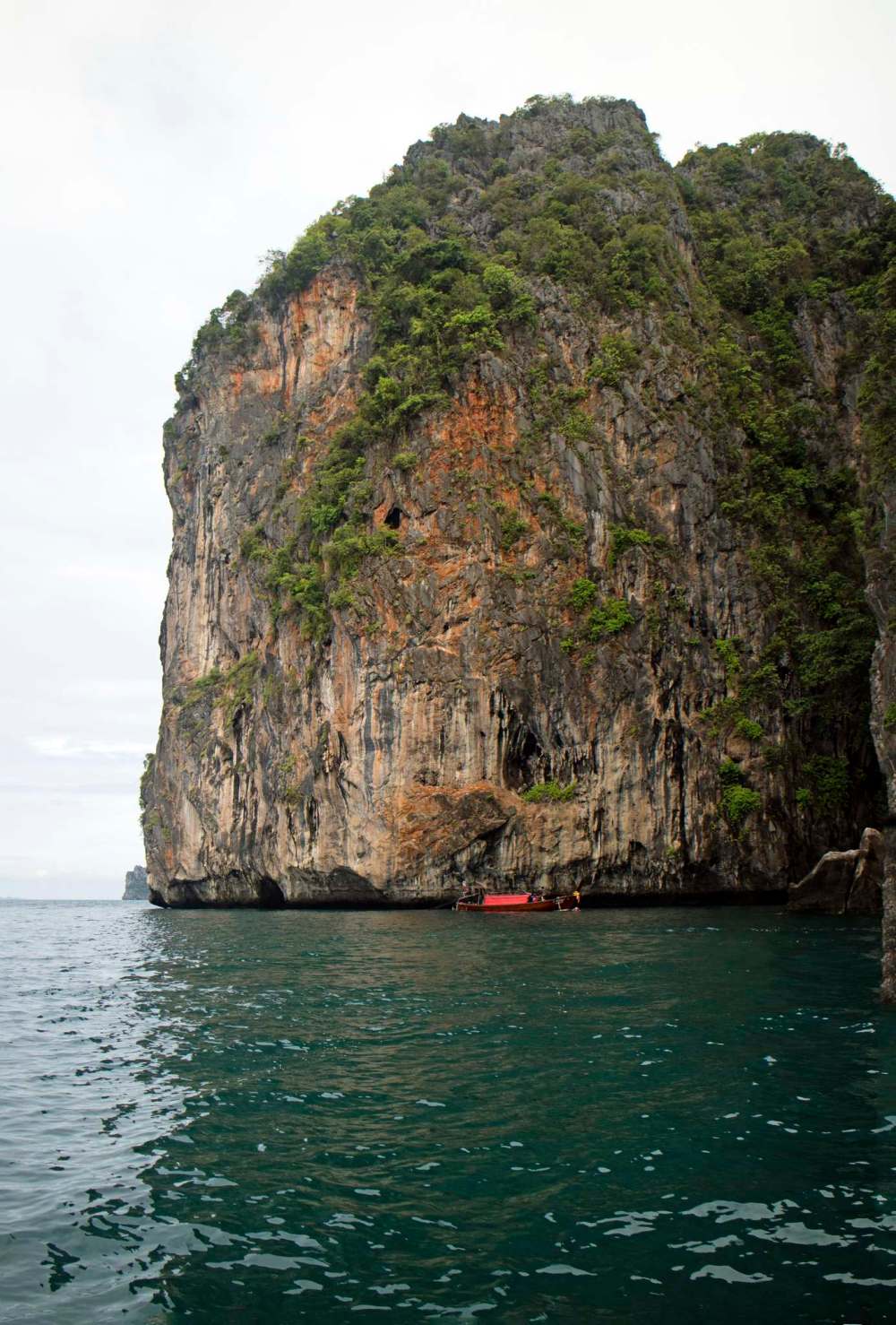
We stopped under Ko Waen’s rocky cliffs that shot straight up from the sea. I sat on the side of the boat and somersaulted backward into the water. There were no sharks, but I found a (nearly) perfectly camouflaged pink stonefish resting on the coral. It had a comically grouchy face, but stonefish — the world’s most venomous — are no joke.
Back aboard, we ate lunch and took turns cannonballing off the side of the boat.
As I descended for the second dive, supersized schools of fish parted like a river running around rocks. We swam single-file through a cave, our flashlights illuminating rocky outcroppings. I squeezed through the exit and looked up along a wall of coral that rose 12 metres to the surface. Animals inhabited every nook and cranny.
The night before departing for our Similan Islands stay, Andrew and I slept in Khao Lak, a coastal resort village about 75 km north of Phuket. Many of the hotels, restaurants and shops are new, built during the area’s recovery from the tsunami’s devastation. Several sobering reminders include a police boat that washed up far inland, a memorial and a few museums.
The next morning, we boarded a motorboat at a marina near Khao Lak and rode 90 minutes to Mu Ko Similan National Park, where we transferred to our dive boat, the South Siam 3.
Established in 1982, the park includes the Similan archipelago and more than 25 dive sites. Phuket and Khao Lak scuba shops offer day trips and longer liveaboards to beginning and advanced divers.
Our 30-metre boat slept 28 people, but only 12 guests joined the mostly Thai crew. We were seven overnighters and five day-trippers who would head back to shore after the first two dives. Our daybook was packed with four dives with our German guide Martina. The following day, we would dive three more times before returning to the mainland.
We entered the water at Ko Bangu (also called Island 9), the main archipelago’s northern point. As we dropped into the water, the reef below became perfectly clear, an oasis in a sea of sand.
Hundreds of garden eels rose like reeds from the sea floor, snapping backward into their burrows as I passed. A foot-long, Technicolor mantis shrimp waved its claws on a coral pinnacle. An octopus changed colours as I approached, perhaps annoyed that its hidey-hole beneath a rock wasn’t fooling anybody.
Our night dive began at sunset. Near the bottom, the darkness was total. I swept my flashlight around, illuminating eerie coral and ghostly creatures that stared at me incredulously before darting away.
Huge tuna flashed in and out of my beam. A sleeping boxfish draped like a noodle over a coral branch. A hovering cuttlefish jetted away when I pointed it out to my divemates.
We turned off our flashlights, suspended in complete darkness. I wiggled my hands in front of my face. Tiny silver explosions trailed my fingers: sparkling phytoplankton. I heard a loud grinding as boulders jostled each other in the underwater current.
“Watch for orange reflections,” Martina had said during our briefing. I trained my light on the reef. Dozens of lights — eye shine from shrimp and lobsters — winked at me.
Behind my face mask, I winked back.
— Washington Post